Cane Toad
Rhinella marina (formerly Bufo marinus); native south Texas toads are now treated by USGS as Rhinella horribilis · also called Bufo toad, Giant toad, Marine toad and Mesoamerican cane toad (Rhinella horribilis, the native south Texas toad) · Last checked November 3, 2026.
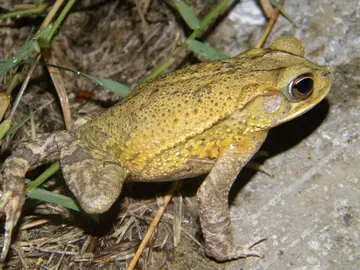

The cane toad (also called the bufo toad) is a large, warty, brown toad with big glands on its shoulders. It is not venomous, but it is poisonous: the milky skin secretion can sicken or kill dogs and cats that bite or mouth it. In people it can irritate the skin and burn the eyes, and eating a toad or its eggs can cause serious illness. It is invasive in central and south Florida and established in Hawaii. In the US it is native only to extreme southern Texas, where USGS now treats the toad as a separate species, the Mesoamerican cane toad. FWC
On this page
Is the cane toad dangerous?
Florida FWC: the skin secretion (bufotoxin) is highly toxic and can sicken or even kill animals that bite or eat cane toads, including pets. In people, it may irritate the skin or burn the eyes of those who handle the toads. FWC
“The skin-gland secretions of cane toads (called bufotoxin) are highly toxic and can sicken or even kill animals that bite or feed on them, including native animals and domestic pets. The skin secretions may irritate the skin or burn the eyes of people who handle them.”
No official source we use states whether this animal is venomous. That does not mean it is harmless: do not handle it.
If someone is bitten or stung, call 911 or Poison Help at 1-800-222-1222.
How to identify a cane toad
A photo or description can narrow it down, but cannot confirm what an animal is or that it is safe. Look from a distance and do not handle wild animals.
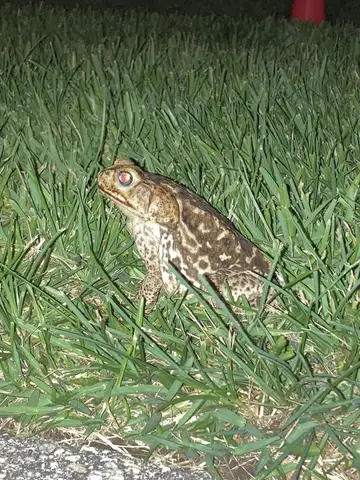
Size: Florida FWC: generally 6 to 9 inches long. UF/IFAS: adults are 3 to 6 inches and some reach 8 or 9 inches. FWC
Colors: Reddish-brown to grayish-brown with a light-yellow or beige belly; females have smooth, mottled brown and white backs; males have rougher, more yellow backs. Pattern: Uniform in color or with darker markings.
Key features
- Large glands behind the eyes that angle down onto the shoulders and give off a milky-white toxin FWC
- Glands are large and somewhat triangular, tapering back to a point UF/IFAS Extension
- No knobs or crests on top of the head; a ridge around the eyes and above the nose UF/IFAS Extension
- Dry, warty skin, stout body and short legs (features of all true toads) UF/IFAS Extension
Young
Newly transformed toadlets are about the size of a raisin and are very hard to tell apart from native toads.
Animals mistaken for the cane toad
Cane Toad or Southern Toad?
Cane Toad
Southern Toad Anaxyrus terrestris
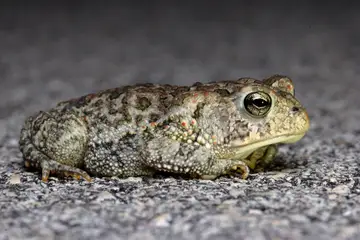

Southern toads reach only 3 to 4 inches, have clear crests like ridges or horns above the eyes, and a small oval gland behind each eye. Cane toads have no crests and a larger triangular gland. FWC
Native. UF/IFAS: small oval poison glands; "no danger to pets".
Cane Toad or Oak Toad?
Cane Toad
Oak Toad Anaxyrus quercicus
Never larger than 1.5 inches, with a light line down the center of the back and orange undersides to the feet. UF/IFAS Extension
Native. UF/IFAS: "no danger to pets".
Cane Toad or Eastern Spadefoot?
Cane Toad
Eastern Spadefoot Scaphiopus holbrooki
Rarely over 2 inches, no crests on the head, often an hourglass shape and yellow markings on the back, and a digging "spade" on the rear feet. UF/IFAS Extension
Native. UF/IFAS: "no danger to pets".
Where the cane toad lives
- Native or listed
- Nonnative or not established
- No official record in our data
- 1–9
- 10–99
- 100–999
- 1,000+
On our state guides
State boundaries: U.S. Census Bureau, cartographic boundary file cb_2024_us_state_20m.
When it is active
Adults are nocturnal. They hide by day and come out after sunset to hunt. Tadpoles and young toads are more active during the day. UF/IFAS Extension
US open-licence records peak in April to September.
Habitat and habits
Habitat: Urban, suburban and agricultural areas: yards, around buildings, and near canals and ponds. UF/IFAS adds golf courses and school campuses, and says there are few records in Florida's natural habitats. FWC
Behavior: Toxin oozes out when a toad feels threatened and squirts out when the glands are squeezed, for example by a predator's or pet's mouth.
Diet: Omnivores: plants, insects, small birds, other toads and frogs, lizards, small mammals and snakes. They will also eat pet food and table scraps left outside.
Young: UF/IFAS: males call from temporary pools, ponds and canals (avoiding swift currents), and breeding usually follows heavy rain. Calling may occur all year in southern Florida but only January through September further north. Females lay 8,000 to 30,000 eggs in long gelatinous strings once or twice a year; eggs and tadpoles are toxic.
Legal status and reporting
Protection: Florida: not protected except by anti-cruelty law. Landowners may remove them from private property year-round, but captured cane toads may not be relocated and released. FWC
Invasive status: Florida FWC lists it as nonnative and invasive. FWC
Report: Florida: FWC points to IveGot1.org for credible cane toad sightings. If you are unsure whether a toad is a cane toad or a native toad, UF/IFAS invites a photo by email to Dr. Steve Johnson at [email protected]. FWC also stresses identifying the toad correctly first, because the native southern toad is beneficial. UF/IFAS Extension
Questions about the cane toad
Cane toad poison
Cane toads are poisonous, not venomous. Florida FWC says their skin secretion (bufotoxin) is highly toxic and can sicken or kill pets and other animals that bite or eat them. In people, it may irritate the skin or burn the eyes. USGS says people can become sick or even die from eating the toads or their eggs. In an emergency, call 911 or Poison Help at 1-800-222-1222.
Cane toad florida
Florida FWC calls the cane toad nonnative and invasive. It lives in central and south Florida, generally south of the I-4 corridor, mostly in yards, around buildings and near canals and ponds. UF/IFAS says a small population appears to be established in Deland, Volusia County.
Cane toad hawaii
Yes. Bishop Museum says the cane toad was purposefully introduced to Hawaii in 1932 and is widely distributed in the lowlands of all main islands except Lana'i. USGS lists it as established in Hawaii.
Cane toads in texas
Yes, in extreme southern Texas, where the toad is native. USGS now treats the native south Texas toad as a separate species, the Mesoamerican cane toad (Rhinella horribilis), which looks the same as Rhinella marina from the outside. Like the cane toad, it has large glands that produce bufotoxins.
Cane toad size
Florida FWC gives 6 to 9 inches. UF/IFAS says adults are usually 3 to 6 inches, with some reaching 8 or 9 inches. USGS says they can weigh up to 3.3 lb. Newly transformed toadlets are about the size of a raisin.
Cane toad sound
UF/IFAS describes the call as a persistent, low-pitched, warbling trill. Dense populations may call all night.
Cane toad vs southern toad
Florida FWC: adult cane toads are 6 to 9 inches, while southern toads only reach 3 to 4 inches. Southern toads have clear crests like ridges or horns above the eyes and a small oval gland behind each eye. Cane toads have no crests and a larger triangular gland. UF/IFAS says the southern toad's glands are no danger to pets.
Cane toad australia
UF/IFAS says cane toads were introduced to Australia in the 1930s to control cane beetles. Because of their toxicity they severely affected Australian ecosystems, and numbers of native predators fell where they spread. This guide covers the US only.
Sources
- Cane Toad (species profile). Florida Fish and Wildlife Conservation Commission (FWC). archived copy, captured October 13, 2026; checked November 3, 2026. Archived copy.
Quoted passages (8)
“The skin-gland secretions of cane toads (called bufotoxin) are highly toxic and can sicken or even kill animals that bite or feed on them, including native animals and domestic pets. The skin secretions may irritate the skin or burn the eyes of people who handle them.”
“Cane toads generally range in size from 6 to 9 inches in length.”
“They have enlarged glands behind the eyes, which angle downward onto the shoulders. The glands secrete a potent milky-white toxin (bufotoxin)”
“In Florida, cane toads are found in urban, suburban and agricultural areas. Cane toads are commonly found in yards, around buildings or near canals and ponds.”
“If available, cane toads may be attracted to and eat human table scraps and pet food.”
“Cane toads are considered an invasive species”
“Cane toads are not protected in Florida except by anti-cruelty law and can be removed from private property and humanely killed year-round with landowner permission. Captured cane toads may not be relocated and released.”
“Southern toads will have well defined cranial crests which look like ridges or horns above their eyes and a small, oval shaped gland visible behind their eyes. Cane toads do not have crests above their eyes and possess a larger, triangular shaped gland behind their eye.”
- Cane Toad (Rhinella marina) - Species Profile. U.S. Geological Survey, Nonindigenous Aquatic Species Database. Revision Date 9/5/2025; checked November 3, 2026.
- Mesoamerican Cane Toad (Rhinella horribilis) - Species Profile. USGS Nonindigenous Aquatic Species Database. Revision date 6/22/2022; checked November 3, 2026.
- Good Guys & Bad Guys card: Cane Toad. Bishop Museum (Hawaii Biological Survey). undated page; checked November 3, 2026.
- WEC387 The Cane or "Bufo" Toad (Rhinella marina) in Florida. UF/IFAS Extension (EDIS). Original July 2017; checked November 3, 2026.
Quoted passages (10)
“Poison glands enlarged and somewhat triangular, tapering back to a point”
“No knobs or crests on top of head”
“Have dry, warty skin”
“It is very difficult to distinguish among the toadlets of the different species of toads found in Florida.”
“…some individuals ooze poison when they feel threatened. However, the toxin will squirt when parotoid glands are squeezed, such as by the mouth of a predator or pet.”
“Adult cane toads are nocturnal, remaining hidden during the day and emerging only after sunset to hunt for food.”
“…females depositing 8,000– 30,000 eggs in long, gelatinous strings once or twice per year. Breeding usually follows heavy rain.”
“…please email Dr. Steve Johnson at [email protected] with a picture of the toad”
“Never larger than 1.5 inches—Florida's smallest toad”
“Prominent digging "spade" on rear feet”
- GBIF.org occurrence records, human observations licensed CC0 1.0 or CC BY 4.0 only, accessed November 3, 2026. The datasets behind these counts are listed on our Sources page.
- State boundaries: U.S. Census Bureau, cartographic boundary file cb_2024_us_state_20m.