Nebraska Game and Parks Commission: Nebraska is home to 11 species of frogs and toads and two species of salamanders.
This page lists 12 species: 11 from Nebraska Game and Parks Commission's Amphibians, Frog and toad species and 1 named in other official sources.
Nebraska Game and Parks Commission gives a total of 11; the 12 here are the frogs and toads official sources name one by one.
No official source we use states whether this animal is venomous. That does not mean it is harmless: do not handle it.
Size
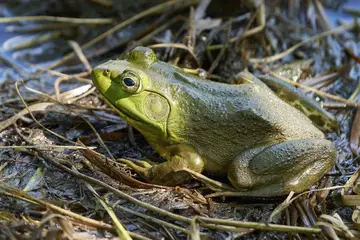
Usually 6 to 8 inches long (NCWRC); can reach 8 inches or more and weigh over 2 pounds (CDFW). Missouri gives 3.5 to 6 inches snout to vent, occasionally to 8.75.
How to recognize it
No ridge (dorsolateral fold) down each side of the back
Large round eardrum: about twice the eye in males, about eye-sized in females
Fully webbed hind feet, longest toe extends past the webbing
Range: In Nebraska, the American bullfrog can be found throughout the entire state. Introductions and naturalizations have occurred throughout much of the western U.S. where it is considered a nuisance species.
Habitat: This frog can be found in any permanent body of water. It can survive in ponds and lakes with or without fish. Shallow water along shores is their preferred habitat for foraging. They also can leave the water and make extensive migrations to different bodies of water, especially during a rainstorm. (Nebraska Game and Parks Commission)
No official source we use states whether this animal is venomous. That does not mean it is harmless: do not handle it.
Size
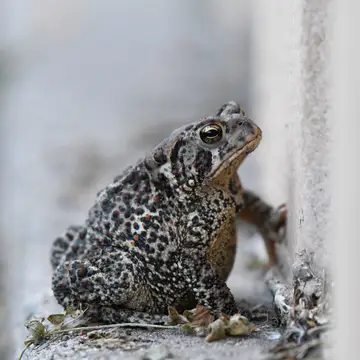
2 to 3.5 inches long (NCWRC: up to 4 inches); females are larger than males.
How to recognize it
Dark spots on the back hold only a few large warts; the similar Fowler's toad has three or more. Agencies give different counts for the American toad (TWRA: one or two; Ohio DNR: one, two or three; Georgia DNR: usually no more than one), so wart count alone does not settle it; check the head crests too (see lookalikes).
A large, kidney- or bean-shaped parotoid gland behind each eye that usually does not touch the bony ridge (cranial crest) above the eye, or touches it only by a short spur.
Enlarged warts on the lower leg.
Where in Nebraska
In Nebraska, the American toad reaches the western edge of its range and is restricted to the eastern most counties; they typically are only seen in Washington, Douglas … Nebraska Game and Parks Commission
What the sources say
Range: In Nebraska, the American toad reaches the western edge of its range and is restricted to the eastern most counties; they typically are only seen in Washington, Douglas and Sarpy counties.
Habitat: In Nebraska, the American toad is found in riparian woodlands and deciduous forests along the Missouri River. For breeding, this toad will use temporary and permanent wetlands. (Nebraska Game and Parks Commission)
No official source we use states whether this animal is venomous. That does not mean it is harmless: do not handle it.
Where in Nebraska
In Nebraska, the Blanchard’s cricket frog is found in the eastern two-thirds of the state along all the major streams and their tributaries. Nebraska Game and Parks Commission
What the sources say
Habitat: This frog is common along edges of both temporary and permanent bodies of water. They prefer areas with abundant vegetation where they can hide from predators. During the fall months, the cricket frog is commonly found in areas a fair distance from water around the limestone edges of Thayer, Jefferson and Gage counties. (Nebraska Game and Parks Commission)
No confirmed photo of Boreal chorus frog
Boreal chorus frog
Pseudacris maculata
Not stated
Venom
No official source we use states whether this animal is venomous. That does not mean it is harmless: do not handle it.
Habitat: These frogs are very versatile in their habitat choices. During breeding season, they can use nearly any body of water. After the breeding season, they can be found far from water in areas from open grasslands to dense woodlands. They will take cover beneath rocks and in crayfish burrows to avoid extreme climactic conditions. (Nebraska Game and Parks Commission)
No confirmed photo of Cope’s gray treefrog
Cope’s gray treefrog
Hyla chrysoscelis
Not stated
Venom
No official source we use states whether this animal is venomous. That does not mean it is harmless: do not handle it.
Where in Nebraska
In Nebraska, the Cope’s gray treefrog is found in the southeastern counties, although there have been individuals collected in isolated areas in more northern and … Nebraska Game and Parks Commission
What the sources say
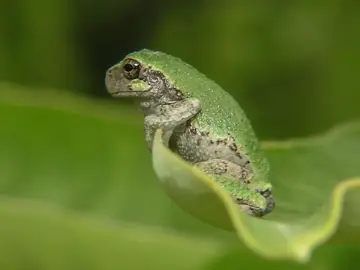
Range: In Nebraska, the Cope’s gray treefrog is found in the southeastern counties, although there have been individuals collected in isolated areas in more northern and western counties. Their range is expected to expand as prairie streams begin to become more wooded environments.
Habitat: This frog species are common around riparian woodlands and oak savannas near temporary and permanent bodies of water. (Nebraska Game and Parks Commission)
No official source we use states whether this animal is venomous. That does not mean it is harmless: do not handle it.
Where in Nebraska
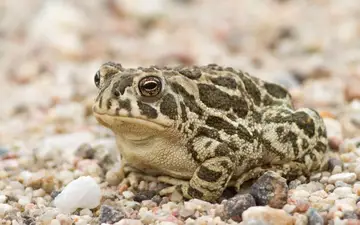
In Nebraska, the Great Plains toad is found throughout the state but are more common in the western half to two-thirds in mixed- and shortgrass prairies. Nebraska Game and Parks Commission
What the sources say
Habitat: This species of toad is a true grassland inhabitant and can be found in short-, mixed- and tallgrass prairies throughout the state. They can be found in areas with permanent bodies of water, but they also are known to exist in areas where the water is seasonal or where there is no permanent body of water for miles. (Nebraska Game and Parks Commission)
No official source we use states whether this animal is venomous. That does not mean it is harmless: do not handle it.
Where in Nebraska
In Nebraska, this species occupies the northern half of the state above an approximate line that follows the Platte River. Nebraska Game and Parks Commission
What the sources say
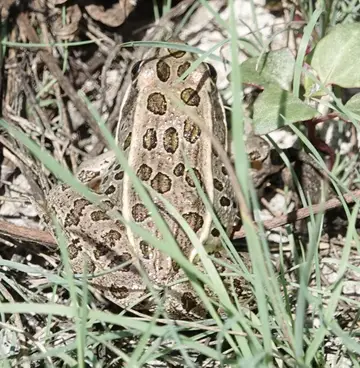
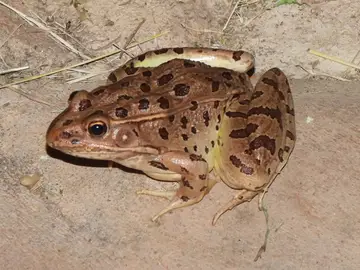
Habitat: This frog is found in meadows and semi-permanent bodies of water. They also have been known to inhabit cattle stock tanks. Just like the plains leopard frog this species can wander far from water but is less tolerant of dry conditions. (Nebraska Game and Parks Commission)
Habitat: You can find a plains leopard frog in ponds, streams, lakes, rivers and any other suitable body of water. This species is known to wander far from water as long as there are moist conditions. This is a true grassland species using its spots to camouflage in the vegetation. (Nebraska Game and Parks Commission)
No confirmed photo of Plains spadefoot
Plains spadefoot
Spea bombifrons
Not stated
Venom
No official source we use states whether this animal is venomous. That does not mean it is harmless: do not handle it.
Where in Nebraska
In Nebraska, this species it is known from the entire state with the exception of the extreme southeastern corner. Nebraska Game and Parks Commission
What the sources say
Habitat: The plains spadefoot is a grassland species and can be found near any grassland or prairie habitat, even those areas that receive very little precipitation. Loose soil is preferred and permanent bodies of water are not necessary. (Nebraska Game and Parks Commission)
No official source we use states whether this animal is venomous. That does not mean it is harmless: do not handle it.
Where in Nebraska
In Nebraska, the western narrow-mouthed toad is known from multiple areas in the extreme portion of Gage and Webster counties, but they are probably more widespread than … Nebraska Game and Parks Commission
Conservation
Nongame species in need of conservation, "Species with no take" (Neb. Admin. Code Ch. 10, effective 06/04/2025)
What the sources say
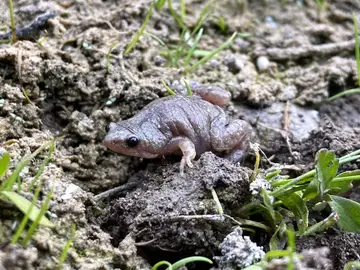
Range: In Nebraska, the western narrow-mouthed toad is known from multiple areas in the extreme portion of Gage and Webster counties, but they are probably more widespread than this.
Habitat: This frog prefers moist grasslands with limestone rocky outcrops. These animals also use burrows excavated by mammals, arthropods and other animals. (Nebraska Game and Parks Commission)
No confirmed photo of Woodhouse’s toad
Woodhouse’s toad
Anaxyrus woodhousii
Not stated
Venom
No official source we use states whether this animal is venomous. That does not mean it is harmless: do not handle it.
Habitat: Woodhouse’s toads can occupy a variety of habitats including woodland edges, grasslands, agricultural fields, parks, golf courses, and even suburban and urban backyards and gardens. (Nebraska Game and Parks Commission)
When frogs and toads are active in Nebraska
Records of frogs and toads in Nebraska peak in June to August. They show when people record frogs and toads, not how many there are (about month bars).
JanFebMarAprMayJunJulAugSepOctNovDec
472 records of frogs and toads in Nebraska by month (GBIF, CC0 and CC BY records).
How to report
NGPC: 402-471-0641 (or a local conservation officer). Sick or dead wildlife: report to a Game and Parks office. Invasive species: Nebraska Invasive Species Council, [email protected] or its Report A Sighting page. Reptile and amphibian sightings: UNL Report A Sighting form (herpneb.unl.edu/report-sighting). Nebraska Game and Parks Commission
Contact Us. Nebraska Game and Parks Commission. archived copy, captured August 24, 2026; checked November 3, 2026.Quoted passages (1)
“You may contact us by mail, phone at 402-471-0641, or the contact form below.”
Amphibians. Nebraska Game and Parks Commission. archived copy, captured July 20, 2024; checked November 3, 2026.Quoted passages (1)
“Nebraska is home to 11 species of frogs and toads and two species of salamanders.”
Chapter 10, Nongame Species In Need Of Conservation. Nebraska Game and Parks Commission (Nebraska Administrative Code, Chapter 10; copy hosted by UNL). Effective Date: 06/04/2025; checked November 3, 2026.