Feral hog (feral swine, wild pig)
Sus scrofa · also called feral swine, wild pig, wild hog and wild boar · Last checked November 3, 2026.
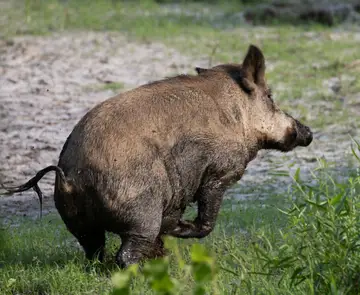
Feral hogs (feral swine, wild pigs, Sus scrofa) are free-roaming pigs descended from escaped or released domestic pigs, Eurasian wild boar and their hybrids. They are not native to the Americas. Adults average 75 to 250 pounds, and some get twice as large. USDA APHIS calls them a dangerous and destructive invasive species. They carry at least 30 viral and bacterial diseases and nearly 40 parasites that can pass to people, pets and livestock, including brucellosis. APHIS also says they have been aggressive toward people and have even attacked farmers, golfers, hikers and picnickers. State agencies confirm feral hogs in many states. Examples: every Florida county, every Louisiana parish, every Texas county except El Paso, and established populations in Michigan and Ohio. They are rare in Pennsylvania. USDA APHIS Wildlife Services
On this page
Is the feral hog dangerous?
USDA APHIS: feral swine pose great risks to human health and safety. They harbor diseases they can pass to people and pets, they cause collisions with vehicles and aircraft, and they have been aggressive toward people and have even attacked them. USDA APHIS Wildlife Services
“Feral swine cause great risks to human health and safety, by harboring and transmitting diseases to people and pets and by causing collisions with vehicles and aircraft. … Other risks posed by feral swine to people include attacks on individuals or collisions with vehicles and aircraft.”
Bites and stings: No official source checked describes bites specifically. APHIS says feral swine have been aggressive toward people and have even attacked farmers, golfers, hikers and picnickers, and that aggression can increase when they link people with food. Colorado Parks and Wildlife says they have 4 continuously growing tusks.
How to identify a feral hog
A photo or description can narrow it down, but cannot confirm what an animal is or that it is safe. Look from a distance and do not handle wild animals.
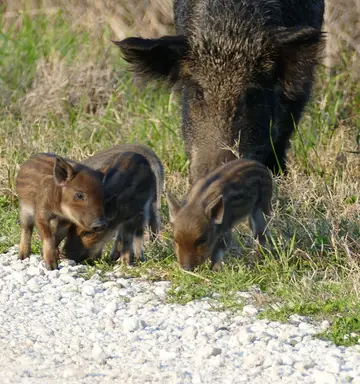
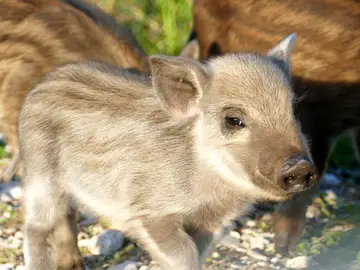
Size: Adults average 75 to 250 pounds, but some get twice as large. They can stand up to 3 feet tall and reach 5 feet long, and males (boars) are larger than females (sows). FWC says Florida wild hogs can weigh more than 150 pounds and be 5 to 6 feet long. Ohio State Extension says Ohio adults typically weigh 125 to 200 pounds. USDA APHIS Wildlife Services
Colors: white, black, brown and red. Pattern: varies; any combination of colors (crossbreeding); piglets striped or spotted, losing it as they mature.
Key features
- Look much like domestic hogs but are generally thinner, with thicker hides of coarse, bristly hair and longer tusks USDA APHIS Wildlife Services
- Four continuously growing tusks, 2 on top and 2 below Colorado Parks and Wildlife
- Russian (Eurasian) boar type: long, straight, narrow snout; dark-colored or camouflage coat; light-tipped bristles Michigan Invasive Species Program
- Tracks look like deer tracks but have a blunter toe and a square shape, compared with the pointed, heart-shaped deer track USDA APHIS Wildlife Services
- Signs: extensive rooting or digging, muddy wallows, tree rubbing (often after wallowing), tunnels and trails through thick vegetation, hoof tracks in mud near water, and scat that resembles dog feces USDA APHIS Wildlife Services
- Muscular and strong; can run up to 30 miles per hour USDA APHIS Wildlife Services
Young
Piglets are often striped or spotted and lose that coloring as they mature. Colorado Parks and Wildlife says young are born with a reddish coat with lengthwise stripes.
Animals mistaken for the feral hog
Feral hog (feral swine, wild pig) or Javelina (collared peccary)?
Feral hog (feral swine, wild pig)
Javelina (collared peccary) Pecari tajacu
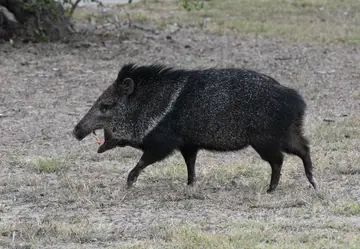
APHIS: the javelina is a native, pig-like mammal of the American Southwest. It is generally much smaller than feral swine, silver-grey to black with a lighter collar, and has no tail. Texas A&M AgriLife adds that javelinas have small, round ears, while feral hogs have longer, pointed ears and a distinct, easily visible tail. The two sources give different javelina weights: APHIS says 15 to 25 lbs, Texas A&M says an adult typically weighs 55 pounds. USDA APHIS Wildlife Services
Feral hog (feral swine, wild pig) or Domestic pig?
Feral hog (feral swine, wild pig)
Domestic pig Sus scrofa domesticus
Same species. APHIS says feral swine look very much like domestic hogs but are generally thinner, with thicker, coarse, bristly hair and longer tusks. Virginia DWR treats any swine that is wild, or that no one can prove ownership of, as a feral hog, and says color and origin do not matter. USDA APHIS Wildlife Services
Where the feral hog lives
- Native or listed
- Nonnative or not established
- No official record in our data
- 1–9
- 10–99
- 100–999
- 1,000+
On our state guides
- Alabama mammalsNonnative
- Arizona mammals
- Arkansas mammalsNonnative
- California mammalsNonnative
- Florida mammalsNonnative
- Hawaii mammalsNonnative
- Iowa mammals
- Kansas mammalsNonnative
- Louisiana mammalsNonnative
- Mississippi mammalsNonnative
- Missouri mammalsNonnative
- Montana mammalsNonnative
- Nebraska mammalsNonnative
- New Mexico mammals
- North Carolina mammalsNonnative
- Oklahoma mammalsNonnative
- Pennsylvania mammalsNonnative
- Tennessee mammalsNonnative
- Texas mammalsNonnative
- West Virginia mammalsNonnative
State boundaries: U.S. Census Bureau, cartographic boundary file cb_2024_us_state_20m.
When it is active
Usually active at night, so they are seen less often in daylight, especially in hot, humid climates (APHIS). TPWD says they are generally active at dusk and dawn but may feed at night. CDFW says heavy hunting pressure can make them active only at night. USDA APHIS Wildlife Services
US open-licence records peak in January to April, October and December.
Habitat and habits
Habitat: Extreme habitat generalists that can survive in most areas but prefer to stay near streams or other water (NCWRC). In Florida they prefer oak-cabbage palm hammocks, freshwater marshes and sloughs, pine flatwoods and open farmland. In California they use woodland, chaparral, meadow and grassland. In Michigan they live in mixed forest and farm landscapes and use wetlands year-round. N.C. Wildlife Resources Commission
Behavior: They usually travel in family groups called sounders: two or more adult sows and their young, from a few animals up to about 30. Adult boars usually live alone or in bachelor groups. They root with their snouts, which can leave ground looking plowed, and wallow in mud during warm months.
Diet: Opportunistic omnivores that eat about 3% to 5% of their body mass daily. They mostly eat plants: grasses, mast such as acorns, roots, tubers and crops. They also eat invertebrates and vertebrates, including ground-nesting bird eggs, reptiles, amphibians, deer fawns and young livestock.
Young: They can breed year-round and have up to two litters of 4 to 12 piglets a year. They become sexually mature at 6 to 8 months, so a population can potentially double in 4 months. TPWD gives an average gestation of about 115 days.
Legal status and reporting
Federal: USDA APHIS Wildlife Services runs a National Feral Swine Damage Management Program and treats feral swine as an invasive species to be managed. No federal protected status was found. USDA APHIS Wildlife Services
Invasive status: Invasive (APHIS: 'a dangerous and destructive invasive species'). USDA APHIS Wildlife Services
Report: Nationally, APHIS asks people to report feral swine sightings online or with the 'Squeal on Pigs!' app, or to call the APHIS Wildlife Services office in their state. Ohio State Extension's fact sheet gives the Wildlife Services number as 1-866-4USDAWS (1-866-487-3297). State contacts are listed in byState. USDA APHIS Wildlife Services
Questions about the feral hog
Feral hogs
Feral hogs (feral swine, wild pigs, Sus scrofa) are free-roaming pigs descended from escaped or released domestic pigs, Eurasian wild boar and their hybrids. They are not native to the Americas. Adults average 75 to 250 pounds and can stand 3 feet tall and 5 feet long. USDA APHIS calls them a dangerous and destructive invasive species. They carry at least 30 viral and bacterial diseases and nearly 40 parasites that can pass to people and pets, including brucellosis, and have even attacked farmers, golfers, hikers and picnickers. They usually move in family groups called sounders and are mostly active at night. To report one, APHIS points to its online form, the 'Squeal on Pigs!' app, or your state's Wildlife Services office.
Feral hogs florida
Yes. FWC says wild hogs occur in all 67 Florida counties. They are not native to Florida, though resident populations have been there for hundreds of years, possibly since Hernando DeSoto in 1539, and FWC calls them invasive. They prefer oak-cabbage palm hammocks, freshwater marshes and sloughs, pine flatwoods and open farmland, can weigh more than 150 pounds, and usually travel in small family groups or alone. FWC says wild hogs can carry parasites and diseases, some of which can pass to people, pets and livestock.
Feral hogs texas
TPWD says wild pigs occupied every Texas county except El Paso County as of 2019. Of an estimated 6.9 million wild pigs in the US in 2016, about 2.6 million were estimated to live in Texas. TPWD says wild pigs can carry and transmit at least 30 bacterial, fungal and viral diseases that threaten humans, livestock and wildlife; brucellosis, leptospirosis, toxoplasmosis and trichinosis can infect people. Collisions with vehicles can cause human injury and death. TPWD also cites studies estimating about $118.8 million a year in agricultural losses in Texas.
Feral hogs in michigan
Yes. Michigan's invasive species program lists feral swine as 'Russian boar' (Sus scrofa), marked 'Established in Michigan' and 'Prohibited in Michigan', including hybrids with domestic pigs. In Michigan they live in mixed forest and farm landscapes and use wetlands. The state says Russian boar can be aggressive toward humans and can transmit several serious diseases. Report sightings to USDA Wildlife Services at 517-336-1928 or with the DNR's online reporting form.
Feral hogs in ohio
Yes, according to a 2013 Ohio State University Extension fact sheet written with ODNR Division of Wildlife and USDA Wildlife Services. As of 2013, feral swine had established breeding populations in at least 13 Ohio counties, mainly in the unglaciated south. These included a contiguous block of Adams, Athens, Gallia, Hocking, Jackson, Lawrence, Ross, Scioto and Vinton counties, with other populations documented in Preble, Butler, Lorain and Ashtabula counties. The fact sheet says releasing feral swine is illegal in Ohio and asks people to report sightings to the ODNR Division of Wildlife at 1-800-WILDLIFE (1-800-945-3543).
Feral hogs in pa
Rare. The Pennsylvania Game Commission says feral swine sightings have occurred over the past decade but remain rare, and any breeding populations are small and likely limited to Bedford and Fulton counties. The Game Commission calls feral swine a dangerous, destructive and invasive species and has removed their protection in all counties. Report any sighting immediately to the Game Commission at 1-833-PGC-WILD or 1-833-PGC-HUNT.
Feral hogs in pa map
In text, the Pennsylvania Game Commission says any breeding populations are small and likely limited to Bedford and Fulton counties. Nationally, USDA APHIS publishes county-level maps of feral swine populations for 1982 to 2025 on its distribution page.
Sources
- Feral Swine: Managing an Invasive Species. USDA APHIS Wildlife Services (National Feral Swine Damage Management Program). archived copy, captured October 24, 2026; checked November 3, 2026.
Quoted passages (2)
“They are a dangerous and destructive invasive species, and their populations have expanded across the country.”
“Report feral swine sightings online or via the "Squeal on Pigs!" app (available in the App Store and Google Play). … Call the APHIS Wildlife Services office in your State for more information and help dealing with feral swine.”
- Feral Swine: History and Distribution. USDA APHIS Wildlife Services. archived copy, captured October 19, 2026; checked November 3, 2026.
Quoted passages (1)
“The National Feral Swine Damage Management Program has effectively reduced the number of states with feral swine populations and curbed expansion in the U.S.”
- Feral Swine: Identification. USDA APHIS Wildlife Services. archived copy, captured October 19, 2026; checked November 3, 2026.
Quoted passages (10)
“Adult feral swine weigh between 75 and 250 pounds on average, but some can get twice as large. This invasive species can reach 3 feet in height and 5 feet in length. Males (boars) are larger than females (sows).”
“Feral swine often look very similar to domestic hogs, but are generally thinner with thicker hides of coarse bristly hair and longer tusks.”
“Although feral swine tracks look similar to deer tracks, they have a blunter-tipped toe, and their tracks have a square shape, compared to the pointed heart-shaped tracks of deer.”
“Extensive rooting or digging generally occurs as feral swine search for food. … Muddy wallows, especially in moist areas during warmer months. … Tree rubbing, which often occurs after wallowing. … Tunnels and trails leading through thick vegetation. … Hoof tracks in the mud near springs, ponds, and streams … Scat, which resembles dog feces and may contain partially digested remnants of acorns, grains, and the hair, scales, or feathers of animals that feral swine have eaten.”
“Feral swine are muscular and strong, and can run up to 30 miles per hour.”
“Piglets are often striped or spotted, but lose this coloration as they mature.”
“Feral swine generally travel in family groups, called sounders, composed of two or more adult sows and their young. Sounders can vary in size, including a few individuals to as many as 30 members. Adult boars usually live alone or in bachelor groups, only joining a sounder to breed.”
“Because they are usually active at night, feral swine are less frequently seen during daylight hours, particularly in hot, humid climates.”
“Feral swine can breed year-round and can have up to two litters of 4 to 12 piglets per year. Since they become sexually mature at 6 to 8 months of age, feral swine populations have the potential to double in size in 4 months”
“Feral swine should not be confused with the collared peccary (javelina), a native pig-like mammal of the American Southwest which is generally much smaller than feral swine (15–25 lbs.) and silver-grey to black in color with a defined lighter colored collar. … Collared peccary—also known as ‘javelina’—are smaller than feral swine, with a square build, distinct lighter collar of fur, and no tail.”
- Feral Swine: Damage to People and Pets. USDA APHIS Wildlife Services. archived copy, captured May 20, 2026; checked November 3, 2026.
Quoted passages (1)
“Feral swine cause great risks to human health and safety, by harboring and transmitting diseases to people and pets and by causing collisions with vehicles and aircraft. … Other risks posed by feral swine to people include attacks on individuals or collisions with vehicles and aircraft.”
- Wild Hog (species profile). Florida Fish and Wildlife Conservation Commission (FWC). archived copy, captured October 22, 2026; checked November 3, 2026.
- Feral Hogs. Louisiana Department of Wildlife and Fisheries. undated page; checked November 3, 2026.
- Feral Hogs (Wild Pigs) in Texas. Texas Parks and Wildlife Department. undated page; checked November 3, 2026.
Quoted passages (1)
“Wild pigs are omnivores, generally categorized as opportunistic feeders, and typically consume between 3% and 5% of their total body mass daily”
- Invasive Species: Russian Boar. Michigan Invasive Species Program (Michigan DNR, EGLE and MDARD). archived copy, captured September 3, 2025; checked November 3, 2026.
Quoted passages (1)
“Long, straight, narrow snout relative to domestic pigs. … Dark-colored or camouflage coat. … Light-tipped bristles.”
- Feral Swine in Ohio: Managing Damage and Conflicts (Fact sheet W-26). Ohio State University Extension (Ohioline); authors from ODNR Division of Wildlife, USDA APHIS Wildlife Services and OSU. Copyright 2013; checked November 3, 2026.
- Feral Swine. Pennsylvania Game Commission. undated page; checked November 3, 2026.
- Species profile: European Wild Hog/Feral Hog/European-Feral Crossbreed. Colorado Parks and Wildlife. undated page; checked November 3, 2026.
Quoted passages (1)
“Feral hogs have 4 continuously growing tusks, 2 on top, 2 below.”
- Feral Swine (NCWRC species page). N.C. Wildlife Resources Commission. undated page; checked November 3, 2026.
Quoted passages (1)
“Feral swine are extreme habitat generalists and can survive in most areas, though they prefer to stay near streams or other sources of water.”
- Wild Hog (hunting page). Florida Fish and Wildlife Conservation Commission (FWC). archived copy, captured October 25, 2026; checked November 3, 2026.
- GBIF.org occurrence records, human observations licensed CC0 1.0 or CC BY 4.0 only, accessed November 3, 2026. The datasets behind these counts are listed on our Sources page.
- State boundaries: U.S. Census Bureau, cartographic boundary file cb_2024_us_state_20m.