Javelina
Pecari tajacu (official sources also use Dicotyles tajacu and Tayassu tajacu) · also called collared peccary and peccary · Last checked November 3, 2026.
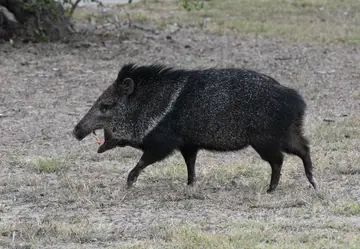
The javelina, or collared peccary, is a stocky, pig-like hoofed mammal with grizzled black-and-gray hair and a pale collar around the neck. It is not a pig. Texas Parks and Wildlife says aggressive encounters with people are very rare, but Arizona Game and Fish says javelina occasionally bite, almost always where people have fed them, and that a bite can be a serious wound. Javelina can also seriously hurt or kill dogs. Texas Parks and Wildlife says that in the United States it is found only in Arizona, New Mexico and Texas. Texas Parks and Wildlife Department
On this page
Is the javelina dangerous?
Arizona Game and Fish says javelina occasionally bite people, almost always when people feed them, and can inflict a serious wound. Arizona Game and Fish Department
“Javelina occasionally bite humans, but incidents of bites are almost always associated with people providing the javelina with food. Javelina can inflict a serious wound.”
Bites and stings: Can bite. AZGFD: occasional bites, almost always tied to people feeding javelina; the wound can be serious. Sharp canine teeth are used in defense when cornered (TPWD).
If someone is bitten or stung, call 911 or Poison Help at 1-800-222-1222.
How to identify a javelina
A photo or description can narrow it down, but cannot confirm what an animal is or that it is safe. Look from a distance and do not handle wild animals.
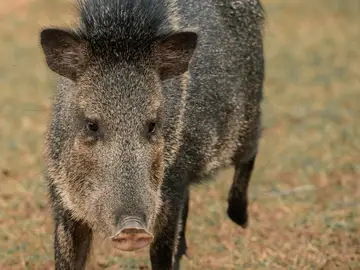
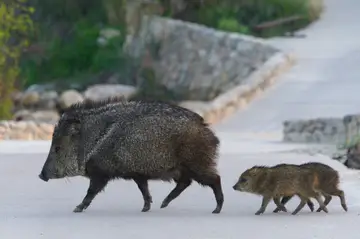
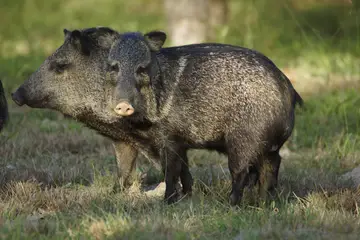
Size: About 18 inches tall and 32 to 36 inches long; average adult 40 to 60 pounds (NPS). TPWD's Texas figure is 35 to 45 pounds on average, with some at 50 to 60. US National Park Service
Colors: Coarse salt-and-pepper fur; peppered black, gray and brown hair. Pattern: Pale collar around the neck and shoulders; dark mane along the back that bristles when frightened or angry.
Key features
- Pig-like snout and stout body, but not a true pig Texas Parks and Wildlife Department
- No visible tail and a single dewclaw on the hind legs Texas A&M AgriLife Extension
- Scent gland above the tail with a strong musky odor US National Park Service
- Sharp canines about two inches long US National Park Service
Young
Newborns up to about three months old are red-brown or tan and are called "reds" (AZGFD); NPS Saguaro says babies weigh about 1 pound at birth.
Animals mistaken for the javelina
Javelina or Feral hog?
Javelina
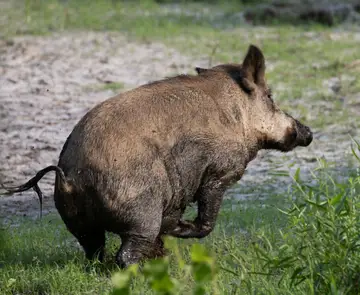
Javelina are in a different family from pigs, have no visible tail and have a single dewclaw on the hind legs. Texas A&M AgriLife Extension
Where the javelina lives
- Native or listed
- Nonnative or not established
- No official record in our data
- 1–9
- 10–99
- 100–999
- 1,000+
On our state guides
State boundaries: U.S. Census Bureau, cartographic boundary file cb_2024_us_state_20m.
When it is active
Active in cooler parts of the day: largely nocturnal in hot weather; in winter, early morning and late afternoon. Texas Parks and Wildlife Department
US open-licence records peak in January to April, October and December.
Habitat and habits
Habitat: Arid and semi-arid country: South Texas brush, Trans-Pecos desert grassland and Edwards Plateau oak-juniper woodland; in Arizona also the edges of Phoenix and much of Tucson. Texas Parks and Wildlife Department
Behavior: Live in herds. Very poor eyesight can make an escaping javelina look like it is charging.
Diet: Mostly plants, especially prickly pear, plus roots, bulbs, beans and seeds; sometimes insects and garbage.
Young: Breed in any month; about 5-month gestation; two young is typical. At Big Bend and Saguaro most births come in the summer rainy season, but Arizona Game and Fish says Arizona young are born year-round, most often from November to March.
Legal status and reporting
Protection: Game animal in Texas, hunted under license and season rules; listed by New Mexico BISON-M as harvested big game; protected inside Big Bend National Park. Texas Parks and Wildlife Department
Report: Arizona: call the local AZGFD regional office on weekdays about a javelina acting aggressively toward people, trapped, or held by someone; after hours call the dispatcher at 623 236-7201. Arizona Game and Fish Department
Sources
- Javelina in Trans-Pecos West Texas Habitat. Texas Parks and Wildlife Department. undated page; checked November 3, 2026.
Quoted passages (3)
“In Texas the javelina is found in the more arid or semi-arid parts of the state with most occurring in the South Texas brush country, the Trans-Pecos' desert grasslands, and the Edwards Plateau's oak-juniper woodlands.”
“In the winter, they are generally active in the early morning and late afternoon. Javelina are largely nocturnal during the hotter times of the year.”
“In Texas, javelina are classified as a game animal”
- Living with Javelina. Arizona Game and Fish Department. archived copy, captured March 17, 2026; checked November 3, 2026.
Quoted passages (5)
“Javelina occasionally bite humans, but incidents of bites are almost always associated with people providing the javelina with food. Javelina can inflict a serious wound.”
“Newborns up to three months old are red-brown or tan and are called ‘reds’”
“Eat primarily plants, including cacti, succulent plants, bulbs, tubers, beans and seeds; sometimes eat insects, garbage and grubs”
“Very poor eyesight, may appear to be charging when actually trying to escape, keen sense of smell”
“After hours and weekends, call the Arizona Game and Fish Department radio dispatcher at 623 236-7201.”
- The Javelina in Texas (PWD BK W7000-1669). Texas Parks and Wildlife Department. © 2008 TPWD, PWD BK W7000-1669; checked November 3, 2026.
- Javelinas (Introducing Mammals to Young Naturalists). Texas Parks and Wildlife Department. undated page; checked November 3, 2026.
Quoted passages (1)
“It has a piglike snout and a stout little body, but these characteristics are not enough to make it a member of the true pig family.”
- Javelina (Saguaro National Park). U.S. National Park Service. updated May 5, 2025; checked November 3, 2026.
Quoted passages (3)
“…javelinas stand about 18 inches tall and are between 32 and 36 inches long. An average adult weighs 40 to 60 pounds.”
“A scent gland located just above the short tail gives off a strong, musky odor.”
“They use their sharp, two-inch canine teeth to shred and consume the pads, spines and all.”
- Collared Peccary (Pecari tajacu), RWFM-PU-420. Texas A&M AgriLife Extension. September 2024; checked November 3, 2026.
Quoted passages (2)
“Unlike pigs, javelinas have no visible tail and only a single dewclaw on their hind legs.”
“Javelinas are often confused with feral hogs, but they are not in the same family as pigs.”
- Javelinas (Big Bend National Park). U.S. National Park Service. updated July 5, 2020; checked November 3, 2026.
Quoted passages (1)
“Javelina can breed any month of the year, but most births occur in May, June, or July, after a five-month gestation period.”
- GBIF.org occurrence records, human observations licensed CC0 1.0 or CC BY 4.0 only, accessed November 3, 2026. The datasets behind these counts are listed on our Sources page.
- State boundaries: U.S. Census Bureau, cartographic boundary file cb_2024_us_state_20m.