Nine-banded armadillo
Dasypus novemcinctus · also called armadillo and armored pig · Last checked November 3, 2026.
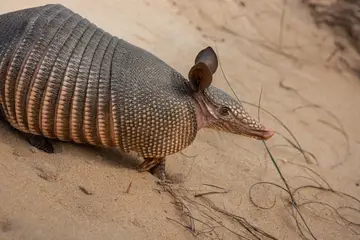

The nine-banded armadillo is a cat-sized mammal covered in bony armor that digs for insects and grubs, mostly at night. It is the only armadillo in the southeastern US; it spread north and east from Texas and is now found across much of the South, reaching North Carolina in the late 2000s and listed as naturalized in Virginia. No official source checked says whether it is venomous or bites (not stated). State agencies warn it can carry diseases, including leprosy (reported human cases are rare), and advise against bare-hand contact. N.C. Wildlife Resources Commission
On this page
Is the nine-banded armadillo dangerous?
Disease risk, not venom: armadillos can carry diseases transmissible to people, including leprosy, but reports are rare. Agencies advise wearing gloves or not touching armadillos with bare hands and avoiding contact with their blood and fluids. University of Georgia Warnell School
“Armadillos may carry diseases transmissible to humans, but reports are rare.”
How to identify a nine-banded armadillo
A photo or description can narrow it down, but cannot confirm what an animal is or that it is safe. Look from a distance and do not handle wild animals.
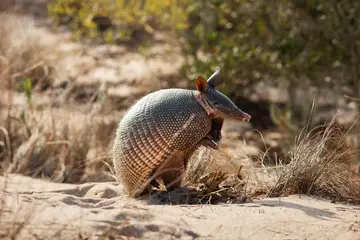

Size: Cat-sized: 15-17 in long not counting the tail, 8-17 lb (FWC); 24-32 in including a 9.5-14.5 in tail (UGA). FWC
Colors: brown to yellow-brown. Pattern: armor with movable bands (7-11) across the middle.
Key features
- bony skin plates that form a shell, which make it easy to identify University of Georgia Warnell School
- long scaly tail, deer-like ears, long pig-like snout N.C. Wildlife Resources Commission
- tail encased in 12 bony rings; no canine or incisor teeth SCDNR
Young
Young are born fully formed with eyes open in March or April, weigh 3-4 oz and walk within hours.
Where the nine-banded armadillo lives
- Native or listed
- Nonnative or not established
- No official record in our data
- 1–9
- 10–99
- 100–999
- 1,000+
On our state guides
- Alabama mammals
- Arkansas mammals
- Florida mammalsNonnative
- Georgia mammalsNonnative
- Illinois mammalsNonnative
- Indiana mammals
- Iowa mammals
- Kansas mammals
- Kentucky mammals
- Louisiana mammals
- Mississippi mammals
- Missouri mammals
- Nebraska mammals
- North Carolina mammalsNonnative
- Oklahoma mammals
- South Carolina mammals
- Tennessee mammals
- Texas mammals
- Virginia mammalsNonnative
State boundaries: U.S. Census Bureau, cartographic boundary file cb_2024_us_state_20m.
When it is active
Mostly active at night (FWC). UGA: in winter often active during the warmer part of the day, shifting to cooler night hours in summer; SCDNR sheet: in summer active mainly from twilight through early morning. Cold limits its spread north (UGA: does not tolerate below about 36°F). FWC
Too few open-licence records to chart by month: GBIF has only 27 records CC0 or CC BY human observations of this species in the US.
Habitat and habits
Habitat: Forested or semi-open habitat with loose soil it can dig; absent where soil is too hard to dig. FWC
Behavior: Forages slowly by smell with its snout to the ground, digs many burrows, can walk underwater or gulp air to swim, and when startled often leaps straight up before running.
Diet: Insects and other invertebrates, especially grubs; occasionally berries and bird eggs.
Young: Breeds in summer with delayed implantation; usually four identical same-sex young (quadruplets) born in spring from a single egg.
Legal status and reporting
Federal: Not on federal or Texas lists of species of concern, per The Mammals of Texas (7th ed., 2016); the Federal ESA cell for the armadillo row in NCWRC's 2025 SWAP table is empty. Natural Science Research Laboratory, Museum of Texas Tech University
Protection: Not protected in Georgia (UGA), and a nongame species with no closed season in North Carolina (NCWRC); Georgia law prohibits keeping armadillos in captivity. In New Mexico, BISON-M lists it as 'Not a Game Species' with limited protection (non-resident permit required) and ranks it Critically Imperiled in NM (S1). University of Georgia Warnell School
Invasive status: Treated as nonnative in parts of its US range: 'exotic species and a pest' (UGA, Georgia); introduced/exotic in NCWRC's 2025 SWAP table; naturalized in Virginia (DWR) and Florida (FWC). Not on any official invasive list checked. University of Georgia Warnell School
Report: North Carolina asks the public to report armadillo sightings (photo, location, date, alive or dead) via the NC Armadillo Project on iNaturalist, [email protected], or the NC Wildlife Helpline 866-318-2401. In Florida, FWC regional offices give technical assistance for armadillo problems. N.C. Wildlife Resources Commission
Questions about the nine-banded armadillo
Are there armadillos in florida?
Yes. FWC says armadillos are now common throughout most of Florida and are considered naturalized.
Are there armadillos in georgia?
Yes. UGA Extension says they are common in central and southern Georgia and found in most of the state's 159 counties, though they may be absent from mountain counties.
Are there armadillos in north carolina?
Yes. NCWRC says they reached North Carolina in the late 2000s and lists confirmed observations across the state; it asks the public to report sightings.
Are there armadillos in south carolina?
Yes. UGA Extension's range statement includes South Carolina, and SCDNR publishes armadillo rules for the state: no closed season on armadillos on private lands with a valid hunting license.
Are there armadillos in tennessee?
Yes. TWRA says they reached Tennessee in roughly the last thirty years and occur across the state except eastern Tennessee, spreading west to east.
Are there armadillos in missouri?
A Georgia extension publication (UGA, 2017 series) names Missouri within the armadillo's range, and SCDNR's sheet names southwest Missouri. No Missouri agency source was checked.
Armadillo leprosy
Armadillos can carry the bacterium that causes leprosy. UGA Extension says relatively few human cases are known, mostly in Texas and Louisiana and linked to eating raw or undercooked armadillo meat; NCWRC cites a study finding 0-10% of southeastern armadillos infected.
Armadillo disease
FWC lists St. Louis encephalitis, leptospires, arboviruses and leprosy; SCDNR adds the Chagas parasite. Agencies advise not touching armadillos with bare hands.
Sources
- Armadillo, Nine-Banded (NCWRC species page). N.C. Wildlife Resources Commission. undated page; checked November 3, 2026.
Quoted passages (2)
“The Nine-banded Armadillo is a unique mammal, with its armor-like skin and long, scaly tail. … It has deer-like ears and and has been nicknamed ‘Armored pig’ for its long, pig-like snout”
“CALL the NC Wildlife Helpline at 866-318-2401”
- WSFNR-17-36 Nine-banded Armadillo (M. T. Mengak). University of Georgia Warnell School (Extension publication series; PDF hosted on gadnrle.org). May 2017'); checked November 3, 2026.
Quoted passages (5)
“Armadillos may carry diseases transmissible to humans, but reports are rare.”
“No other mammal in Georgia has bony skin plates or a ‘shell’, which makes the armadillo easy to identify.”
“Fully formed young are born with their eyes open in March or April. They weigh 3-4 ounces at birth and can walk within a few hours”
“Armadillos are considered both an exotic species and a pest.”
“However, Georgia law prohibits keeping armadillos in captivity. Because they are not protected in Georgia, they can be hunted or trapped throughout the year.”
- Armadillo (species profile). Florida Fish and Wildlife Conservation Commission (FWC). archived copy, captured July 29, 2026; checked November 3, 2026. Archived copy.
Quoted passages (4)
“A mature armadillo is 15 to 17 inches long (not counting the tail) with a weight of 8 to 17 pounds.”
“Armadillos prefer forested or semi-open habitats with loose textured soil that allows them to dig easily.”
“When startled, armadillos often leap high into the air and then run quickly to a nearby burrow.”
“They are most active at night, and have very poor eyesight.”
- TPWD Wildlife Fact Sheet: Nine-banded Armadillo (Dasypus novemcinctus). Texas Parks and Wildlife Department. undated page; checked November 3, 2026.
Quoted passages (2)
“The armadillo eats insects and other invertebrates. They are skilled at digging for grubs and occasionally eat berries and bird eggs.”
“All four young, always of the same sex, are identical quadruplets and developed from the same egg.”
- South Carolina Species Information: Armadillos. SCDNR (prepared by National Wildlife Control Training Program). undated page; checked November 3, 2026.
Quoted passages (1)
“Canine and incisor teeth are absent. … The long, tapering tail is encased in 12 bony rings.”
- List of Native and Naturalized Fauna of Virginia. Virginia Department of Wildlife Resources (DWR). May, 2026; checked November 3, 2026.
- The Mammals of Texas, Online Edition: species account Dasypus novemcinctus. Natural Science Research Laboratory, Museum of Texas Tech University. Feb 9, 2026; checked November 3, 2026.
Quoted passages (1)
“…the armadillo does not appear on the federal or state lists of concerned species.”
- Nine-Banded Armadillo (Hunted) (Tennessee Watchable Wildlife species account). Tennessee Wildlife Resources Agency (Tennessee Watchable Wildlife website). undated page; checked November 3, 2026.
- GBIF.org occurrence records, human observations licensed CC0 1.0 or CC BY 4.0 only, accessed November 3, 2026. The datasets behind these counts are listed on our Sources page.
- State boundaries: U.S. Census Bureau, cartographic boundary file cb_2024_us_state_20m.