Lionfish
Pterois volitans and Pterois miles (two nearly identical species treated together) · also called red lionfish, devil firefish, zebrafish and firefish · Last checked November 3, 2026.
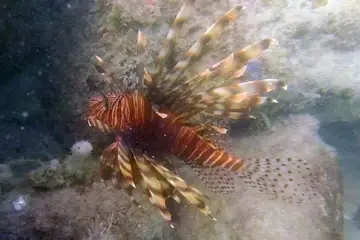
Lionfish are striped, fan-finned reef fish from the Indo-Pacific that are now invasive in US Atlantic, Gulf and Caribbean waters. They are venomous: their fin spines can deliver a very painful sting, and NOAA says to seek medical attention immediately if stung. Established populations run along the Atlantic coast from Florida to North Carolina and into the Gulf of America; young fish are occasionally seen as far north as New York in summer. A separate native lionfish lives in Hawaii, and it is venomous too. NOAA National Ocean Service
On this page
Is the lionfish dangerous?
NOAA: the spines deliver a venomous sting that can last for days and cause extreme pain, sweating, respiratory distress and even paralysis. NOAA says to seek medical attention immediately if stung. NOAA National Ocean Service
“The spines of this species deliver a venomous sting that can last for days and cause extreme pain, sweating, respiratory distress, and even paralysis.”
Bites and stings: Not stated. The danger officials describe is a sting from the fin spines.
If someone is bitten or stung, call 911 or Poison Help at 1-800-222-1222.
How to identify a lionfish
A photo or description can narrow it down, but cannot confirm what an animal is or that it is safe. Look from a distance and do not handle wild animals.
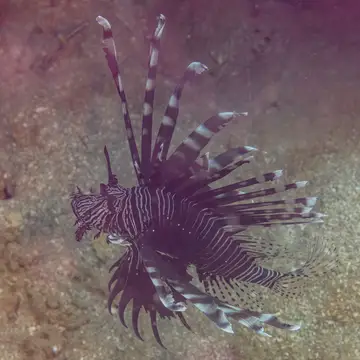

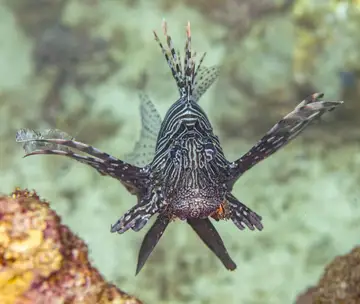

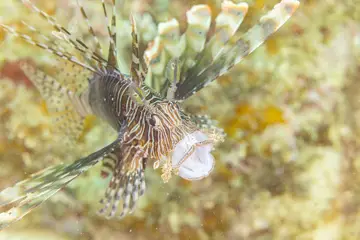

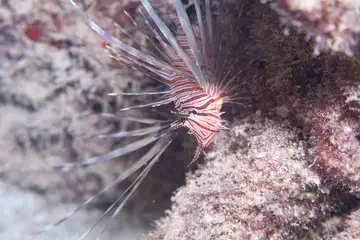
Size: Adults grow to about 18 inches (NOAA); USGS lists 47 cm. Juveniles can be 1 inch or less. NOAA National Ocean Service
Colors: brown, maroon and white. Pattern: striped and banded.
Key features
- Fleshy tentacles above the eyes and below the mouth, fan-like pectoral fins and long, separated dorsal spines. NOAA National Ocean Service
- 13 dorsal spines and 3 anal spines. NOAA National Ocean Service
- Slow-moving and conspicuous. NOAA National Ocean Service
Young
Juveniles may be 1 inch or less. In New York, juveniles turn up sporadically in summer.
Animals mistaken for the lionfish
Lionfish or Red lionfish and devil firefish (each other)?
Lionfish
Red lionfish and devil firefish (each other) Pterois volitans / Pterois miles
USGS: the two invasive species look the same; positive identification takes genetic analysis. USGS Nonindigenous Aquatic Species
Where the lionfish lives
- Native or listed
- Nonnative or not established
- No official record in our data
- 1–9
- 10–99
- 100–999
- 1,000+
On our state guides
- Alabama sharks and marine lifeNonnative
- Florida sharks and marine lifeNonnative
- Georgia sharks and marine lifeNonnative
- Louisiana sharks and marine lifeNonnative
- Mississippi sharks and marine lifeNonnative
- Rhode Island sharks and marine lifeNonnative
State boundaries: U.S. Census Bureau, cartographic boundary file cb_2024_us_state_20m.
When it is active
Thought to hunt at night, but in the Atlantic they are often seen moving about by day. Found year-round in Florida waters. NOAA National Ocean Service
US open-licence records peak in June to August.
Habitat and habits
Habitat: Warm marine waters, from 1 to 300 feet (NOAA), on hard bottom, mangrove, seagrass, coral and artificial reefs such as shipwrecks. FWC says up to 1,000 feet. NOAA Fisheries adds that they tolerate brackish coastal zones. NOAA National Ocean Service
Behavior: Ambush hunters that use outstretched pectoral fins to corner prey.
Diet: Top predator that eats over 50 species of fish; USGS also lists crustaceans.
Young: Reproduce all year; a mature female releases roughly two million eggs a year.
Legal status and reporting
Invasive status: Invasive in the US Southeast and Caribbean, per NOAA. NOAA National Ocean Service
Report: Report sightings to USGS Nonindigenous Aquatic Species or the REEF online form (both listed by Florida FWC). New York: send photos and location to NYSDEC or report through iMapInvasives; do not release one alive. Florida Fish and Wildlife Conservation Commission
Questions about the lionfish
Lionfish poison
Lionfish are venomous through their spines. NOAA Fisheries says that while the spines are venomous, the meat is considered safe to eat. If stung, call 911 or Poison Help at 1-800-222-1222.
Lionfish meat
NOAA Fisheries says the meat is considered safe to eat and that ciguatera poisoning from eating lionfish is very rare. It also notes a small food market for lionfish.
Lionfish invasive
Yes. NOAA calls lionfish an invasive species in US Southeast and Caribbean coastal waters. They compete with native fish such as snapper and grouper and can harm reefs.
Lionfish predators
Few are known. USGS says there are few documented natural predators other than larger lionfish eating smaller ones. NOAA Fisheries says very few outside their home range, and NOAA's Ocean Service says no known predators.
Lionfish florida
Yes. Florida FWC says lionfish are found year-round in Florida waters and calls them invasive. It encourages divers, anglers and commercial harvesters to remove them. The daily bag limit is unlimited.
Sources
- What is a lionfish? NOAA National Ocean Service. updated September 23, 2026; checked November 3, 2026.
Quoted passages (11)
“The spines of this species deliver a venomous sting that can last for days and cause extreme pain, sweating, respiratory distress, and even paralysis.”
“An adult lionfish can grow as large as 18 inches, while juveniles may be as small as 1 inch or less.”
“They have fleshy tentacles above their eyes and below the mouth; fan-like pectoral fins; long, separated dorsal spines”
“13 dorsal spines; 10-11 dorsal soft rays; 3 anal spines; and 6-7 anal soft rays.”
“Lionfish are slow-moving and conspicuous”
“Lionfish have been found in water depths from 1 to 300 feet on hard bottom, mangrove, seagrass, coral, and artificial reefs (like shipwrecks).”
“Lionfish consume over 50 species of fish including some economically and ecologically important species.”
“Lionfish are active hunters who ambush their prey by using their outstretched, fan-like pectoral fins to slowly pursue and "corner" them.”
“Lionfish are thought to be nocturnal hunters, but they have been found with full stomachs during the day in the Atlantic. … Although in the Atlantic, lionfish are often seen moving about during the day, both alone and in small groups.”
“…lionfish have no known predators and reproduce all year long; a mature female releases roughly two million eggs a year.”
“…is a flourishing invasive species in U.S. Southeast and Caribbean coastal waters.”
- Impacts of Invasive Lionfish. NOAA Fisheries. undated page; checked November 3, 2026.
- Lionfish (Pterois volitans/miles) - Species Profile. USGS Nonindigenous Aquatic Species. updated November 3, 2026; checked November 3, 2026.
Quoted passages (1)
“Two visually identical species have been introduced into the north-west Atlantic Ocean, Caribbean Sea and the Gulf of America. … At this time, positive identification can only be achieved through genetic analysis.”
- Lionfish. NYSDEC. archived copy, captured January 20, 2026; checked November 3, 2026.
Quoted passages (1)
“In New York, juvenile lionfish have sporadically been observed in the summer months.”
- Good Guys & Bad Guys card: lionfish. Bishop Museum, Hawaii Biological Survey. undated page; checked November 3, 2026.
- Lionfish (saltwater recreational regulations). Florida Fish and Wildlife Conservation Commission. archived copy, captured October 19, 2026; checked November 3, 2026.
Quoted passages (1)
“Report a lionfish sighting or harvest … Reef Environmental Education Foundation (REEF) online reporting form. USGS' Nonindigenous Aquatic Species (NAS).”
- GBIF.org occurrence records, human observations licensed CC0 1.0 or CC BY 4.0 only, accessed November 3, 2026. The datasets behind these counts are listed on our Sources page.
- State boundaries: U.S. Census Bureau, cartographic boundary file cb_2024_us_state_20m.