States Wildlife

Sharks in Mississippi: Species, Stingrays & Safety

Last checked November 3, 2026 against official sources.

On this page
  1. Which sharks, rays and other marine animals can hurt you
  2. All 23 sharks, rays and other marine animals
  3. Lookalikes
  4. When they are active
  5. If you are bitten or stung
  6. How to report
  7. What official sources say
  8. About this list
  9. Sources

This page lists 23 sharks, rays and other marine animals: 17 from The University of Southern Mississippi, School of Ocean Science and Engineering, Center for Fisheries Research and Development's Identification Guide to Sharks of Mississippi and 6 named in other official sources. 3 are venomous by official accounts. 1 is nonnative.

Not every species: this page shows the sharks, rays and other marine animals named in the official sources below. How lists are built.

Which sharks, rays and other marine animals can hurt you

Official sources single out these sharks, rays and other marine animals in Mississippi, in their own words:

All 23 sharks, rays and other marine animals

Venomous species first, then A to Z. Do not handle them.

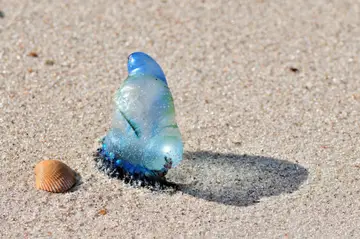
Portuguese Man-of-War
Photo: Tom Kennedy · CC BY 4.0 · iNaturalist

Portuguese Man-of-War

Physalia physalis

Venomous per National Park Service, Gulf Islands National Seashore

Danger to people
“Other species in this area which are known to be of potential danger include: … Portuguese Man-of-War” Mississippi Regional Poison Control Center (University of Mississippi Medical Center); hosted by the Mississippi State Department of Health
Size
Float rises up to 6 in above the water and is up to 10 in long. Tentacles average about 30 ft and may reach about 100 ft; South Carolina DNR cites up to 165 ft.
How to recognize it
  • Gas-filled, balloon-like float on the water's surface
  • Long tentacles hanging below the float
  • A colony, not a single animal, drifting with wind and currents
What the sources say

Venom: “Vinegar can cause unfired stinging cells, called nematocysts, to fire, injecting more venom” (National Park Service, Gulf Islands National Seashore)

Full Portuguese Man-of-War guide

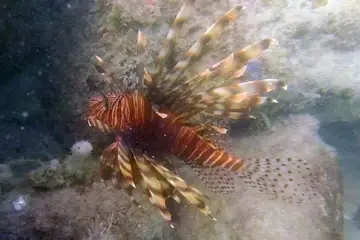
Red Lionfish
Photo: Kristof Zyskowski · CC BY 4.0 · iNaturalist

Red Lionfish

Pterois volitans

Venomous Invasive per Mississippi Aquatic Invasive Species Task Force; hosted by MDWFP

Size
Adults grow to about 18 inches (NOAA); USGS lists 47 cm. Juveniles can be 1 inch or less.
How to recognize it
  • Fleshy tentacles above the eyes and below the mouth, fan-like pectoral fins and long, separated dorsal spines.
  • 13 dorsal spines and 3 anal spines.
  • Slow-moving and conspicuous.
What the sources say

Venom: “This popular aquarium pet with a bold appearance and venomous ‘mane-like’ spines first escaped into Florida’s Atlantic waters in 1992 as a result of Hurricane Andrew.” (Mississippi Aquatic Invasive Species Task Force; hosted by MDWFP)

Full Red Lionfish guide

No confirmed photo of Atlantic Sharpnose Shark

Atlantic Sharpnose Shark

Rhizoprionodon terraenovae

Not stated

Venom
No official source we use states whether this animal is venomous. That does not mean it is harmless: do not handle it.
No confirmed photo of Blacknose Shark

Blacknose Shark

Carcharhinus acronotus

Not stated

Venom
No official source we use states whether this animal is venomous. That does not mean it is harmless: do not handle it.
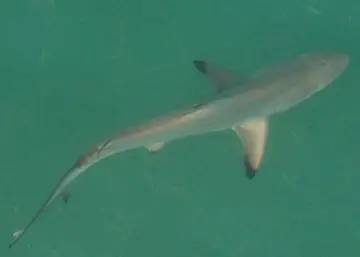
Blacktip Shark
Photo: John G. Phillips · CC BY 4.0 · iNaturalist

Blacktip Shark

Carcharhinus limbatus

Not stated

Venom
No official source we use states whether this animal is venomous. That does not mean it is harmless: do not handle it.
Size
Average about 5 feet and 50 pounds; maximum about 8 feet.
How to recognize it
  • Anal fin usually has no black tip
  • Long, pointed snout; small eyes
  • First dorsal fin begins over or slightly behind the rear of the pectoral fins

Full Blacktip Shark guide

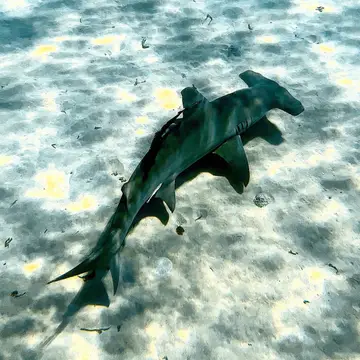
Bonnethead
Photo: Quinn · CC BY 4.0 · iNaturalist

Bonnethead

Sphyrna tiburo

Not stated

Venom
No official source we use states whether this animal is venomous. That does not mean it is harmless: do not handle it.
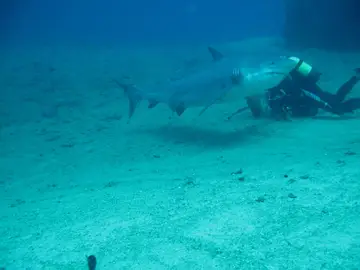
Bull Shark
Photo: Judita bagon · CC BY-SA 3.0 · Wikimedia Commons · resized

Bull Shark

Carcharhinus leucas

Not stated

Venom
No official source we use states whether this animal is venomous. That does not mean it is harmless: do not handle it.
Size
Reported maximum varies by source: about 11 ft (Alabama), over 10 ft with a 6 to 8 ft average (South Carolina), about 13 ft (Florida Museum).
How to recognize it
  • Very short, broadly rounded snout
  • Stout, heavy body
  • No ridge between the dorsal fins

Full Bull Shark guide

No confirmed photo of Dusky Shark

Dusky Shark

Carcharhinus obscurus

Not stated

Venom
No official source we use states whether this animal is venomous. That does not mean it is harmless: do not handle it.
No confirmed photo of Finetooth Shark

Finetooth Shark

Carcharhinus isodon

Not stated

Venom
No official source we use states whether this animal is venomous. That does not mean it is harmless: do not handle it.
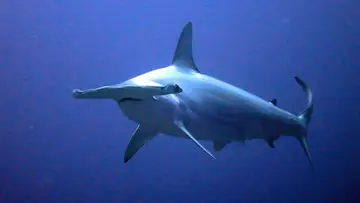
Great Hammerhead
Photo: Robin White · CC BY 4.0 · iNaturalist

Great Hammerhead

Sphyrna mokarran

Not stated

Venom
No official source we use states whether this animal is venomous. That does not mean it is harmless: do not handle it.
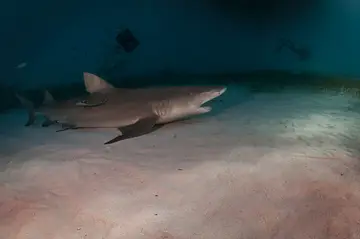
Lemon Shark
Photo: GregAmptman · CC BY 4.0 · Wikimedia Commons

Lemon Shark

Negaprion brevirostris

Not stated

Venom
No official source we use states whether this animal is venomous. That does not mean it is harmless: do not handle it.
Size
Maximum about 10.5 ft (Florida).
How to recognize it
  • Two large dorsal fins of similar size and shape
  • Blunt, rounded snout shorter than the mouth is wide
  • No ridge between the dorsal fins

Full Lemon Shark guide

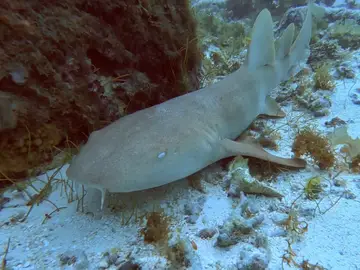
Nurse Shark
Photo: Matteo Bellucci · CC BY 4.0 · iNaturalist

Nurse Shark

Ginglymostoma cirratum

Not stated

Venom
No official source we use states whether this animal is venomous. That does not mean it is harmless: do not handle it.
Size
Usually 4 to 8 ft (SCDNR); adults average 7.5 to 8 ft and over 200 lb (Florida Museum); maximum about 9 ft (FWC).
How to recognize it
  • A distinct, long barbel ('feeler') on each nostril, which no other shark has
  • First dorsal fin starts above the pelvic fins; both dorsal fins rounded
  • Small mouth near the tip of a very short, rounded snout

Full Nurse Shark guide

No confirmed photo of Sandbar Shark

Sandbar Shark

Carcharhinus plumbeus

Not stated

Venom
No official source we use states whether this animal is venomous. That does not mean it is harmless: do not handle it.
Conservation
Guide: "Large Coastal, Prohibited" (prohibited species per the guide's management category key)
Scalloped Hammerhead
Photo: NOAA Photo Library · Public domain · Wikimedia Commons

Scalloped Hammerhead

Sphyrna lewini

Not stated

Venom
No official source we use states whether this animal is venomous. That does not mean it is harmless: do not handle it.
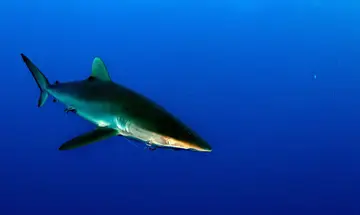
Silky Shark
Photo: Joi Ito from Inbamura, Japan · CC BY 2.0 · Wikimedia Commons

Silky Shark

Carcharhinus falciformis

Not stated

Venom
No official source we use states whether this animal is venomous. That does not mean it is harmless: do not handle it.
Conservation
Guide: "Large Coastal, Prohibited" (prohibited species per the guide's management category key)
No confirmed photo of Smalltail Shark

Smalltail Shark

Carcharhinus porosus

Not stated

Venom
No official source we use states whether this animal is venomous. That does not mean it is harmless: do not handle it.
No confirmed photo of Smalltooth Sawfish

Smalltooth Sawfish

Pristis pectinata

Not stated

Venom
No official source we use states whether this animal is venomous. That does not mean it is harmless: do not handle it.
Conservation
Endangered (ESA), per guide: "Smalltooth sawfish are listed as endangered under the Endangered Species Act (ESA)"
No confirmed photo of Spinner Shark

Spinner Shark

Carcharhinus brevipinna

Not stated

Venom
No official source we use states whether this animal is venomous. That does not mean it is harmless: do not handle it.
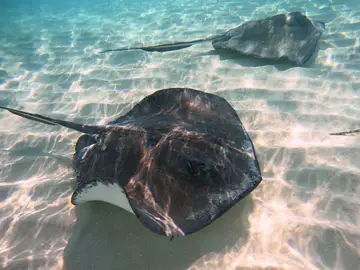
No confirmed photo of Stingrays (as a group)

Stingrays (as a group)

Not stated

Venom
No official source we use states whether this animal is venomous. That does not mean it is harmless: do not handle it.
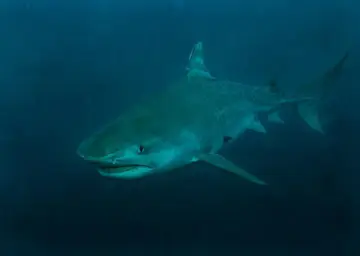
Tiger Shark
Photo: Georgina Jones · CC BY-SA 4.0 · iNaturalist · resized

Tiger Shark

Galeocerdo cuvier

Not stated

Venom
No official source we use states whether this animal is venomous. That does not mean it is harmless: do not handle it.
Size
Florida gives a maximum of about 18 ft and 2,000 lb.
How to recognize it
  • Blunt snout and vertical bars on the sides
  • Very broad head; short, broadly rounded snout much shorter than the mouth is wide
  • Large triangular teeth, strongly serrated, with a deep notch on the outer edge

Full Tiger Shark guide

No confirmed photo of Torpedo Ray

Torpedo Ray

Not stated

Venom
No official source we use states whether this animal is venomous. That does not mean it is harmless: do not handle it.
Danger to people
“One interesting ray is the torpedo ray, which produces its own electricity. Although the electric current is not strong enough to kill a person, it is severe enough to give a strong jolt.” Della McCaughan and Zan Skelton; hosted by the Mississippi Department of Marine Resources

Sharks and Marine Life people confuse

Lemon Shark or Nurse shark?

Lemon Shark
Photo: GregAmptman · CC BY 4.0 · Wikimedia Commons

Lemon Shark Not stated

Nurse shark
Photo: Matteo Bellucci · CC BY 4.0 · iNaturalist

Nurse shark Not stated

Also has a large second dorsal fin, but its first dorsal fin sits over the pelvic fins and it has barbels at the nostrils.

Lemon Shark or Bull shark?

Lemon Shark
Photo: GregAmptman · CC BY 4.0 · Wikimedia Commons

Lemon Shark Not stated

Bull shark
Photo: Judita bagon · CC BY-SA 3.0 · Wikimedia Commons · resized

Bull shark Not stated

Bull sharks have a second dorsal fin much smaller than the first; in lemon sharks the two are nearly the same size.

Bull Shark or Sandbar shark?

Bull Shark
Photo: Judita bagon · CC BY-SA 3.0 · Wikimedia Commons · resized

Bull Shark Not stated

No confirmed photo of Sandbar shark

Sandbar shark Not stated

Sandbar sharks (and oceanic whitetip, bignose, silky, dusky and night sharks) have a ridge between the dorsal fins; bull sharks do not.

Lionfish or Red lionfish and devil firefish (each other)?

Lionfish
Photo: Kristof Zyskowski · CC BY 4.0 · iNaturalist

Lionfish Venomous

Red lionfish and devil firefish (each other)
Photo: Kristof Zyskowski · CC BY 4.0 · iNaturalist

Red lionfish and devil firefish (each other) Venomous

USGS: the two invasive species look the same; positive identification takes genetic analysis.

Photos show typical adults; individuals vary. Never get close to compare.

When sharks, rays and other marine animals are active in Mississippi

Records of sharks, rays and other marine animals in Mississippi peak in February, July and September. They show when people record sharks, rays and other marine animals, not how many there are (about month bars).

30 records of sharks, rays and other marine animals in Mississippi by month (GBIF, CC0 and CC BY records).

If you are bitten or stung

Call 911 or Poison Help at 1-800-222-1222 right away. Poison Help connects you to your local poison center, any time of day.

How to report

Bear problems or sightings, and nuisance-animal guidance: MDWFP Wildlife Bureau (601) 432-2199. Nuisance animal technical guidance is also available from USDA Wildlife Services (MS) (662) 325-3014. Coastal invasive species: MDMR Invasive Species Coordinator (228) 523-4113. Sawfish sightings: 1-844-4SAWFISH. MDWFP

What official sources say

Are there sharks in mississippi waters?

Yes. USM identification guide covers sharks in Mississippi coastal waters; the Atlantic sharpnose is the most common. Local waters are a nursery area for many coastal sharks. A 1984 MDMR-hosted book says there are few reported attacks in this area. The University of Southern Mississippi, School of Ocean Science and Engineering, Center for Fisheries Research and Development

“Through our research, we have found that our local waters are an important nursery area for many coastal shark species.”

Are there lionfish in mississippi waters?

Yes. Red lionfish is in the MDMR state saltwater records (record dated 02/14/17). They have venomous spines and the state calls them invasive. Mississippi Department of Marine Resources

“Lionfish, Red Pterois volitans”

About this list

The species list comes from Identification Guide to Sharks of Mississippi (USM Center for Fisheries Research and Development; developed with MDMR and USFWS Sport Fish Restoration support) (The University of Southern Mississippi, School of Ocean Science and Engineering, Center for Fisheries Research and Development (developed with support from the Mississippi Department of Marine Resources and USFWS Sport Fish Restoration), undated PDF; retrieved 2026-11-03). 6 more entries come from other official sources named on each card.

Venom labels come only from official sources and link to them; "Not stated" never means harmless. How labels work.

"Nonnative" and "Invasive" follow the wording of the source list. See invasive species in Mississippi.

Sources

  1. About Us. Mississippi Department of Wildlife, Fisheries, and Parks (MDWFP). undated page; checked November 3, 2026.
  2. Identification Guide to Sharks of Mississippi (Hoffmayer, Franks, Shelley, Higgs and Hendon). The University of Southern Mississippi, School of Ocean Science and Engineering, Center for Fisheries Research and Development (developed with support from the Mississippi Department of Marine Resources and USFWS Sport Fish Restoration). undated page; checked November 3, 2026.
    Quoted passages (1)
    “Through our research, we have found that our local waters are an important nursery area for many coastal shark species.”
  3. Venomous Animals of Mississippi. Mississippi Regional Poison Control Center (University of Mississippi Medical Center); hosted by the Mississippi State Department of Health. archived copy, captured February 18, 2025; checked November 3, 2026.
    Quoted passages (2)
    “Other species in this area which are known to be of potential danger include: … Portuguese Man-of-War”
    “Punctures by the spine of a catfish fin deposit a venom”
  4. Jellyfish and Siphonophores. National Park Service, Gulf Islands National Seashore. updated December 9, 2019; checked November 3, 2026.
    Quoted passages (1)
    “Vinegar can cause unfired stinging cells, called nematocysts, to fire, injecting more venom”
  5. State Saltwater Records: Conventional. Mississippi Department of Marine Resources. undated page; checked November 3, 2026.
    Quoted passages (1)
    “Lionfish, Red Pterois volitans”
  6. Mississippi State Management Plan for Aquatic Invasive Species (Final Draft). Mississippi Aquatic Invasive Species Task Force; hosted by MDWFP. March 20, 2013; checked November 3, 2026.
    Quoted passages (1)
    “This popular aquarium pet with a bold appearance and venomous ‘mane-like’ spines first escaped into Florida’s Atlantic waters in 1992 as a result of Hurricane Andrew.”
  7. Kathy's Journal: Vertebrates of the Mississippi Gulf Coast (Book VI, Marine Discovery Series). Della McCaughan and Zan Skelton; hosted by the Mississippi Department of Marine Resources. 1984; checked November 3, 2026.
    Quoted passages (2)
    “One interesting ray is the torpedo ray, which produces its own electricity. Although the electric current is not strong enough to kill a person, it is severe enough to give a strong jolt.”
    “The barb, or spine, located partway down the tail, is sharp and (like a kitchen knife) has serrated side projections which are dangerous. … The skin covering the base of the barb has toxic cells that can cause pain and infection.”
  8. Gulf Coast Fisherman, Issue 17, Spring 2020. Mississippi State University Extension Service. Spring 2020; checked November 3, 2026.
  9. Black Bear Program. Mississippi Department of Wildlife, Fisheries, and Parks (MDWFP). undated page; checked November 3, 2026.
    Quoted passages (1)
    “If you are experiencing problems involving black bears or want to report a recent bear sighting, please contact MDWFP at (601) 432-2199.”
  10. GBIF.org occurrence records, human observations licensed CC0 1.0 or CC BY 4.0 only, accessed November 3, 2026. The datasets behind these counts are listed on our Sources page.