Portuguese Man o' War
Physalia physalis · also called Portuguese man-of-war, man o' war, man-of-war and man-o-war · Last checked November 3, 2026.
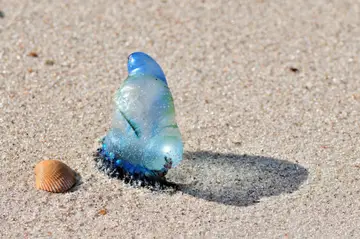
The Portuguese man o' war is a venomous ocean animal with a balloon-like blue, violet or pink float and long stinging tentacles. It looks like a jellyfish but is a siphonophore, a colony of specialized individuals. NOAA says its sting is rarely deadly to people but is painful and causes welts, and it may still sting weeks after washing ashore. In the US it drifts into coastal waters from Florida around the Gulf to Texas, sometimes north up the Atlantic, and bluebottles strand on Hawaii's beaches. NOAA National Ocean Service
On this page
Is the portuguese man o' war dangerous?
NOAA: the sting is rarely deadly to people, but it is painful and causes welts on exposed skin. NOAA National Ocean Service
“While the man o’ war’s sting is rarely deadly to people, it packs a painful punch and causes welts on exposed skin.”
Bites and stings: It does not bite; it stings with stinging cells on its tentacles. The sting is a reflex, and dead animals, beached animals and severed tentacles can still sting.
If someone is bitten or stung, call 911 or Poison Help at 1-800-222-1222.
How to identify a portuguese man o' war
A photo or description can narrow it down, but cannot confirm what an animal is or that it is safe. Look from a distance and do not handle wild animals.
Size: Float rises up to 6 in above the water and is up to 10 in long. Tentacles average about 30 ft and may reach about 100 ft; South Carolina DNR cites up to 165 ft. NOAA National Ocean Service
Colors: float blue, violet or pink. Pattern: translucent float tinged with pink, purple or blue.
Key features
- Gas-filled, balloon-like float on the water's surface NOAA National Ocean Service
- Long tentacles hanging below the float NOAA National Ocean Service
- A colony, not a single animal, drifting with wind and currents NOAA National Ocean Service
Animals mistaken for the portuguese man o' war
Portuguese Man o' War or By-the-wind sailor?
Portuguese Man o' War
By-the-wind sailor
Smaller, also with a blue bladder, and causes only a mild, tingling sting. South Carolina DNR says all jellyfish with a blue float should be considered dangerous. South Carolina Department of Natural Resources
South Carolina DNR: only a mild, tingling sting.
Portuguese Man o' War or Box jellyfish?
Portuguese Man o' War
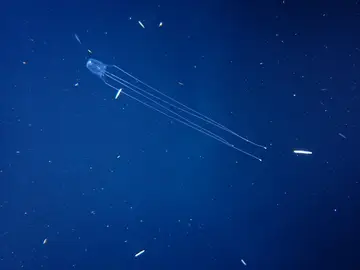
South Carolina DNR describes the box jelly by its cube-shaped bell. It describes the man-of-war by its gas-filled float, and says it is a colony and not a true jellyfish. South Carolina Department of Natural Resources
Venomous; see the box jellyfish page.
Where the portuguese man o' war lives
- Native or listed
- Nonnative or not established
- No official record in our data
- 1–9
- 10–99
- 100–999
- 1,000+
On our state guides
State boundaries: U.S. Census Bureau, cartographic boundary file cb_2024_us_state_20m.
When it is active
In the Gulf, sightings tend to increase during hurricane season (Texas A&M Galveston). In Hawaii they are most common along bays and beaches during strong onshore winds. Texas A&M University at Galveston
US open-licence records peak in January to April and December.
Habitat and habits
Habitat: The open ocean surface of warm tropical and subtropical seas; wind, currents and storms carry it into coastal waters. South Carolina Department of Natural Resources
Behavior: Cannot swim; drifts on wind and currents, sometimes in groups of 1,000 or more. Sea turtles, some fish, crabs, violet sea-snails and Glaucus sea slugs eat it.
Diet: Small fish, crustaceans and plankton, paralyzed by its tentacles.
Young: Specialized reproductive polyps (gonozooids) reproduce for the colony.
Legal status and reporting
Federal: No record returned by the USFWS ECOS query for Physalia physalis on 2026-11-03; not itself a statement of listing status. US Fish and Wildlife Service
Report: No national reporting program found. At Fire Island National Seashore (2015 notice), visitors should alert lifeguards, park rangers or law enforcement. Follow local beach warnings. National Park Service
Questions about the portuguese man o' war
Portuguese man o war
A venomous, floating ocean colony with a blue, violet or pink float and long stinging tentacles. It is related to jellyfish but is not a true jellyfish.
Portuguese man o war jellyfish
It is often called a jellyfish, but NOAA says it is a siphonophore, a colony of genetically identical individuals, closely related to jellyfish.
Portuguese man o war vs jellyfish
The man o' war is not a true jellyfish. It is a colony of specialized polyps that cannot live without each other, with a gas-filled float on the surface. South Carolina DNR says it is closely related to jellyfish. Both can sting.
Portuguese man o war vs box jellyfish
They are different animals. The man o' war floats on the surface with a gas-filled float and is a colony. A box jelly has a cube-shaped bell. Both are venomous. See the box jellyfish page.
Portuguese man o war tentacle length
NOAA says tentacles average about 30 ft and may reach about 100 ft. South Carolina DNR's taxonomic center cites up to 165 ft.
Portuguese man o war sting
NOAA says the sting is rarely deadly to people but is painful and causes welts. South Carolina DNR calls the stings extremely painful and says severe stings can occur even when the animal is beached or dead.
Portuguese man o war sting on human
NOAA describes pain and welts on exposed skin. Hawaii Ocean Safety says symptoms include stinging, burning, redness and swollen lymph nodes, and that severe reactions may be life threatening. Call 911 or Poison Help at 1-800-222-1222.
Portuguese man o war sting treatment
Call 911 or Poison Help at 1-800-222-1222. Official sources disagree on first aid for this sting, so this guide does not give treatment steps.
Portuguese man o war in florida
Yes. The Florida Museum says it often washes up on Florida's coasts, and the National Park Service lists it among the most common jellies around Fort Matanzas.
Portuguese man o war hawaii calendar
Hawaii Ocean Safety ties man-o-war to strong onshore winds, not dates. The dated forecast it describes, 9 to 10 days after the full moon, is for box jellyfish.
Sources
- What is a Portuguese Man o' War? NOAA National Ocean Service. page shows 'Last updated' with no date; checked November 3, 2026.
Quoted passages (6)
“While the man o’ war’s sting is rarely deadly to people, it packs a painful punch and causes welts on exposed skin.”
“…grow to an average of 10 meters (about 30 feet) and may extend by as much as 30 meters (about 100 feet)”
“…recognized by its balloon-like float”
“Lurking below the float are long strands of tentacles and polyps”
“…propelled by winds and ocean currents alone”
“…sometimes float in legions of 1,000 or more”
- The Portuguese man-of-war (Physalia physalis). South Carolina Department of Natural Resources. undated page; checked November 3, 2026.
Quoted passages (3)
“The man-of-war is adapted to live its life entirely in the open ocean.”
“Potential food items such as small fish, crustaceans and plankton are paralyzed by these stinging cells”
“…the reproductive polyps”
- UH scientists scrutinize first aid for man o' war stings. University of Hawaii News. May 2, 2017; checked November 3, 2026.
- Portuguese Man O' War Spotted On Galveston Beaches. Texas A&M University at Galveston. February 11, 2025; checked November 3, 2026.
Quoted passages (1)
“These sightings, while not uncommon, tend to increase during hurricane season in the Gulf.”
- ECOS species report query for the four taxa. U.S. Fish and Wildlife Service. live query result 2026-11-03; checked November 3, 2026.
- Portuguese Man O' War Reported on Fire Island and Long Island South Shore Beaches. National Park Service. updated July 10, 2015; checked November 3, 2026.
Quoted passages (1)
“If visitors observe a Portuguese Man o’ War on Fire Island, they should alert lifeguards, park rangers, or law enforcement officers”
- Sea Science: Jellyfish. South Carolina Department of Natural Resources. undated page; checked November 3, 2026.
Quoted passages (2)
“…all jellyfish having a blue float should be considered dangerous”
“Known as the box jelly because of its cube-shaped bell”
- Understanding Beach Warning Signs. Hawaii Ocean Safety (State of Hawaii). undated page; checked November 3, 2026.
- Jellyfish and Siphonophores. National Park Service, Gulf Islands National Seashore. updated December 9, 2019; checked November 3, 2026.
- Five Facts: Portuguese man-of-war. Florida Museum of Natural History, University of Florida. September 24, 2020; checked November 3, 2026.
- Jellyfish - Fort Matanzas National Monument. National Park Service. updated June 28, 2023; checked November 3, 2026.
- GBIF.org occurrence records, human observations licensed CC0 1.0 or CC BY 4.0 only, accessed November 3, 2026. The datasets behind these counts are listed on our Sources page.
- State boundaries: U.S. Census Bureau, cartographic boundary file cb_2024_us_state_20m.