Box Jellyfish
Cubozoa · also called box jelly, sea wasp and cubomedusae · Last checked November 3, 2026.
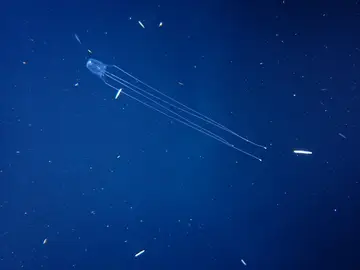
Box jellyfish are jellyfish with a cube-shaped bell and tentacles hanging from its four corners. They are venomous and their sting can be severe. NOAA says only a few of the roughly 50 species can kill people, mainly in the Indo-Pacific and northern Australia. Box jellies in US waters are not the deadly Australian species, but they still sting hard: South Carolina calls its sea wasp the most venomous jellyfish in its waters and says a sting may require hospitalization. Box jellies are found off the South Carolina and Georgia coasts and in Hawaii. NOAA National Ocean Service
This page covers a class (Cubozoa), not a single species.
On this page
Is the box jellyfish dangerous?
NOAA: box jellyfish stings can cause paralysis, cardiac arrest and death within minutes, but only a few of the roughly 50 species have venom that can kill people, mainly in the Indo-Pacific and northern Australia. NOAA National Ocean Service
“People and animals unfortunate enough to be injected with this poison may experience paralysis, cardiac arrest, and even death, all within a few minutes of being stung. But don’t choose the mountains over the ocean just yet. Of the 50 or so species of box jellyfish, also called sea wasps, only a few have venom that can be lethal to humans.”
Bites and stings: Box jellies do not bite; they sting with stinging cells (nematocysts) on their tentacles.
If someone is bitten or stung, call 911 or Poison Help at 1-800-222-1222.
How to identify a box jellyfish
A photo or description can narrow it down, but cannot confirm what an animal is or that it is safe. Look from a distance and do not handle wild animals.
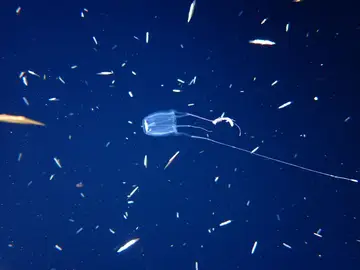
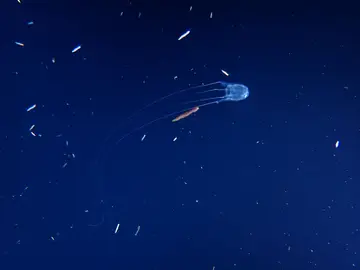
Size: South Carolina's sea wasp: 5 to 6 inches across and 4 to 6 inches tall. Hawaii's largest box jelly (C. alata): about 1.5 to 2 inches across and 3 inches tall. South Carolina Department of Natural Resources
Colors: Transparent body with thin pinkish tentacles (Hawaii species).
Key features
- Cube-shaped bell South Carolina Department of Natural Resources
- Tentacles hang from the four corners South Carolina Department of Natural Resources
- Strong swimmers (up to about four knots) with clusters of eyes on each side of the box, unlike most jellyfish (NOAA) NOAA National Ocean Service
Animals mistaken for the box jellyfish
Box Jellyfish or Portuguese Man o' War?
Box Jellyfish
Portuguese Man o' War Physalia physalis
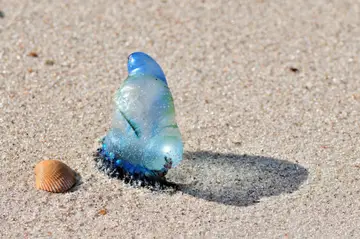
The man o' war is not a true jellyfish: it has a gas-filled purple-blue float up to 10 inches long, with tentacles that can trail 30 to 60 feet. Box jellies have a transparent cube-shaped bell with tentacles from the corners. South Carolina Department of Natural Resources
Highly venomous; South Carolina says all jellyfish with a blue float should be considered dangerous.
Box Jellyfish or Sea Nettle?
Box Jellyfish
Sea Nettle Chrysaora quinquecirrha
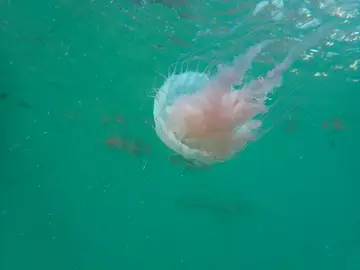
Saucer-shaped bell, usually brown or red, 6 to 8 inches across, with four oral arms and long tentacles around the edge. South Carolina Department of Natural Resources
Moderate to severe stings; causes most jellyfish stings in South Carolina.
Where the box jellyfish lives
- Native or listed
- Nonnative or not established
- No official record in our data
- 1–9
- 10–99
- 100–999
- 1,000+
State boundaries: U.S. Census Bureau, cartographic boundary file cb_2024_us_state_20m.
When it is active
Hawaii: box jelly 'invasions' on O'ahu shores usually occur 8 to 10 days after a full moon. The Waikiki Aquarium calendar gives only estimates and says jellyfish may be present on any day. Waikiki Aquarium, University of Hawaii at Manoa
US open-licence records for all box jellyfish (class Cubozoa) peak in August and October to November.
Habitat and habits
Habitat: Shallow tropical and warm coastal seas: quiet bays, estuaries and sandy shorelines; some in the open ocean. Waikiki Aquarium, University of Hawaii at Manoa
Behavior: Strong swimmers that can see; the sea wasp goes deeper at midday and comes up in early morning, late afternoon and evening.
Diet: NOAA: mainly shrimp and small fish; they may actively hunt.
Young: C. alata gathers to spawn at night in summer (studied in Puerto Rico); larvae settle as tiny polyps that each turn into a jelly after about ten weeks; adults may live more than a year.
Legal status and reporting
Federal: No record returned by the USFWS ECOS query for Chiropsalmus quadrumanus or Alatina alata on 2026-11-03; not itself a statement of listing status. US Fish and Wildlife Service
Questions about the box jellyfish
Box jellyfish
Jellyfish with a cube-shaped bell and tentacles from the four corners. NOAA says only a few of about 50 species can kill people, mostly in the Indo-Pacific and northern Australia. US box jellies, such as South Carolina's sea wasp and Hawaii's winged box jelly, sting painfully; a sea wasp sting may require hospitalization. Call 911 or Poison Help at 1-800-222-1222.
Portuguese man o war vs box jellyfish
The Portuguese man o' war is not a true jellyfish: it is a colony with a purple-blue gas-filled float and very long tentacles. A box jelly is a true jellyfish with a transparent cube-shaped bell and tentacles at the corners. Both are venomous. Hawaii's Waikiki Aquarium says Hawaii's box jelly sting is more painful than the man o' war's.
Sources
- What is the most venomous marine animal? NOAA National Ocean Service. updated September 23, 2026; checked November 3, 2026.
Quoted passages (3)
“People and animals unfortunate enough to be injected with this poison may experience paralysis, cardiac arrest, and even death, all within a few minutes of being stung. But don’t choose the mountains over the ocean just yet. Of the 50 or so species of box jellyfish, also called sea wasps, only a few have venom that can be lethal to humans.”
“Most notably, box jellyfish can swim—at maximum speeds approaching four knots—whereas most species of jellyfish float wherever the current takes them, with little control over their direction. Box jellyfish can also see. They have clusters of eyes on each side of the box.”
“Their speed and vision leads some researchers to believe that box jellyfish actively hunt their prey, mainly shrimp and small fish.”
- Sea Science: Jellyfish. South Carolina Department of Natural Resources. undated page; checked November 3, 2026.
Quoted passages (6)
“Sea wasps are strong, graceful swimmers reaching 5-6 inches in diameter and 4-6 inches in height.”
“Known as the box jelly because of its cube-shaped bell”
“Several long tentacles hang from the four corners of the cube.”
“Some jellyfish, such as the sea wasp, descend to deeper waters during the bright sun of the midday and surface during early morning, late afternoon and evening.”
“Although closely related to jellyfish, the Portuguese man-ofwar is not a ‘true’ jellyfish. … The gas-filled float of the man-of-war is purple-blue, up to 10 inches long. Under the float, tentacles equipped with thousands of stinging cells hang from the feeding polyps which extend as much as 30 to 60 feet.”
“Common in the summer, this jellyfish is saucer-shaped, usually brown or red, and 6-8 inches in diameter. Four oral arms and long marginal tentacles hang from the bell and can extend several feet.”
- Understanding Jellyfish. University of Georgia Cooperative Extension (Camden County ANR). published 2023-08-22, modified 2025-09-23; checked November 3, 2026.
- Box Jelly (animal guide). Waikiki Aquarium, University of Hawaii at Manoa. page modified 2020-07-02; checked November 3, 2026.
Quoted passages (3)
“They generally occur in quiet, shallow waters of protected bays and estuaries, and over sandy-bottomed shorelines, though some species have been reported in the open ocean.”
“Researchers have found that in most cases, the jellyfish "invasions" occur eight to ten days after a full moon.”
“After maturing into adults, box jellies may live for more than a year and probably spawn more than once.”
- ECOS species report query (p16). U.S. Fish and Wildlife Service. live query 2026-11-03; checked November 3, 2026.
Quoted passages (1)
“Chiropsalmus quadrumanus: no record returned”
- GBIF.org occurrence records, human observations licensed CC0 1.0 or CC BY 4.0 only, accessed November 3, 2026. The datasets behind these counts are listed on our Sources page.
- State boundaries: U.S. Census Bureau, cartographic boundary file cb_2024_us_state_20m.