Blacktip Shark
Carcharhinus limbatus · also called Atlantic Blacktip, Blackfin shark, Small blacktip and Spot-fin ground shark · Last checked November 3, 2026.
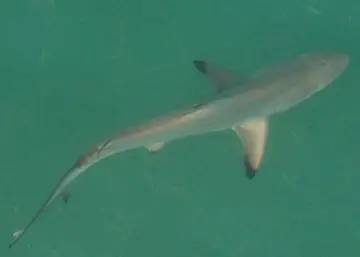
The blacktip shark is a medium-sized, fast-swimming coastal shark, gray to gray-brown above and white below, with black tips on most of its fins. It is common in shallow coastal waters, bays and estuaries of the Atlantic and Gulf coasts, and Hawaii's agency lists it as well. Alabama's agency says that without food or other special circumstances it is likely of little hazard to people, but it has bitten people: FWC says it has been implicated in attacks on bathers, and the Florida Museum says most bites are minor, mistaken-identity bites, often on surfers. Florida's agency says shark bites in Florida waters are extremely unlikely and rarely life-threatening. Outdoor Alabama
On this page
Is the blacktip shark dangerous?
Has been implicated in attacks on bathers. FWC
“Has been implicated in attacks on bathers.”
Bites and stings: Yes, occasionally. The International Shark Attack File table lists 35 confirmed unprovoked bites worldwide, none fatal, and warns that the table must be used with caution because requiem sharks like the blacktip are hard to identify. The Florida Museum's species profile instead gives 29 unprovoked attacks, one fatal, and says blacktips cause about 20% of Florida bites, often on surfers.
No official source we use states whether this animal is venomous. That does not mean it is harmless: do not handle it.
If someone is bitten or stung, call 911 or Poison Help at 1-800-222-1222.
How to identify a blacktip shark
A photo or description can narrow it down, but cannot confirm what an animal is or that it is safe. Look from a distance and do not handle wild animals.
Size: Average about 5 feet and 50 pounds; maximum about 8 feet. Outdoor Alabama
Colors: Gray, gray-brown or bluish gray above; white below; a conspicuous white band along the flank. Pattern: Black tips on the pectoral fins, second dorsal fin and lower tail lobe, sometimes the pelvic fins.
Key features
- Anal fin usually has no black tip Outdoor Alabama
- Long, pointed snout; small eyes Outdoor Alabama
- First dorsal fin begins over or slightly behind the rear of the pectoral fins Outdoor Alabama
- Black fin tips may fade with age Florida Museum of Natural History
Young
About 1.5 to 2 feet long at birth; black markings may be indistinct in juveniles.
Animals mistaken for the blacktip shark
Blacktip Shark or Spinner Shark?
Blacktip Shark
Spinner Shark Carcharhinus brevipinna
The blacktip's anal fin is white (no black tip); the spinner shark usually has a black-tipped anal fin. New York State Department of Environmental Conservation
Where the blacktip shark lives
- Native or listed
- Nonnative or not established
- No official record in our data
- 1–9
- 10–99
- 100–999
- 1,000+
On our state guides
- Delaware sharks and marine life
- Florida sharks and marine life
- Georgia sharks and marine life
- Hawaii sharks and marine life
- Maryland sharks and marine life
- Mississippi sharks and marine life
- New Jersey sharks and marine life
- New York sharks and marine life
- South Carolina sharks and marine life
State boundaries: U.S. Census Bureau, cartographic boundary file cb_2024_us_state_20m.
When it is active
Seasonal migrant: forms large schools during annual migrations and moves south and into deeper coastal water in winter. FWC
US open-licence records peak in May to June.
Habitat and habits
Habitat: Common in Florida's coastal waters, bays and estuaries; a very active, fast swimmer often seen at the surface. FWC
Behavior: Fast and active; often schools, especially during migration. It may leap out of the water and spin several times before falling back.
Diet: Mainly fish, plus small sharks, rays and skates, squid, crabs, octopus and lobster.
Young: Gives birth to live young, 1 to 10 pups per litter; females enter shallow bays in spring and early summer to give birth.
Legal status and reporting
Federal: Not listed under the ESA (ECOS returned no record). Federally managed by NOAA Fisheries as an Atlantic large coastal shark (50 CFR part 635, Appendix A). eCFR / NOAA Fisheries
Protection: Not a prohibited species in Florida: FWC lists it as a harvestable Group 1 shark with no minimum size (bag limit 1 shark per person per day). Check current state and federal fishing rules. FWC
Report: South Carolina asks anglers who catch a tagged shark to record the tag number and report it to SCDNR in Charleston. SCDNR Marine Resources Division
Questions about the blacktip shark
Blacktip shark
A common, fast-swimming coastal shark of the Atlantic and Gulf coasts, gray above and white below, with black tips on most fins but usually not the anal fin. Adults average about 5 feet. It has bitten people, mostly minor bites, but Florida's wildlife agency says shark bites in Florida waters are extremely unlikely and rarely life-threatening. For any serious injury, call 911.
Sources
- Blacktip Shark. Alabama Department of Conservation and Natural Resources (Outdoor Alabama). undated page; checked November 3, 2026.
Quoted passages (5)
“Size: Average size about 5 ft. and 50 lbs, maximum 8 ft.”
“The tip of the anal fin is usually plain (no black tip).”
“Appearance: Shark with a long and pointed snout. Small eyes.”
“Origin of the first dorsal fin usually over or slightly behind the insertion of the pectoral fins.”
“Size at birth about 1.5 to 2 ft.”
- Blacktip Shark (FWRI shark species). Florida Fish and Wildlife Conservation Commission (FWC). archived copy, captured February 11, 2026; checked November 3, 2026. Archived copy.
Quoted passages (6)
“Has been implicated in attacks on bathers.”
“Common in Florida's coastal waters, bays and estuaries.”
“Feeds primarily on fishes but also eat small sharks, some rays and skates, squid, crabs, octopus, and lobster.”
“May leap out of the water and, like the related spinner shark, spin around several times before dropping back into the sea.”
“Migrates southward and into deeper coastal waters during winter months.”
“Females swim into shallow bays in spring and early summer to give birth.”
- Discover Fishes species profile: Carcharhinus limbatus (Blacktip shark). Florida Museum of Natural History (University of Florida). updated February 3, 2025; checked November 3, 2026.
Quoted passages (1)
“The black tips found on the pectoral fins, first and second dorsals, pelvic fins, and lower caudal lobe are conspicuous, though they tend to fade with age.”
- Reducing the odds of a shark encounter (FWRI). Florida Fish and Wildlife Conservation Commission (FWC). archived copy, captured July 31, 2026; checked November 3, 2026.
- Hawaii Sharks: Species List. Hawaii DLNR Division of Aquatic Resources. undated page; checked November 3, 2026.
- 50 CFR Part 635 Appendix A — Species Tables (Oceanic Sharks). eCFR / NOAA Fisheries. current eCFR text retrieved 2026-11-03; checked November 3, 2026.
Quoted passages (1)
“Atlantic and Gulf of America blacktip, Carcharhinus limbatus”
- Sharks (saltwater recreational regulations). Florida Fish and Wildlife Conservation Commission (FWC). archived copy, captured October 14, 2026; checked November 3, 2026.
Quoted passages (1)
“Group 1 sharks (8 species) have no minimum size limit and include:”
- Sharks of South Carolina. SCDNR Marine Resources Division (C. H. Farmer III). 2004; checked November 3, 2026.
Quoted passages (1)
“South Carolina anglers can provide valuable information on migration and growth by reporting the capture of tagged sharks to the SCDNR in Charleston.”
- Sharks. New York State Department of Environmental Conservation. archived copy, captured August 18, 2026; checked November 3, 2026.
Quoted passages (1)
“The Atlantic blacktip shark looks similar to the spinner shark. The distinguishing characteristic is the white anal fin on the Atlantic blacktip shark.”
- GBIF.org occurrence records, human observations licensed CC0 1.0 or CC BY 4.0 only, accessed November 3, 2026. The datasets behind these counts are listed on our Sources page.
- State boundaries: U.S. Census Bureau, cartographic boundary file cb_2024_us_state_20m.