States Wildlife

Sharks in Maryland: Species, Stingrays & Safety

Last checked November 3, 2026 against official sources.

On this page
  1. Which sharks, rays and other marine animals can hurt you
  2. All 25 sharks, rays and other marine animals
  3. Lookalikes
  4. When they are active
  5. If you are bitten or stung
  6. What official sources say
  7. About this list
  8. Sources

DNR: Maryland manages 41 species of coastal sharks, including spiny dogfish.

This page lists 25 sharks, rays and other marine animals. Official accounts call 1 of them mildly venomous. DNR gives a total of 41; the 25 here are the sharks, rays and other marine animals official sources name one by one.

Which sharks, rays and other marine animals can hurt you

Official sources single out these sharks, rays and other marine animals in Maryland, in their own words:

  • Spiny Dogfish Shark

    Mildly venomous dorsal spines. “Watch out for those two dorsal spines, they are mildly venomous.” DNR

  • Jellyfish (Chesapeake Bay and mid-Atlantic)

    Venom in stingers. “Stings from jellyfish found off the shores of Maryland typically produce mild symptoms.” Maryland Poison Center

All 25 sharks, rays and other marine animals

From A to Z. Do not handle them.

No confirmed photo of Spiny Dogfish Shark

Spiny Dogfish Shark

Squalus acanthias

Mildly venomous per DNR

What the sources say

Venom: “Watch out for those two dorsal spines, they are mildly venomous.” (DNR)

Habitat: Spiny dogfish may be found in oceans and coastal zones but rarely enter the upper reaches of estuaries. (DNR)

No confirmed photo of Atlantic sharpnose shark

Atlantic sharpnose shark

Rhizoprionodon terraenovae

Not stated

Venom
No official source we use states whether this animal is venomous. That does not mean it is harmless: do not handle it.
No confirmed photo of Blacknose shark

Blacknose shark

Carcharhinus acronotus

Not stated

Venom
No official source we use states whether this animal is venomous. That does not mean it is harmless: do not handle it.
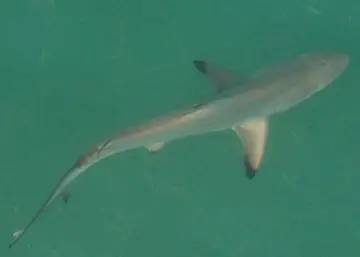
Blacktip shark
Photo: John G. Phillips · CC BY 4.0 · iNaturalist

Blacktip shark

Carcharhinus limbatus

Not stated

Venom
No official source we use states whether this animal is venomous. That does not mean it is harmless: do not handle it.
Size
Average about 5 feet and 50 pounds; maximum about 8 feet.
How to recognize it
  • Anal fin usually has no black tip
  • Long, pointed snout; small eyes
  • First dorsal fin begins over or slightly behind the rear of the pectoral fins

Full Blacktip shark guide

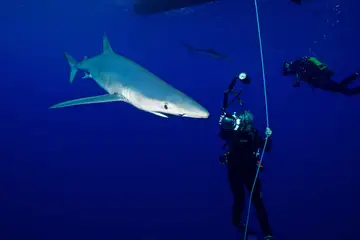
Blue shark
Photo: Juergen Gangoly · CC BY-SA 4.0 · Wikimedia Commons · resized

Blue shark

Prionace glauca

Not stated

Venom
No official source we use states whether this animal is venomous. That does not mean it is harmless: do not handle it.
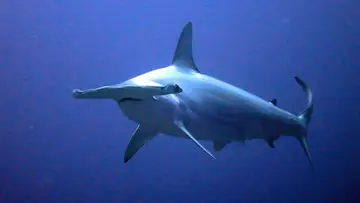
Bonnethead
Photo: Quinn · CC BY 4.0 · iNaturalist

Bonnethead

Sphyrna tiburo

Not stated

Venom
No official source we use states whether this animal is venomous. That does not mean it is harmless: do not handle it.
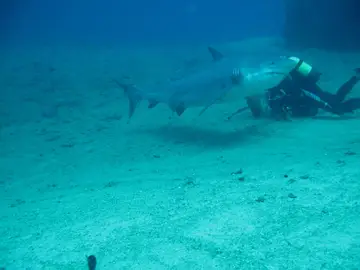
Bull shark
Photo: Judita bagon · CC BY-SA 3.0 · Wikimedia Commons · resized

Bull shark

Carcharhinus leucas

Not stated

Venom
No official source we use states whether this animal is venomous. That does not mean it is harmless: do not handle it.
Size
Reported maximum varies by source: about 11 ft (Alabama), over 10 ft with a 6 to 8 ft average (South Carolina), about 13 ft (Florida Museum).
How to recognize it
  • Very short, broadly rounded snout
  • Stout, heavy body
  • No ridge between the dorsal fins
Where in Maryland
Also found in the main stem and some rivers of the Chesapeake Bay Library of Maryland Regulations

Full Bull shark guide

No confirmed photo of Common thresher shark

Common thresher shark

Alopias vulpinus

Not stated

Venom
No official source we use states whether this animal is venomous. That does not mean it is harmless: do not handle it.
No confirmed photo of Dusky shark

Dusky shark

Not stated

Venom
No official source we use states whether this animal is venomous. That does not mean it is harmless: do not handle it.
No confirmed photo of Finetooth shark

Finetooth shark

Carcharhinus isodon

Not stated

Venom
No official source we use states whether this animal is venomous. That does not mean it is harmless: do not handle it.
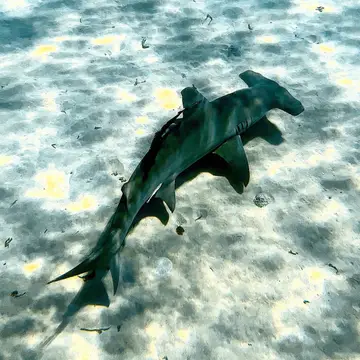
Great hammerhead shark
Photo: Robin White · CC BY 4.0 · iNaturalist

Great hammerhead shark

Sphyrna mokarran

Not stated

Venom
No official source we use states whether this animal is venomous. That does not mean it is harmless: do not handle it.
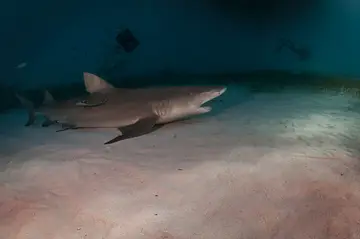
Lemon shark
Photo: GregAmptman · CC BY 4.0 · Wikimedia Commons

Lemon shark

Negaprion brevirostris

Not stated

Venom
No official source we use states whether this animal is venomous. That does not mean it is harmless: do not handle it.
Size
Maximum about 10.5 ft (Florida).
How to recognize it
  • Two large dorsal fins of similar size and shape
  • Blunt, rounded snout shorter than the mouth is wide
  • No ridge between the dorsal fins

Full Lemon shark guide

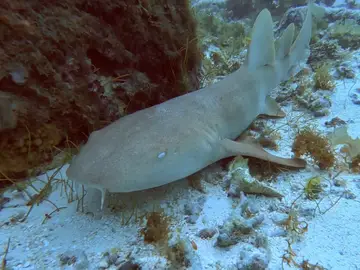
Nurse shark
Photo: Matteo Bellucci · CC BY 4.0 · iNaturalist

Nurse shark

Ginglymostoma cirratum

Not stated

Venom
No official source we use states whether this animal is venomous. That does not mean it is harmless: do not handle it.
Size
Usually 4 to 8 ft (SCDNR); adults average 7.5 to 8 ft and over 200 lb (Florida Museum); maximum about 9 ft (FWC).
How to recognize it
  • A distinct, long barbel ('feeler') on each nostril, which no other shark has
  • First dorsal fin starts above the pelvic fins; both dorsal fins rounded
  • Small mouth near the tip of a very short, rounded snout

Full Nurse shark guide

No confirmed photo of Oceanic white tip shark

Oceanic white tip shark

Not stated

Venom
No official source we use states whether this animal is venomous. That does not mean it is harmless: do not handle it.
No confirmed photo of Porbeagle shark

Porbeagle shark

Lamna nasus

Not stated

Venom
No official source we use states whether this animal is venomous. That does not mean it is harmless: do not handle it.
No confirmed photo of Portuguese Man O' War

Portuguese Man O' War

Not stated

Venom
No official source we use states whether this animal is venomous. That does not mean it is harmless: do not handle it.
No confirmed photo of Sand tiger shark

Sand tiger shark

Not stated

Venom
No official source we use states whether this animal is venomous. That does not mean it is harmless: do not handle it.
No confirmed photo of Sandbar shark

Sandbar shark

Not stated

Venom
No official source we use states whether this animal is venomous. That does not mean it is harmless: do not handle it.
Scalloped hammerhead shark
Photo: NOAA Photo Library · Public domain · Wikimedia Commons

Scalloped hammerhead shark

Sphyrna lewini

Not stated

Venom
No official source we use states whether this animal is venomous. That does not mean it is harmless: do not handle it.
No confirmed photo of Sea nettle

Sea nettle

Chrysaora chesapeakei

Not stated

Venom
No official source we use states whether this animal is venomous. That does not mean it is harmless: do not handle it.
What the sources say

Habitat: Most abundant in the tributaries of the middle Bay, where salinity levels range from 10 to 20 parts per thousand (ppt) (NOAA National Centers for Coastal Ocean Science)

No confirmed photo of Shortfin mako shark

Shortfin mako shark

Not stated

Venom
No official source we use states whether this animal is venomous. That does not mean it is harmless: do not handle it.
No confirmed photo of Smooth hammerhead shark

Smooth hammerhead shark

Sphyrna zygaena

Not stated

Venom
No official source we use states whether this animal is venomous. That does not mean it is harmless: do not handle it.
No confirmed photo of Smoothhound

Smoothhound

Mustelus canis

Not stated

Venom
No official source we use states whether this animal is venomous. That does not mean it is harmless: do not handle it.
No confirmed photo of Spinner shark

Spinner shark

Carcharhinus brevipinna

Not stated

Venom
No official source we use states whether this animal is venomous. That does not mean it is harmless: do not handle it.
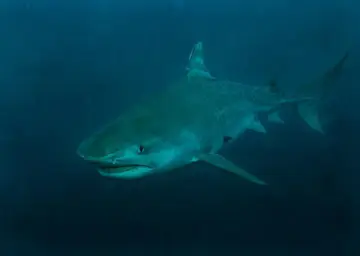
Tiger shark
Photo: Georgina Jones · CC BY-SA 4.0 · iNaturalist · resized

Tiger shark

Galeocerdo cuvier

Not stated

Venom
No official source we use states whether this animal is venomous. That does not mean it is harmless: do not handle it.
Size
Florida gives a maximum of about 18 ft and 2,000 lb.
How to recognize it
  • Blunt snout and vertical bars on the sides
  • Very broad head; short, broadly rounded snout much shorter than the mouth is wide
  • Large triangular teeth, strongly serrated, with a deep notch on the outer edge

Full Tiger shark guide

Sharks and Marine Life people confuse

Bull Shark or Lemon shark?

Bull Shark
Photo: Judita bagon · CC BY-SA 3.0 · Wikimedia Commons · resized

Bull Shark Not stated

Lemon shark
Photo: GregAmptman · CC BY 4.0 · Wikimedia Commons

Lemon shark Not stated

Lemon and sand tiger sharks have a large second dorsal fin; a bull shark's second dorsal fin is much smaller than the first.

Lemon Shark or Nurse shark?

Lemon Shark
Photo: GregAmptman · CC BY 4.0 · Wikimedia Commons

Lemon Shark Not stated

Nurse shark
Photo: Matteo Bellucci · CC BY 4.0 · iNaturalist

Nurse shark Not stated

Also has a large second dorsal fin, but its first dorsal fin sits over the pelvic fins and it has barbels at the nostrils.

Photos show typical adults; individuals vary. Never get close to compare.

When sharks, rays and other marine animals are active in Maryland

Records of sharks, rays and other marine animals in Maryland peak in July to August. They show when people record sharks, rays and other marine animals, not how many there are (about month bars).

267 records of sharks, rays and other marine animals in Maryland by month (GBIF, CC0 and CC BY records).

If you are bitten or stung

Call 911 or Poison Help at 1-800-222-1222 right away. Poison Help connects you to your local poison center, any time of day.

What official sources say

Are there sharks in Maryland?

Yes. DNR manages 41 species of coastal sharks; some, like the bull shark, also occur in the main stem and some rivers of the Chesapeake Bay. DNR

“Some sharks are found strictly in coastal waters, and others, like the bull shark, are also found in the main stem and some rivers of the Chesapeake Bay.”

About this list

The species list comes from Shark Facts; COMAR 08.02.22.02 Recreational Shark Fishery; Maryland Guide to Fishing and Crabbing: Sharks (Maryland Department of Natural Resources (DNR), undated page; Internet Archive capture 2026-10-05). 25 more entries come from other official sources named on each card.

Venom labels come only from official sources and link to them; "Not stated" never means harmless. How labels work.

Sources

  1. Maryland's Wildlife Species. Maryland Department of Natural Resources (DNR). archived copy, captured September 6, 2026; checked November 3, 2026. Archived copy.
  2. Shark Facts. Maryland Department of Natural Resources (DNR). archived copy, captured October 5, 2026; checked November 3, 2026. Archived copy.
    Quoted passages (2)
    “Maryland manages 41 species of coastal sharks, including spiny dogfish.”
    “Some sharks are found strictly in coastal waters, and others, like the bull shark, are also found in the main stem and some rivers of the Chesapeake Bay.”
  3. Fish Facts: Spiny Dogfish Shark. Maryland Department of Natural Resources (DNR). archived copy, captured June 12, 2026; checked November 3, 2026. Archived copy.
    Quoted passages (1)
    “Watch out for those two dorsal spines, they are mildly venomous.”
  4. COMAR 08.02.22.02 Recreational Shark Fishery. Library of Maryland Regulations. as fetched 2026-11-03; checked November 3, 2026.
  5. Maryland Guide to Fishing and Crabbing: Sharks. Maryland DNR guide, hosted by eRegulations. updated September 16, 2026; checked November 3, 2026.
  6. Sea Nettles Forecast. NOAA National Centers for Coastal Ocean Science. undated page; checked November 3, 2026.
  7. Maryland Critters that Bite and Sting (eAntidote). Maryland Poison Center. June 17, 2020; checked November 3, 2026.
  8. What you need to know about Bites and Stings. Maryland Poison Center (University of Maryland School of Pharmacy). Revised 07/2023; checked November 3, 2026.
    Quoted passages (1)
    “Stings from jellyfish found off the shores of Maryland typically produce mild symptoms.”
  9. GBIF.org occurrence records, human observations licensed CC0 1.0 or CC BY 4.0 only, accessed November 3, 2026. The datasets behind these counts are listed on our Sources page.