Bull Shark
Carcharhinus leucas · also called Zambezi shark and Nicaragua shark · Last checked November 3, 2026.
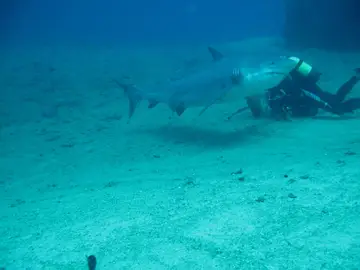

The bull shark is a large, stout gray shark of coastal waters that also enters rivers and fresh water. Official sources describe it as dangerous to people: Florida's wildlife agency calls it one of the more dangerous shark species. In the US, official sources place it along the Atlantic and Gulf coasts, and it has been reported far up rivers. FWC
On this page
Is the bull shark dangerous?
One of the more dangerous shark species, accounting for the third highest number of attacks on humans. FWC
“One of the more dangerous shark species, accounting for the third highest number of attacks on humans.”
Bites and stings: Yes. The International Shark Attack File lists 93 non-fatal and 26 fatal confirmed unprovoked attacks worldwide (119 total), and warns that the table must be used with caution.
No official source we use states whether this animal is venomous. That does not mean it is harmless: do not handle it.
If someone is bitten or stung, call 911 or Poison Help at 1-800-222-1222.
How to identify a bull shark
A photo or description can narrow it down, but cannot confirm what an animal is or that it is safe. Look from a distance and do not handle wild animals.
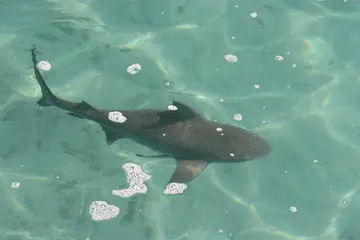
Size: Reported maximum varies by source: about 11 ft (Alabama), over 10 ft with a 6 to 8 ft average (South Carolina), about 13 ft (Florida Museum). Outdoor Alabama
Colors: Gray above, white or pale below. Pattern: Fin tips dusky but not strikingly marked.
Key features
- Very short, broadly rounded snout SCDNR Marine Resources Division
- Stout, heavy body Outdoor Alabama
- No ridge between the dorsal fins Florida Museum of Natural History
- Small eyes Florida Museum of Natural History
Young
Younger sharks have dark fin tips that fade to dusky as they grow. Florida Museum gives size at birth as 56-81 cm (about 2-3 ft).
Animals mistaken for the bull shark
Bull Shark or Sandbar shark?
Bull Shark
Sandbar shark Carcharhinus plumbeus
Sandbar sharks (and oceanic whitetip, bignose, silky, dusky and night sharks) have a ridge between the dorsal fins; bull sharks do not. SCDNR Marine Resources Division
Bull Shark or Lemon shark?
Bull Shark
Lemon shark Negaprion brevirostris
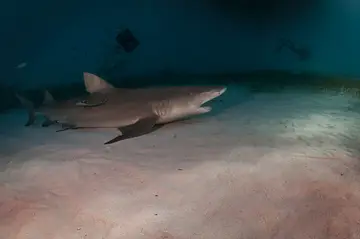

Lemon and sand tiger sharks have a large second dorsal fin; a bull shark's second dorsal fin is much smaller than the first. SCDNR Marine Resources Division
Where the bull shark lives
- Native or listed
- Nonnative or not established
- No official record in our data
- 1–9
- 10–99
- 100–999
- 1,000+
On our state guides
- Delaware sharks and marine life
- Florida sharks and marine life
- Georgia sharks and marine life
- Maryland sharks and marine life
- Mississippi sharks and marine life
- New Jersey sharks and marine life
- South Carolina sharks and marine life
State boundaries: U.S. Census Bureau, cartographic boundary file cb_2024_us_state_20m.
When it is active
In the western Atlantic, moves north along the US coast in summer and returns south as coastal water cools. Florida Museum of Natural History
US open-licence records peak in May and September to October.
Habitat and habits
Habitat: Coastal, estuary and offshore waters; commonly enters estuaries and may inhabit fresh water, sometimes hundreds of miles inland through coastal rivers. FWC
Behavior: Appears sluggish when cruising near the bottom but capable of quick bursts.
Diet: Opportunistic: bony fishes, sharks, rays, invertebrates, dolphins, sea turtles and sea birds.
Young: Live birth, 1 to 13 pups per litter; shallow bays and coastal lagoons serve as nurseries.
Legal status and reporting
Federal: Listed among large coastal sharks in the federal Atlantic highly migratory species rules (50 CFR 635 Appendix A). eCFR / NOAA Fisheries
Protection: Not stated as protected in sources checked. Florida: harvestable, Group 2, 54 inch fork length minimum. FWC
Questions about the bull shark
Bull shark freshwater
Yes, bull sharks can enter fresh water. Florida's wildlife agency says they are one of the few sharks that may inhabit fresh water, sometimes hundreds of miles inland. Alabama says they cannot maintain an entire life cycle there; Florida Museum says they can breed in fresh water but do so less regularly than in estuaries and the sea.
Bull shark size
Alabama gives a maximum of about 11 ft for females and about 10 ft for males. South Carolina says they average 6 to 8 ft. Florida Museum reports a maximum of about 13 ft.
Bull shark teeth
South Carolina describes broadly triangular, coarsely serrated upper teeth and more erect, finely serrated lower teeth.
Are there bull sharks in alabama?
Yes. Alabama's conservation department includes it in its shark ID guide.
Are there bull sharks in alabama rivers?
Alabama's conservation department says bull sharks travel far up warm rivers, naming the Mississippi and the Alabama.
Are there bull sharks in illinois?
Florida Museum reports them over 1,800 miles up the Mississippi River in Illinois. That is a range record, not a statement that they live there; no Illinois agency statement was checked.
Are there bull sharks in south carolina?
Yes. SCDNR says the species occurs abundantly in South Carolina coastal waters and offshore, and is known to swim up rivers.
Are there bull sharks in georgia?
NOAA says bull sharks are among the top three tagged sharks swimming through Gray's Reef National Marine Sanctuary off Georgia.
Are there bull sharks in texas?
Yes. A 2018 Texas Parks and Wildlife bulletin lists bull sharks among the 5 most common sharks in Texas Gulf waters.
Sources
- Bull Shark (FWRI shark species). Florida Fish and Wildlife Conservation Commission (FWC). archived copy, captured October 21, 2026; checked November 3, 2026.
Quoted passages (4)
“One of the more dangerous shark species, accounting for the third highest number of attacks on humans.”
“Common apex predator that inhabits estuarine, nearshore and offshore waters of both the Gulf and Atlantic coasts of Florida. Commonly enters estuarine waters and is one of the few shark species that may inhabit freshwater, sometimes venturing hundreds of miles inland via coastal river systems.”
“Versatile and opportunistic feeder. Stomach contents have included a variety of bony fishes and invertebrate species, sharks, rays, dolphins, sea turtles, and sea birds.”
“Gives birth to live young. Litters contain 1-13 pups. Size at birth about 2.4 feet. Utilizes shallow bays and coastal lagoons as nursery areas.”
- Bull Shark - Discover Fishes. Florida Museum of Natural History. updated February 3, 2025; checked November 3, 2026.
Quoted passages (5)
“They lack an interdorsal ridge.”
“Bull sharks have small eyes relative to most other carcharhinid sharks”
“In younger individuals the fins have dark tips which fade to a more diffuse dusky color as they grow. … Size at birth is 56-81 cm (~2-3 ft)”
“Bull sharks appear sluggish as they cruise slowly along the bottom, but are capable of quick bursts”
“In the western Atlantic, bull sharks migrate north along the coast of the U.S. during summer, swimming as far north as Massachusetts, and then return to tropical climates when the coastal waters cool”
- Bull Shark. Alabama Department of Conservation and Natural Resources (Outdoor Alabama). undated page; checked November 3, 2026.
Quoted passages (2)
“Maximum about 11 ft. (females); males reach about 10 ft.”
“Stocky to very heavy-bodied species.”
- Sharks of South Carolina. SCDNR Marine Resources Division (C. H. Farmer III). 2004; checked November 3, 2026.
Quoted passages (3)
“…a very short, broadly rounded snout that is much shorter than width of mouth”
“4) the absence of an interdorsal ridge … SIMILAR SPECIES: The oceanic whitetip shark (p. 82), the sandbar shark (p. 84), the bignose shark (p. 86), the silky shark (p. 88), the dusky shark (p. 90), and the night shark (p. 92) have an interdorsal ridge.”
“5) a second dorsal fin much smaller than first. … The sand tiger shark (p. 64) and the lemon shark (p. 98) have a large second dorsal fin.”
- 50 CFR Part 635 Appendix A — Species Tables (Oceanic Sharks). eCFR / NOAA Fisheries. current eCFR text retrieved 2026-11-03; checked November 3, 2026.
Quoted passages (1)
“Bull, Carcharhinus leucas”
- Sharks (saltwater recreational regulations). Florida Fish and Wildlife Conservation Commission (FWC). archived copy, captured October 14, 2026; checked November 3, 2026.
Quoted passages (1)
“Group 2 sharks (7 species) have a 54 inch (fork length) minimum size limit”
- Fishes and Sharks. NOAA Gray's Reef National Marine Sanctuary. undated page; checked November 3, 2026.
- TPWD email bulletin: Sharks? We've got a few in Texas. Texas Parks and Wildlife Department (GovDelivery bulletin). July 26, 2018; checked November 3, 2026.
- GBIF.org occurrence records, human observations licensed CC0 1.0 or CC BY 4.0 only, accessed November 3, 2026. The datasets behind these counts are listed on our Sources page.
- State boundaries: U.S. Census Bureau, cartographic boundary file cb_2024_us_state_20m.