Nurse Shark
Ginglymostoma cirratum · also called tiburon gato (Caribbean) · Last checked November 3, 2026.
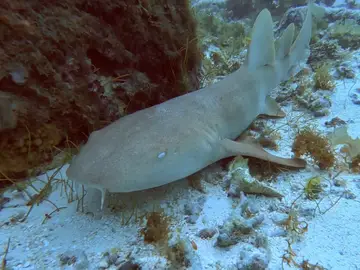
The nurse shark is a slow, yellowish-tan to brown shark that lives on the bottom. It has two whisker-like barbels at its nostrils and often lies still on the sea floor by day. Florida's wildlife agency says it has been involved in only a few attacks on people, most of them provoked. Florida Museum warns that a disturbed nurse shark can bite with a vise-like grip that can cause serious injury. In the US it is common in the shallow waters of south Florida and the Florida Keys, and official sources also record it off South Carolina and Georgia. FWC
On this page
Is the nurse shark dangerous?
FWC: this sluggish bottom-dwelling shark has been involved in only a few attacks on humans, most of which were provoked. FWC
“This sluggish bottom-dwelling shark has been involved in only a few attacks on humans, most of which were provoked.”
Bites and stings: Yes, rarely, and mostly when provoked. Florida Museum says a disturbed nurse shark may bite with a powerful, vise-like grip that can cause serious injury. The International Shark Attack File lists 9 confirmed unprovoked attacks worldwide, none fatal.
No official source we use states whether this animal is venomous. That does not mean it is harmless: do not handle it.
If someone is bitten or stung, call 911 or Poison Help at 1-800-222-1222.
How to identify a nurse shark
A photo or description can narrow it down, but cannot confirm what an animal is or that it is safe. Look from a distance and do not handle wild animals.
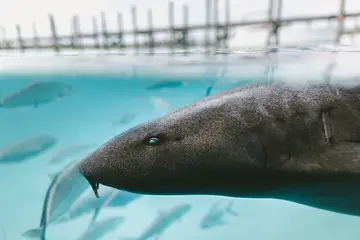

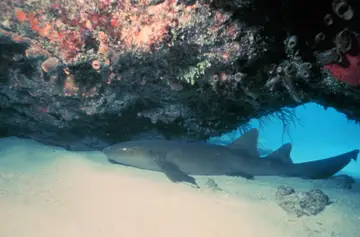

Size: Usually 4 to 8 ft (SCDNR); adults average 7.5 to 8 ft and over 200 lb (Florida Museum); maximum about 9 ft (FWC). FWC
Colors: Yellowish to dark brown above; light tan to dark brown. Pattern: Adults plain; young may have small dark spots and crossbars.
Key features
- A distinct, long barbel ('feeler') on each nostril, which no other shark has SCDNR Marine Resources Division
- First dorsal fin starts above the pelvic fins; both dorsal fins rounded SCDNR Marine Resources Division
- Small mouth near the tip of a very short, rounded snout SCDNR Marine Resources Division
- Often seen lying motionless on the bottom FWC
Young
Young up to about 22 in have small black spots across the body; about 1 ft at birth.
Where the nurse shark lives
- Native or listed
- Nonnative or not established
- No official record in our data
- 1–9
- 10–99
- 100–999
- 1,000+
On our state guides
- Delaware sharks and marine life
- Florida sharks and marine life
- Georgia sharks and marine life
- Maryland sharks and marine life
- Mississippi sharks and marine life
- South Carolina sharks and marine life
State boundaries: U.S. Census Bureau, cartographic boundary file cb_2024_us_state_20m.
When it is active
Nocturnal: hunts along the bottom at night and rests by day. Florida Museum of Natural History
US open-licence records peak in June to August.
Habitat and habits
Habitat: Abundant in nearshore waters of Florida's Gulf and Atlantic coasts; prefers coral reefs, rocks and mangrove islands. FWC
Behavior: Rests on the bottom or in caves and crevices by day, sometimes in groups of up to 40 lying close together.
Diet: Mainly bottom invertebrates such as spiny lobsters, shrimps, crabs, sea urchins, squid, octopus and mollusks, plus some fish, especially grunts.
Young: Live young: litters of 20 to 50 pups, about 1 ft at birth. Mating groups are reported in the Florida Keys and Dry Tortugas, often in very shallow water.
Legal status and reporting
Federal: Listed among large coastal sharks in the federal Atlantic highly migratory species rules (50 CFR 635 Appendix A). eCFR / NOAA Fisheries
Protection: Not stated as protected in the sources checked. Florida: harvestable, Group 2, 54 inch fork length minimum. FWC
Sources
- Nurse Shark (FWRI shark species). Florida Fish and Wildlife Conservation Commission (FWC). archived copy, captured January 22, 2026; checked November 3, 2026. Archived copy.
Quoted passages (6)
“This sluggish bottom-dwelling shark has been involved in only a few attacks on humans, most of which were provoked.”
“Maximum size about 9 feet.”
“Often seen lying motionless on the bottom.”
“An abundant, coastal, tropical and subtropical shark that inhabits nearshore waters of both the Gulf and Atlantic coasts of Flordia. Often seen lying motionless on the bottom. Preferred habitats are coral reefs, rocks, and mangrove islands.”
“Feeds mainly on bottom invertebrates such as spiny lobsters, shrimps, crabs, sea urchins, squid, octopi, and marine molluscs; also feeds on some fish species, especially grunts.”
“Gives birth to live young. Litters contain 20-50 pups. Size at birth about 1 foot. Mating aggregations reported in Florida Keys and Dry Tortugas, often in very shallow water.”
- Nurse Shark (Discover Fishes species profile). Florida Museum of Natural History (University of Florida). revised 2018; checked November 3, 2026.
Quoted passages (3)
“Juveniles up to 55 cm (22 in) have small black spots, with an area of lighter pigmentation surrounding each spot, covering the entire body.”
“They occasionally occur in groups of up to 40 individuals, where they can be seen lying close together, sometimes piled upon one another (Compagno et al. 1984).”
“The nurse shark is a nocturnal animal that rests on sandy bottoms or in shallow-water caves and rock crevices during the day. … Nurse sharks are active during the night, often swimming near the bottom or clambering across the sea floor”
- Sharks of South Carolina. SCDNR Marine Resources Division (C. H. Farmer III). 2004; checked November 3, 2026.
Quoted passages (3)
“The presence of a long and tapering barbel on each nostril separates it from all other sharks.”
“Recognized by 1) the presence of distinct nasal barbels, 2) a first dorsal fin that originates above pelvic fins, and 3) a fan-like caudal fin, not separated into two distinct lobes. … First dorsal fin large, rounded, originates over pelvic fins; second dorsal fin slightly smaller than first, similar in shape”
“…snout very short, broadly rounded; mouth noticeably small, positioned near tip of snout”
- Fishes and Sharks. NOAA Gray's Reef National Marine Sanctuary. undated page; checked November 3, 2026.
- 50 CFR Part 635 Appendix A — Species Tables (Oceanic Sharks). eCFR / NOAA Fisheries. current eCFR text retrieved 2026-11-03; checked November 3, 2026.
Quoted passages (1)
“Nurse, Ginglymostoma cirratum”
- Sharks (saltwater recreational regulations). Florida Fish and Wildlife Conservation Commission (FWC). archived copy, captured October 14, 2026; checked November 3, 2026.
Quoted passages (1)
“Group 2 sharks (7 species) have a 54 inch (fork length) minimum size limit and include: Bull Nurse Spinner Blue Porbeagle Thresher (common)”
- GBIF.org occurrence records, human observations licensed CC0 1.0 or CC BY 4.0 only, accessed November 3, 2026. The datasets behind these counts are listed on our Sources page.
- State boundaries: U.S. Census Bureau, cartographic boundary file cb_2024_us_state_20m.