Tiger Shark
Galeocerdo cuvier · also called niuhi (Hawaiian, per Hawaii DLNR) · Last checked November 3, 2026.
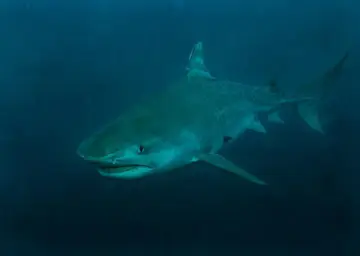
The tiger shark is one of the largest sharks, named for the dark spots and vertical bars on its sides, which fade as it grows. Official sources describe it as dangerous: Florida's wildlife agency says it is second only to the white shark in attacks on humans worldwide, and Hawaii's agency calls it the most dangerous shark in Hawaiian waters. In the US, official sources confirm it in Hawaii, the Gulf (Florida, Alabama) and along the Atlantic coast from Florida to Virginia, with a New Jersey state-record catch off Cape May. FWC
On this page
Is the tiger shark dangerous?
Second only to the white shark in the number of attacks on humans worldwide. FWC
“Tiger sharks are second only to the Great White shark in the number of attacks on humans worldwide.”
Bites and stings: Yes. The International Shark Attack File lists 103 non-fatal and 39 fatal confirmed unprovoked attacks worldwide (142 total), and warns that the table must be used with caution.
No official source we use states whether this animal is venomous. That does not mean it is harmless: do not handle it.
If someone is bitten or stung, call 911 or Poison Help at 1-800-222-1222.
How to identify a tiger shark
A photo or description can narrow it down, but cannot confirm what an animal is or that it is safe. Look from a distance and do not handle wild animals.
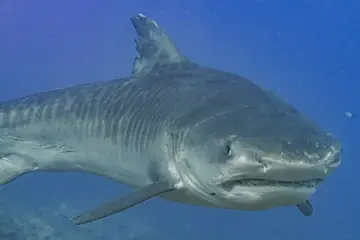
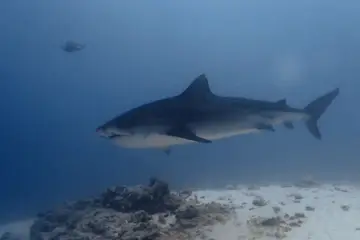
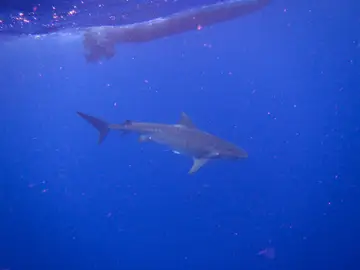
Size: Florida gives a maximum of about 18 ft and 2,000 lb. FWC
Colors: Bluish-gray to grayish-brown above, paler on the sides, dirty yellow to off-white below. Pattern: Dark spots on the back forming bars or stripes along the sides and fins; spots and stripes are boldest in young sharks and fade with age.
Key features
- Blunt snout and vertical bars on the sides Hawaii DLNR Division of Aquatic Resources
- Very broad head; short, broadly rounded snout much shorter than the mouth is wide SCDNR Marine Resources Division
- Large triangular teeth, strongly serrated, with a deep notch on the outer edge SCDNR Marine Resources Division
- A ridge along the back between the two dorsal fins Florida Museum of Natural History
Young
Young sharks are strongly spotted; spots turn to stripes that fade with age.
Animals mistaken for the tiger shark
Tiger Shark or Sand tiger shark?
Tiger Shark
Sand tiger shark Carcharias taurus
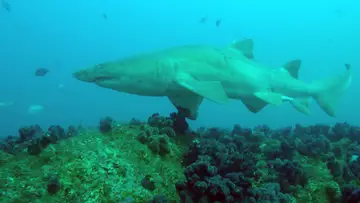
Despite the name, a different shark: the sand tiger has two large dorsal fins of equal size, long pointed teeth with small side points and a pointed snout. The tiger shark has a short, very broadly rounded snout and a small second dorsal fin. SCDNR Marine Resources Division
International Shark Attack File: 36 non-fatal, 0 fatal confirmed unprovoked attacks worldwide (row "Sand Tiger").
Where the tiger shark lives
- Native or listed
- Nonnative or not established
- No official record in our data
- 1–9
- 10–99
- 100–999
- 1,000+
On our state guides
- Delaware sharks and marine life
- Florida sharks and marine life
- Georgia sharks and marine life
- Hawaii sharks and marine life
- Maryland sharks and marine life
- Massachusetts sharks and marine life
- Mississippi sharks and marine life
- New Jersey sharks and marine life
- South Carolina sharks and marine life
- Virginia sharks and marine life
State boundaries: U.S. Census Bureau, cartographic boundary file cb_2024_us_state_20m.
When it is active
Seasonal migrant: moves from the tropics into temperate waters in warmer months and back to the tropics in winter. Florida Museum of Natural History
US open-licence records peak in August to September.
Habitat and habits
Habitat: Common throughout Florida and worldwide in tropical and warm-temperate seas; river mouths, shallow bays and open ocean. FWC
Behavior: Mostly solitary; moves inshore into shallow water at night and back to deeper water by day.
Diet: Eats almost anything: sea turtles, bony fish, seabirds, other sharks, porpoises, skates, rays, conchs, crabs and even garbage.
Young: Live birth; litters of 10 to 80 pups, 27 to 34 inches at birth.
Legal status and reporting
Federal: Listed among large coastal sharks in the federal Atlantic highly migratory species rules (50 CFR 635 Appendix A). eCFR / NOAA Fisheries
Protection: Florida: prohibited from harvest in state waters. Prohibited sharks must stay in the water with gills submerged and be released without delay when fishing from shore. FWC
Questions about the tiger shark
Tiger shark
A very large shark with dark spots and vertical bars that fade with age. Florida's wildlife agency says it ranks second only to the white shark in attacks on humans worldwide. It eats almost anything, from sea turtles to garbage.
Are there tiger sharks in south carolina?
Yes. SCDNR calls it a summer visitor along the South Carolina coast that sometimes enters sounds and inlets.
Are there tiger sharks in virginia?
Yes. Virginia's wildlife agency lists the tiger shark as native. VIMS says tiger sharks only occasionally visit Virginia waters, usually 10 to 20 miles offshore.
Are there tiger sharks in virginia beach?
VIMS reports that the largest shark its Virginia survey ever tagged was a 13-foot female tiger shark caught offshore of Virginia Beach in 2023. VIMS also says tiger sharks are seen less often in the mid-Atlantic today.
Are there tiger sharks in new jersey?
They have been caught there. New Jersey's state record tiger shark weighed 880 pounds and was caught off Cape May in 1988. New Jersey lists the tiger shark among sharks that may be kept, with a closed season from May 15 to July 15 in state waters.
Are there tiger sharks in north carolina?
Not confirmed by a North Carolina agency source checked. Official sources confirm tiger sharks to the south (South Carolina, Georgia) and north (Virginia).
Are there tiger sharks in california?
No official source checked places tiger sharks in California waters. Of the US Pacific, official sources confirm them in Hawaii.
Tiger sharks in massachusetts
Alabama's shark guide gives the western Atlantic range as Massachusetts to Uruguay.
Tiger sharks in connecticut
No official source checked places tiger sharks in Connecticut waters.
Are there tiger sharks in oklahoma?
No official source checked places tiger sharks in Oklahoma. Official sources describe a saltwater shark of coastal waters and the open ocean.
Are there tiger sharks in hawaii?
Yes. Hawaii's Division of Aquatic Resources lists the tiger shark (niuhi) and calls tigers the most dangerous sharks in Hawaiian waters.
Sources
- Tiger Shark (FWRI shark species). Florida Fish and Wildlife Conservation Commission (FWC). archived copy, captured June 9, 2026; checked November 3, 2026.
Quoted passages (5)
“Tiger sharks are second only to the Great White shark in the number of attacks on humans worldwide.”
“Maximum size about 18 feet in length and a weight of 2000 pounds.”
“Common throughout Florida and occurs worldwide in tropical and warm-temperate waters. Found in a variety of habitats including river mouths, shallow bays, and open ocean.”
“Voracious feeders that will eat just about anything. Stomach contents have been reported to include sea turtles, many species of bony fish, marine birds, other sharks, porpoises, skates, rays, conchs, crabs, and garbage”
“Gives birth to live young. Litters contain 10-80 pups. Size at birth 27-34 inches.”
- Shark Fact Sheet. Hawaii DLNR Division of Aquatic Resources. undated page; checked November 3, 2026.
Quoted passages (1)
“A tiger shark is easily recognized by its blunt snout and the vertical bars on its sides.”
- Tiger Shark - Discover Fishes. Florida Museum of Natural History. updated February 3, 2025; checked November 3, 2026.
Quoted passages (2)
“A ridge is present along the back between the two dorsal fins.”
“They move into temperate waters from the tropics in warmer months and return to the tropics during the winter.”
- List of Native and Naturalized Fauna of Virginia. Virginia Department of Wildlife Resources (DWR). May, 2026; checked November 3, 2026.
- State Record Marine Sport Fish (2026 Marine Digest). New Jersey Division of Fish & Wildlife (official digest hosted by eRegulations). updated October 5, 2026; checked November 3, 2026.
- Sharks of South Carolina. SCDNR Marine Resources Division (C. H. Farmer III). 2004; checked November 3, 2026.
Quoted passages (3)
“…a short and broadly rounded snout that is much shorter than width of mouth”
“Both jaws have large, broad-based, triangular teeth with strongly serrated edges and very deeply notched outer margins.”
“If it has large dorsal fins of equal size, long pointed teeth with small lateral points, and a pointed snout – it is a sand tiger shark. … snout short, much shorter than width of mouth, very broadly rounded and thick-tipped … second dorsal fin small”
- Shark Identification Guide. Hawaii DLNR Division of Aquatic Resources. undated page; checked November 3, 2026.
Quoted passages (1)
“…strong spotting pattern in young sharks, turning to stripes which fade with age”
- Tiger Shark. Alabama Department of Conservation and Natural Resources (Outdoor Alabama). undated page; checked November 3, 2026.
Quoted passages (1)
“Tiger sharks are nocturnal and show daily cycles of movement inshore at night into shallow waters, and retreat back to deeper water during daytime. Tiger sharks are mainly solitary.”
- 50 CFR Part 635 Appendix A — Species Tables (Oceanic Sharks). eCFR / NOAA Fisheries. current eCFR text retrieved 2026-11-03; checked November 3, 2026.
Quoted passages (1)
“Tiger, Galeocerdo cuvier”
- Sharks (saltwater recreational regulations). Florida Fish and Wildlife Conservation Commission (FWC). archived copy, captured October 14, 2026; checked November 3, 2026.
Quoted passages (1)
“Tiger shark (Galeocerdo cuvier)”
- Sharks of Virginia. Virginia Institute of Marine Science (William & Mary). undated page; checked November 3, 2026.
- Meet the sharks of Virginia: Surveying the apex predators of the sea. Virginia Institute of Marine Science (William & Mary). July 28, 2026; checked November 3, 2026.
- New Jersey Shark Regulations (2026 Marine Digest). New Jersey Division of Fish & Wildlife (official digest hosted by eRegulations). updated May 11, 2026; checked November 3, 2026.
- Fishes and Sharks. NOAA Gray's Reef National Marine Sanctuary. undated page; checked November 3, 2026.
- Hawaii Sharks: Species List. Hawaii DLNR Division of Aquatic Resources. undated page; checked November 3, 2026.
- GBIF.org occurrence records, human observations licensed CC0 1.0 or CC BY 4.0 only, accessed November 3, 2026. The datasets behind these counts are listed on our Sources page.
- State boundaries: U.S. Census Bureau, cartographic boundary file cb_2024_us_state_20m.