Sand Tiger Shark
Carcharias taurus · also called sand tiger, sandtiger, grey nurse shark (Australia) and spotted raggedtooth shark (South Africa) · Last checked November 3, 2026.
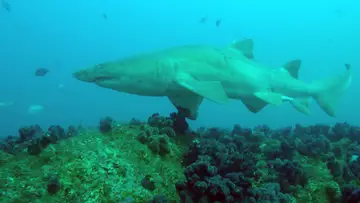
The sand tiger shark is a large, light brown coastal shark, often spotted, with long ragged-looking teeth and two nearly equal dorsal fins. Official sources differ on danger: Alabama says it is docile and not considered dangerous, while South Carolina calls it potentially dangerous to swimmers and divers; the International Shark Attack File lists 36 unprovoked bites worldwide and no deaths. In the US it lives in the Atlantic from the Gulf of Maine to Florida and in the northern Gulf. Federal rules prohibit keeping one, so any caught must be released. Outdoor Alabama
On this page
Is the sand tiger shark dangerous?
Official sources disagree. Alabama: docile and not considered dangerous. South Carolina: potentially dangerous to swimmers and divers. Florida Museum: not aggressive unless provoked, but its size and teeth demand respect. SCDNR Marine Resources Division
“Considered potentially dangerous to swimmers and divers and has been implicated in attacks in other regions of the world.”
Bites and stings: The Florida Museum says it is not aggressive unless provoked and that a handful of bites have happened to spearfishers carrying speared fish. The International Shark Attack File counts 36 unprovoked non-fatal bites and 0 fatal (page updated 2022); an older Florida Museum profile gives 29 (ISAF 2018).
No official source we use states whether this animal is venomous. That does not mean it is harmless: do not handle it.
If someone is bitten or stung, call 911 or Poison Help at 1-800-222-1222.
How to identify a sand tiger shark
A photo or description can narrow it down, but cannot confirm what an animal is or that it is safe. Look from a distance and do not handle wild animals.
Size: Usually about 4 to 9 ft, up to about 10.5 ft. Averages vary: 4 to 7 ft (South Carolina), 4 to 9 ft (Florida Museum), around 8.5 ft (Alabama). Florida Museum of Natural History
Colors: Light brown, light greenish-gray or light grayish-brown above; grayish white or white below. Pattern: Often has darker reddish or brown spots (Alabama, Florida Museum) or yellowish-brown spots (South Carolina), more prominent in juveniles.
Key features
- Two dorsal fins and the anal fin are nearly equal in size Florida Museum of Natural History
- First dorsal fin set far back, closer to the pelvic fins than the pectorals Florida Museum of Natural History
- Long, narrow, pointed teeth with small side points SCDNR Marine Resources Division
- Flattened conical snout Outdoor Alabama
Young
Spots are more prominent in juveniles. Pups measure about 3 ft at birth.
Animals mistaken for the sand tiger shark
Sand Tiger Shark or Lemon shark?
Sand Tiger Shark
Lemon shark Negaprion brevirostris
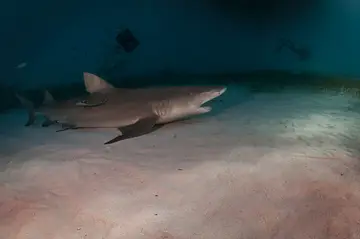

Lemon shark has a broadly rounded snout, narrow teeth without side points and yellowish color. SCDNR Marine Resources Division
See the lemon shark record.
Sand Tiger Shark or Nurse shark?
Sand Tiger Shark
Nurse shark Ginglymostoma cirratum
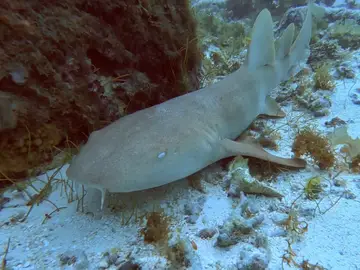
Texas says the sand tiger is similar to the nurse shark but has a distinct lower lobe on the tail fin. Texas Parks and Wildlife Department
See the nurse shark record.
Sand Tiger Shark or Bigeye sand tiger?
Sand Tiger Shark
Bigeye sand tiger Odontaspis noronhai
Texas lists it as similar and rare in Texas waters; it gives no separating feature between the two. Texas Parks and Wildlife Department
Where the sand tiger shark lives
- Native or listed
- Nonnative or not established
- No official record in our data
- 1–9
- 10–99
- 100–999
- 1,000+
State boundaries: U.S. Census Bureau, cartographic boundary file cb_2024_us_state_20m.
When it is active
Migratory: moves poleward in summer and toward the equator in fall and winter. South Carolina says it feeds primarily at night. Virginia reports it inshore in summer. Florida Museum of Natural History
US open-licence records peak in March and September to October.
Habitat and habits
Habitat: Coastal waters from the surf zone and shallow bays to reefs and the outer shelf, from about 6 to 626 ft deep; often near the bottom. Florida Museum of Natural History
Behavior: Slow-moving. Gulps air at the surface and holds it in the stomach so it can hover in the water.
Diet: Bony fishes, rays, squid, crab, lobster and smaller sharks. Schools have been seen feeding cooperatively.
Young: Live-bearing. The largest embryo in each uterus eats the others, so litters are usually two pups, every other year.
Legal status and reporting
Federal: Prohibited species in federal Atlantic shark rules since 1997: it cannot be retained, possessed, sold or purchased, and must be released with minimal injury. NOAA Species of Concern (2004). NOAA Fisheries
Protection: Protected: retention prohibited in federal Atlantic waters and in the state rules checked (AL, FL, GA, LA, NC, NJ, NY, SC, TX). NY DEC says the Atlantic States Marine Fisheries Commission required prohibition in state waters from Maine to Florida. Alabama also calls it Threatened; the IUCN rating is Critically Endangered as of 2021 per NY DEC (the Florida Museum page still shows the older Vulnerable). New York State Department of Environmental Conservation
Questions about the sand tiger shark
Sand tiger shark
A large, light brown Atlantic coastal shark with long ragged teeth and two nearly equal dorsal fins. Official sources disagree on danger: Alabama says not considered dangerous, South Carolina says potentially dangerous to swimmers and divers. The International Shark Attack File lists 36 unprovoked bites and no deaths. It is protected, so any caught must be released.
Sources
- Sand Tiger. Alabama Department of Conservation and Natural Resources (Outdoor Alabama). undated page; checked November 3, 2026.
Quoted passages (2)
“Large shark with a flattened-conical snout.”
“Size at birth about 3.2 ft.”
- Sharks of South Carolina. SCDNR Marine Resources Division. 2004; checked November 3, 2026.
Quoted passages (3)
“Considered potentially dangerous to swimmers and divers and has been implicated in attacks in other regions of the world.”
“…long, narrow, sharp-pointed, smooth-edged teeth with one or less often two small lateral points or denticles on each side of base”
“The lemon shark (p. 98) has a broadly rounded snout, narrow teeth without lateral points, and is yellowish in color.”
- Species Implicated in Attacks - International Shark Attack File. Florida Museum of Natural History. updated January 25, 2022; checked November 3, 2026.
- Sand Tiger Shark - Discover Fishes. Florida Museum of Natural History (University of Florida). Revised 2018; checked November 3, 2026.
Quoted passages (8)
“Average size ranges from four to nine feet with maximum length believed to be around 10.5 feet (320 cm) in females and 9.9 feet (301 cm) in males.”
“First and second dorsal and anal fins nearly equal in size”
“First dorsal fin is placed back on body, closer to pelvic fins than to pectoral fins”
“Sand tigers are commonly found inshore ranging in depths from 6 to 626 feet (1.8 to 191 m).”
“They also consume rays, squid, crab, lobster and other smaller sharks.”
“The shark comes to the surface and gulps air, which it holds in its stomach.”
“It is migratory within its region, moving poleward during the summer while making equatorial movements during the fall and winter months”
“They produce two pups, one from each uterus, every other year”
- Recreational Atlantic Shark Fishery Statuses, Minimum Sizes, and Bag Limits. NOAA Fisheries. updated August 4, 2025; checked November 3, 2026.
- A timeline of Atlantic Shark Fisheries Management Highlights. NOAA Fisheries. undated page; checked November 3, 2026.
Quoted passages (1)
“NOAA Fisheries establishes the prohibited shark species group (sharks that cannot be retained, possessed, sold, or purchased). We add white, whale, basking, sand tiger, and bigeye sand tiger sharks.”
- Species Status Assessment: Sand tiger shark (SWAP 2025). New York State Department of Environmental Conservation. updated January 12, 2024; checked November 3, 2026.
Quoted passages (1)
“…mandated the prohibition of sand tigers in all state waters from Maine to Florida”
- Prohibited shark species. Texas Parks and Wildlife Department. Outdoor Annual 2026-27; checked November 3, 2026.
Quoted passages (2)
“…similar to nurse shark but has a distinct lower lobe of caudal fin”
“Similar to bigeye sand tiger;”
- GBIF.org occurrence records, human observations licensed CC0 1.0 or CC BY 4.0 only, accessed November 3, 2026. The datasets behind these counts are listed on our Sources page.
- State boundaries: U.S. Census Bureau, cartographic boundary file cb_2024_us_state_20m.