This page lists 7 lizards: all from Washington Natural Heritage Program, Washington Department of Fish and Wildlife, BLM and U.S. Forest Service's Checklist of Washington Amphibians and Reptiles.
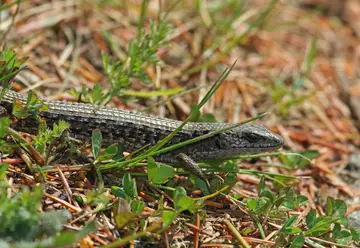
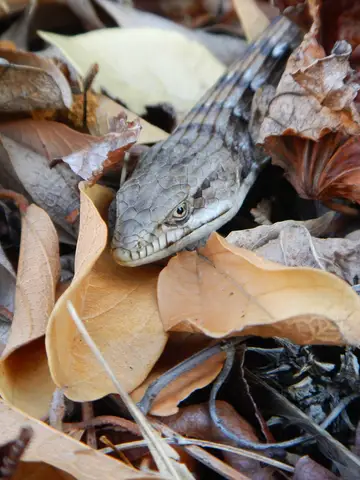
Range: Northern alligator lizards occur in the Pacific Coast, Puget Trough, North Cascades, East Cascades, West Cascades, Okanogan and Rocky Mountain ecoregions. The species enters the Columbia Plateau ecoregion in Spokane and Whitman counties.
Habitat: The northern alligator lizard inhabits grassy, brushy or rocky openings within forested landscapes. (Washington Natural Heritage Program, Washington Department of Fish and Wildlife, BLM and U.S. Forest Service)
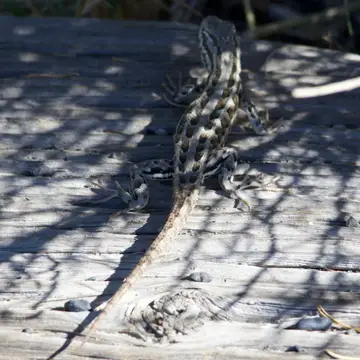
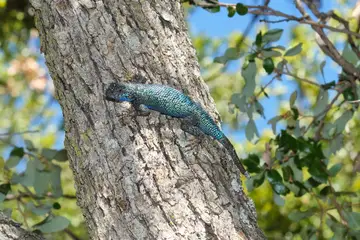
Habitat: Northern sagebrush lizards are associated with vegetated sand dunes and associated sandy habitats that support shrubs and have large areas of bare ground. (Washington Natural Heritage Program, Washington Department of Fish and Wildlife, BLM and U.S. Forest Service)
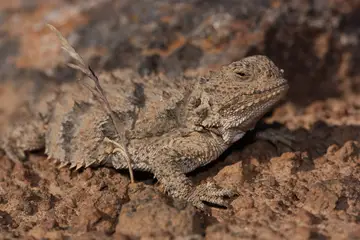
Habitat: In Washington, pygmy short-horned lizards occupy shrubsteppe habitat. (Washington Natural Heritage Program, Washington Department of Fish and Wildlife, BLM and U.S. Forest Service)
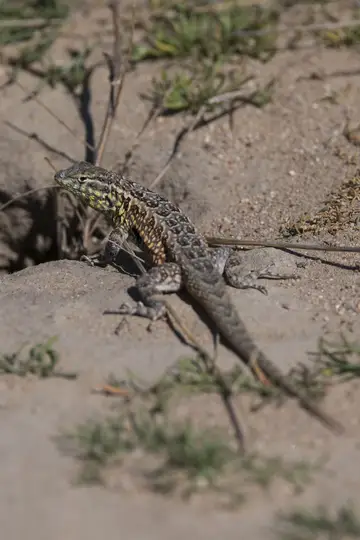
Habitat: Side-blotched lizards are associated with arid areas that support shrubsteppe habitat. (Washington Natural Heritage Program, Washington Department of Fish and Wildlife, BLM and U.S. Forest Service)
Photo: Pacific Southwest Region USFWS from Sacramento, US · Public domain · Wikimedia Commons
Southern alligator lizard
Elgaria multicarinata
Not stated
Venom
No official source we use states whether this animal is venomous. That does not mean it is harmless: do not handle it.
Habitat: The southern alligator lizard is typically found in rocky, grassy or brushy openings within open forested landscapes, primarily Oregon oak-ponderosa pine. (Washington Natural Heritage Program, Washington Department of Fish and Wildlife, BLM and U.S. Forest Service)
Range: The western fence lizard occurs in three discontinuous ecoregions: Puget Trough, East Cascades and the Blue Mountains. A few records also exist on the western edge of Okanogan Ecoregion.
Habitat: In the Puget Trough, western fence lizards occur along shorelines with accumulations of driftwood. (Washington Natural Heritage Program, Washington Department of Fish and Wildlife, BLM and U.S. Forest Service)
Range: This is primarily a lizard of eastern Washington, occurring in the East Cascades, Okanogan, Columbia Basin, Northeast Corner and Blue Mountain ecoregions. A few locations have also been documented in southern Skamania County (West Cascades Ecoregion).
Habitat: Typical habitats are dry open forests, shrubsteppe, and grassland. (Washington Natural Heritage Program, Washington Department of Fish and Wildlife, BLM and U.S. Forest Service)
Smaller (adults under 2.4 in snout to vent), less robust, with orange or rust armpits, no yellow on the back of the thighs and smaller spiny scales. Male sagebrush lizards have blue mottling on the throat; male fence lizards have an entirely blue throat.
Smaller, with fine granular (not spiny) back scales, a fold of skin across the throat and a black spot on the side behind the front leg.
Photos show typical adults; individuals vary. Never get close to compare.
When lizards are active in Washington
Records of lizards in Washington peak in April to May and July to August. They show when people record lizards, not how many there are (about month bars).
JanFebMarAprMayJunJulAugSepOctNovDec
379 records of lizards in Washington by month (GBIF, CC0 and CC BY records).
How to report
Dangerous wildlife: emergency 911; non-emergency 877-933-9847 or the WDFW online report. Invasive species: Washington Invasive Species Council web form or WA Invasives app; aquatic invasive species hotline 1-888-WDFW-AIS, [email protected]. Washington Department of Fish and Wildlife