Western Fence Lizard
Sceloporus occidentalis · also called blue belly and Great Basin fence lizard (subspecies) · Last checked November 3, 2026.
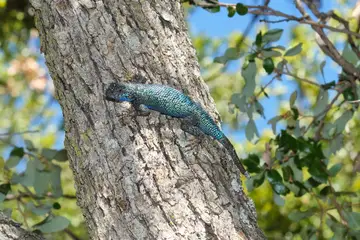
The western fence lizard, often called the 'blue belly', is a medium-sized gray, brown or blackish spiny lizard; official sources here confirm it in California, Oregon and Washington. Males have blue patches on the belly and throat. The National Park Service calls it the most common reptile in California, and Washington and Oregon wildlife agencies describe it there too. NPS Cabrillo says its Great Basin subspecies is often seen basking on rocks, logs and fence posts. No official source collected states whether it is venomous; the CDC notes that reptiles can carry Salmonella. The NPS mentions research finding that a protein in its blood can kill the Lyme disease bacterium in ticks that feed on it. National Park Service
On this page
Is the western fence lizard dangerous?
CDC: reptiles often carry Salmonella, even when healthy. Centers for Disease Control and Prevention
“Reptiles and amphibians often carry Salmonella bacteria in their digestive tracts. Even healthy reptiles and amphibians can carry the bacteria.”
No official source we use states whether this animal is venomous. That does not mean it is harmless: do not handle it.
How to identify a western fence lizard
A photo or description can narrow it down, but cannot confirm what an animal is or that it is safe. Look from a distance and do not handle wild animals.
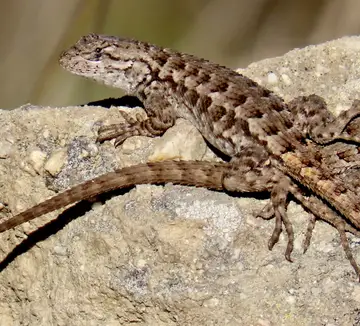
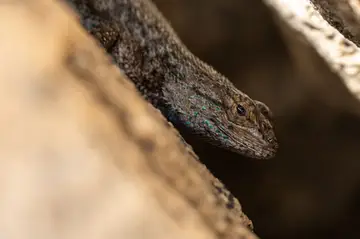

Size: Adults 2.2 to 3.4 inches snout to vent (body without tail). Washington Department of Fish & Wildlife
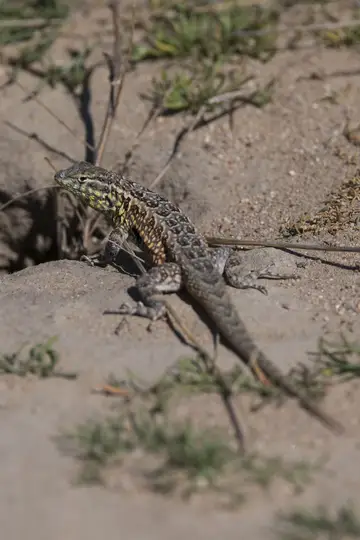
Colors: gray, brown or brownish-black above; can lighten or darken with temperature; blue patches on the sides of the belly and on the throat (strong in males, faint or absent in females); yellow to yellowish-orange on the rear of the limbs. Pattern: two rows of light and dark markings down the back; blotched.
Key features
- keeled, spiny scales on the back Washington Department of Fish & Wildlife
- in mature males the entire throat is blue and the blue belly patches are outlined in black Washington Department of Fish & Wildlife
- yellow scales on the back of the thighs Washington Department of Fish & Wildlife
Young
Hatchlings and juveniles look like adult females but usually have lighter, more contrasting back markings.
Animals mistaken for the western fence lizard
Western Fence Lizard or Sagebrush lizard?
Western Fence Lizard
Sagebrush lizard Sceloporus graciosus
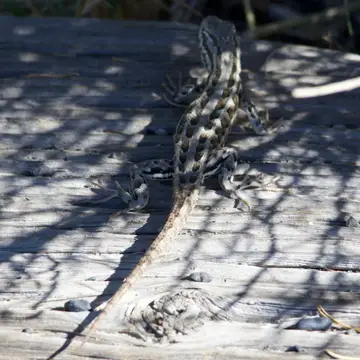
Smaller (adults under 2.4 in snout to vent), less robust, with orange or rust armpits, no yellow on the back of the thighs and smaller spiny scales. Male sagebrush lizards have blue mottling on the throat; male fence lizards have an entirely blue throat. Washington Department of Fish & Wildlife
Western Fence Lizard or Side-blotched lizard?
Western Fence Lizard
Side-blotched lizard Uta stansburiana
Smaller, with fine granular (not spiny) back scales, a fold of skin across the throat and a black spot on the side behind the front leg. Washington Department of Fish & Wildlife
Where the western fence lizard lives
- Native or listed
- Nonnative or not established
- No official record in our data
- 1–9
- 10–99
- 100–999
- 1,000+
On our state guides
State boundaries: U.S. Census Bureau, cartographic boundary file cb_2024_us_state_20m.
When it is active
Active by day, basking. In Washington, activity starts in March around Puget Sound and from April into October in eastern Washington. National Park Service
US open-licence records peak in March to July.
Habitat and habits
Habitat: Wide range: desert canyons, grasslands, oak and ponderosa pine woodland, coniferous forest, coastal scrub, shoreline driftwood and developed areas. Needs vertical structure such as rock piles or logs; absent from dense, humid forest and flat desert valleys. Oregon Department of Fish & Wildlife
Behavior: Excellent climber that escapes up trees or around rock faces when approached. Males defend territories in spring. Shelters under rocks and logs at night and in cool or rainy weather; hibernating lizards sometimes gather in groups.
Diet: Insects (crickets, grasshoppers, beetles, ants, wasps, leafhoppers, aphids) and some spiders.
Young: Egg-laying; young hatch July to September (Presidio), and August and September in eastern Washington.
Legal status and reporting
Protection: Washington: collecting is allowed only under a WDFW Scientific Collection Permit for research and education. Washington Department of Fish & Wildlife
Report: Washington asks people to report sightings, especially outside the mapped range, through the WDFW wildlife reporting form, with a photo and exact location if possible. Washington Department of Fish & Wildlife
Questions about the western fence lizard
Western fence lizard
A medium-sized gray, brown or blackish spiny lizard confirmed by official sources in California, Oregon and Washington, called the 'blue belly' for the blue patches on males. NPS calls it the most common reptile in California; Washington and Oregon wildlife agencies describe it there too.
California lizards blue belly
In California, the lizard often called the 'blue belly' is the western fence lizard. NPS says males have blue patches on the throat and belly and that it is the most common reptile in California. The sagebrush lizard also shows blue on males; Washington's wildlife agency says it is smaller, with orange or rust armpits and only mottled blue on the throat.
Sources
- Western Fence Lizard - Presidio of San Francisco. National Park Service. updated February 28, 2015; checked November 3, 2026.
Quoted passages (2)
“It is primarily diurnal, seeking out basking and perching sites.”
“…the young hatch between July and September.”
- Western fence lizard (Sceloporus occidentalis). Washington Department of Fish & Wildlife. undated page; checked November 3, 2026.
Quoted passages (10)
“Adults range in size from 2.2 to 3.4 inches snout to vent length.”
“…keeled, spiny scales dorsally (topside)”
“…the entire throat of the mature male western fence lizard is blue and the blue belly-patches are distinctly outlined in black.”
“…the keeled scales on the posterior surface of the thighs are yellow.”
“Hatchlings and juveniles are similar in appearance to adult females but usually have lighter and more contrasting dorsal coloration.”
“They are excellent climbers and will escape up trees or scamper around rock faces when approached.”
“Be advised that collection of this species is only permitted under a WDFW Scientific Collection Permit for research and educational activities.”
“If you see this species, please share your observation using the WDFW wildlife reporting form.”
“The northern sagebrush lizard appears similar to the western fence lizard, but they are smaller in size (adults less than 2.4 inches snout to vent length), less robust, have orange- or rust-colored axilla (armpits), lack yellow coloration on the posterior surface of the thighs and the spiny dorsal scales are smaller than in western fence lizards.”
“The side-blotched lizard is smaller, has fine granular scales dorsally, a gular fold (a fold of skin at the throat) and a black spot on the side of the body behind the forelimbs.”
- Western fence lizard in Oregon (ODFW Wildlife Viewing). Oregon Department of Fish & Wildlife. undated page; checked November 3, 2026.
Quoted passages (2)
“The Western fence lizard occupies a wide range of habitats, from desert canyons and grasslands to coniferous forests. It requires vertical structure in its habitat, such as rock piles or logs. It is absent from dense, humid forests and flat desert valleys.”
“This lizard is insectivorous, and feeds on crickets, grasshoppers, beetles, ants, wasps, leafhoppers, and aphids. Some spiders are taken as well.”
- Reptiles and Amphibians - John Muir National Historic Site. National Park Service. updated August 12, 2024; checked November 3, 2026.
- Lizards - Cabrillo National Monument. National Park Service. updated July 28, 2024; checked November 3, 2026.
- Complete List of Amphibian, Reptile, Bird and Mammal Species in California. California Department of Fish and Wildlife (CWHR Program). 2016-05 (document dated "May, 2016"; checked November 3, 2026.
- Reptiles and Amphibians (Healthy Pets, Healthy People). Centers for Disease Control and Prevention. archived copy, captured October 10, 2026; checked November 3, 2026.
Quoted passages (1)
“Reptiles and amphibians often carry Salmonella bacteria in their digestive tracts. Even healthy reptiles and amphibians can carry the bacteria.”
- GBIF.org occurrence records, human observations licensed CC0 1.0 or CC BY 4.0 only, accessed November 3, 2026. The datasets behind these counts are listed on our Sources page.
- State boundaries: U.S. Census Bureau, cartographic boundary file cb_2024_us_state_20m.