States Wildlife

Montana Lizards: Identification Guide With Pictures

Last checked November 3, 2026 against official sources.

On this page
  1. All 6 lizards
  2. Lookalikes
  3. How to report
  4. About this list
  5. Sources

This page lists 6 lizards: all from Montana Natural Heritage Program (Montana State Library) with Montana Fish, Wildlife & Parks: Montana Field Guide's Montana Field Guide: Reptiles. 1 is nonnative.

All 6 lizards

From A to Z.

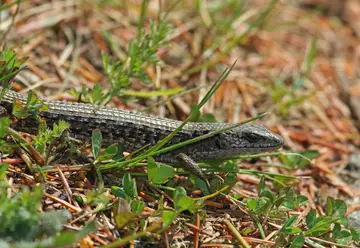
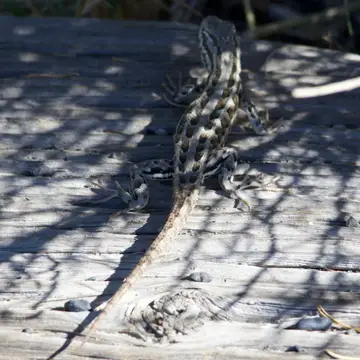
Common Sagebrush Lizard
Photo: Ben · CC0 1.0 · iNaturalist

Common Sagebrush Lizard

Sceloporus graciosus

Not stated

Venom
No official source we use states whether this animal is venomous. That does not mean it is harmless: do not handle it.
Where in Montana
In Montana, there are scattered records east of the Continental Divide across the south-central and southeastern counties north to the Missouri River. Montana Natural Heritage Program (Montana State Library) with Montana Fish, Wildlife & Parks: Montana Field Guide
Conservation
State Rank S4
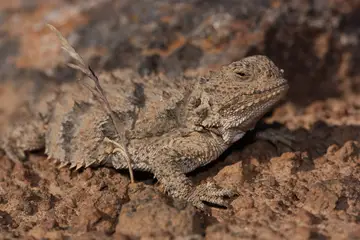
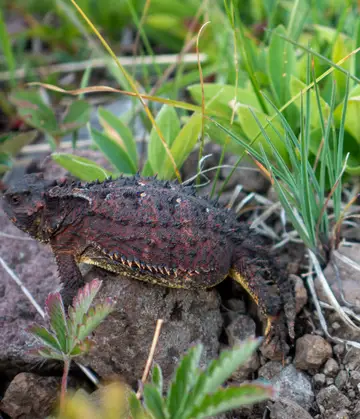
Greater Short-horned Lizard
Photo: Bob Walker · CC BY 4.0 · iNaturalist

Greater Short-horned Lizard

Phrynosoma hernandesi

Not stated

Venom
No official source we use states whether this animal is venomous. That does not mean it is harmless: do not handle it.
Where in Montana
The Greater Short-horned Lizard is found from southeastern Alberta and southwestern Saskatchewan south through eastern Montana, the western Dakotas, Wyoming, western … Montana Natural Heritage Program (Montana State Library) with Montana Fish, Wildlife & Parks: Montana Field Guide
Conservation
Species of Concern; State Rank S3; BLM: SENSITIVE; FWP SWAP: SGCN
What the sources say

Range: The Greater Short-horned Lizard is found from southeastern Alberta and southwestern Saskatchewan south through eastern Montana, the western Dakotas, Wyoming, western Nebraska, Colorado, Utah, eastern Nevada, New Mexico, Arizona, and western Texas to southern Durango (Stebbins 2003).

Habitat: This species occurs in sagebrush and grassland habitats. (Montana Natural Heritage Program (Montana State Library) with Montana Fish, Wildlife & Parks: Montana Field Guide)

Northern Alligator Lizard
Photo: USFWS - Pacific Region · Public domain · Wikimedia Commons

Northern Alligator Lizard

Elgaria coerulea

Not stated

Venom
No official source we use states whether this animal is venomous. That does not mean it is harmless: do not handle it.
Where in Montana
The Northern Alligator Lizard is found at elevations from sea level to 3,200 m (10,500 ft), west of the Continental Divide, from southern British Columbia, south into … Montana Natural Heritage Program (Montana State Library) with Montana Fish, Wildlife & Parks: Montana Field Guide
Conservation
Species of Concern; State Rank S3; FWP SWAP: SGCN
What the sources say

Range: The Northern Alligator Lizard is found at elevations from sea level to 3,200 m (10,500 ft), west of the Continental Divide, from southern British Columbia, south into northern Idaho and western Montana, and through northern and western Washington, western Oregon, the Coast Ranges and Sierra Nevada in California.

Habitat: The Northern Alligator Lizard occurs in areas cooler and more humid than tolerated by other lizards (Tevs and Lowe 2025). (Montana Natural Heritage Program (Montana State Library) with Montana Fish, Wildlife & Parks: Montana Field Guide)

Pygmy Short-horned Lizard
Photo: Walter Siegmund (talk) · CC BY-SA 3.0 · Wikimedia Commons · resized

Pygmy Short-horned Lizard

Phrynosoma douglasii

Not stated

Venom
No official source we use states whether this animal is venomous. That does not mean it is harmless: do not handle it.
Conservation
Potential Species of Concern; State Rank SU
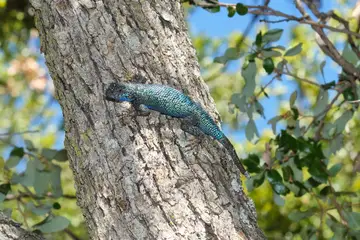
Western Fence Lizard
Photo: Shawn O'Donnell · CC BY 4.0 · iNaturalist

Western Fence Lizard

Sceloporus occidentalis

Not stated Nonnative

Venom
No official source we use states whether this animal is venomous. That does not mean it is harmless: do not handle it.
Size
Adults 2.2 to 3.4 inches snout to vent (body without tail).
How to recognize it
  • Keeled, spiny scales on the back
  • In mature males the entire throat is blue and the blue belly patches are outlined in black
  • Yellow scales on the back of the thighs
Conservation
State Rank SNA

Full Western Fence Lizard guide

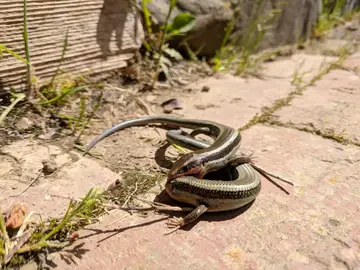
Western Skink
Photo: Andy Kleinhesselink · CC0 1.0 · iNaturalist

Western Skink

Plestiodon skiltonianus

Not stated

Venom
No official source we use states whether this animal is venomous. That does not mean it is harmless: do not handle it.
Where in Montana
The Western Skink is the most widespread, and possibly the most abundant, skink in western North America, being found west of the Continental Divide from southern … Montana Natural Heritage Program (Montana State Library) with Montana Fish, Wildlife & Parks: Montana Field Guide
Conservation
Species of Concern; State Rank S3; FWP SWAP: SGCN
What the sources say

Range: The Western Skink is the most widespread, and possibly the most abundant, skink in western North America, being found west of the Continental Divide from southern British Columbia in the north, south through eastern Washington, Idaho, western Montana, Oregon, northern and coastal California, Nevada, western Utah, northwestern Arizona, and southwestern California, to northern Baja California (Rodgers and Fitch 1947, Tanner 1988a, Richmond and Reeder 2002), at elevations to about 2,530 m (8,300 ft).

Habitat: The Western Skink occupies grasslands, chaparral, open Juniper-Sage shrublands, Piñon-Juniper woodlands, Pine-Oak forests, and mixed conifer forest. (Montana Natural Heritage Program (Montana State Library) with Montana Fish, Wildlife & Parks: Montana Field Guide)

Lizards people confuse

Western Fence Lizard or Sagebrush lizard?

Western Fence Lizard
Photo: Shawn O'Donnell · CC BY 4.0 · iNaturalist

Western Fence Lizard Not stated

Sagebrush lizard
Photo: Ben · CC0 1.0 · iNaturalist

Sagebrush lizard Not stated

Smaller (adults under 2.4 in snout to vent), less robust, with orange or rust armpits, no yellow on the back of the thighs and smaller spiny scales. Male sagebrush lizards have blue mottling on the throat; male fence lizards have an entirely blue throat.

Photos show typical adults; individuals vary. Never get close to compare.

How to report

Boat or trailer with aquatic organisms: 1-800-TIP-MONT (1-800-847-6668). FWP main office: (406) 444-2535. Montana Fish, Wildlife & Parks

About this list

The species list comes from Montana Field Guide: Reptiles (lizard families) (Montana Natural Heritage Program (Montana State Library) with Montana Fish, Wildlife & Parks: Montana Field Guide, Internet Archive captures 2025-05-06 to 2026-09-02, one per family page (each listed below)).

Venom labels come only from official sources and link to them; "Not stated" never means harmless. How labels work.
"Nonnative" and "Invasive" follow the wording of the source list. See invasive species in Montana.

Sources

  1. Contact Us. Montana Fish, Wildlife & Parks. archived copy, captured October 19, 2026; checked November 3, 2026.
  2. Montana Field Guide: Reptiles and Amphibians (family species lists). Montana Natural Heritage Program (Montana State Library) with Montana Fish, Wildlife & Parks: Montana Field Guide. archived copy, captured May 6, 2025; checked November 3, 2026.
  3. Report a suspected AIS. Montana Fish, Wildlife & Parks. archived copy, captured May 3, 2026; checked November 3, 2026.
    Quoted passages (1)
    “If you see a boat or trailer with aquatic organisms attached to it, call 1-800-TIP-MONT (1-800-847-6668) immediately.”