Western Rattlesnake
Crotalus oreganus · also called Northern Pacific rattlesnake, Southern Pacific rattlesnake, Great Basin rattlesnake and midget faded rattlesnake · Last checked November 3, 2026.
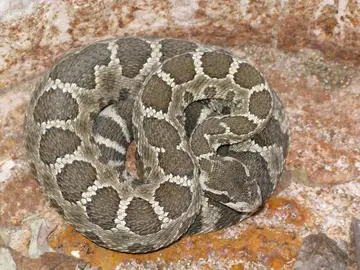

The western rattlesnake is a venomous, heavy-bodied pit viper with a broad triangular head, dark blotches and a rattle on the tail, usually brown, tan, gray or olive. Colorado Parks and Wildlife says its bite is dangerous to humans. Bites are uncommon and seldom fatal, but always a medical emergency. It lives in the western US, including Washington, Oregon, Idaho, California, Nevada, Utah, northwestern Arizona and western Colorado. Washington Department of Fish and Wildlife
On this page
Is the western rattlesnake dangerous?
Colorado Parks and Wildlife: has a venomous bite that is dangerous to humans. Usually not fatal, but very painful and always a medical emergency. Colorado Parks and Wildlife
“…has a venomous bite that is dangerous to humans”
Bites and stings: It bites defensively when threatened; it does not hunt people. CDFW warns a startled rattlesnake may not rattle before striking, and any bite should be treated as venomous. Dead rattlesnakes may still inject venom shortly after death.
If someone is bitten or stung, call 911 or Poison Help at 1-800-222-1222.
How to identify a western rattlesnake
A photo or description can narrow it down, but cannot confirm what an animal is or that it is safe. Look from a distance and do not handle wild animals.
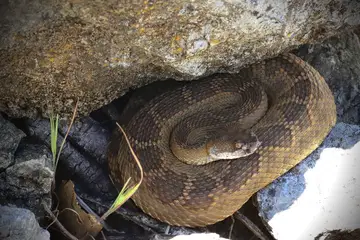
Size: Varies by area and subspecies: up to 63 in. excluding rattle (Arizona); largest in the Northwest 59 in., most Washington adults around 2 ft; 18 to 36 in. average (Oregon); C. o. concolor rarely over 26 in. (Colorado). Arizona Game and Fish Department
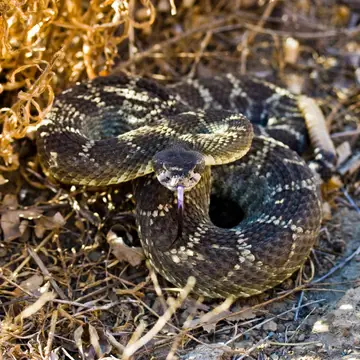
Colors: Straw-yellow, tan, pink, salmon, gray, gray-brown, off-white, cream or olive (Arizona); typically brown or olive, matching habitat (Washington); light brown to greenish brown (Oregon). Pattern: Large dark-edged blotches that narrow into bands near the tail; blotches can be very faded; some older snakes lack body markings entirely; dark line from behind the eye to the corner of the mouth.
Key features
- Rattle on the tail; broad triangular head; facial pits Washington Department of Fish and Wildlife
- Vertical pupils and heat-sensing pits near the nostrils Washington Department of Fish and Wildlife
- Strongly keeled scales Washington Department of Fish and Wildlife
Young
Young look like adults with more vivid color and a single silent button instead of a working rattle.
Animals mistaken for the western rattlesnake
Western Rattlesnake or Gopher snake (gophersnake)?
Western Rattlesnake
Gopher snake (gophersnake) Pituophis catenifer
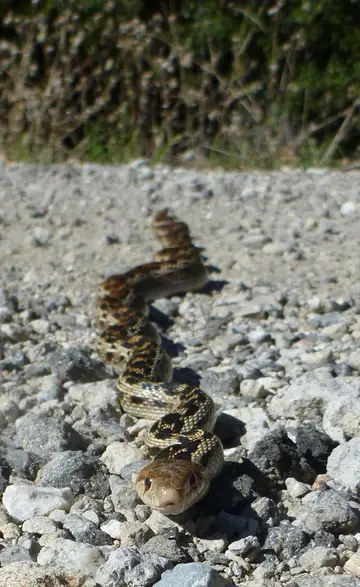

WDFW (Washington): no rattle and no facial pits, oval pupils, smaller square spots, a narrow eye stripe and less keeled scales. It can coil, strike, hiss loudly and vibrate its tail like a rattlesnake, so behavior alone does not tell them apart. Washington Department of Fish and Wildlife
Not venomous, per WDFW and CDFW.
Western Rattlesnake or Nightsnake?
Western Rattlesnake
Nightsnake
WDFW (Washington): resembles a young rattlesnake but has no rattle or facial pits, smaller more numerous spots not outlined in black and white, a pearly white belly and smooth scales. Washington Department of Fish and Wildlife
Where the western rattlesnake lives
- Native or listed
- Nonnative or not established
- No official record in our data
- 1–9
- 10–99
- 100–999
- 1,000+
On our state guides
State boundaries: U.S. Census Bureau, cartographic boundary file cb_2024_us_state_20m.
When it is active
Washington: emerge in April, return to dens from late September, active until late October in some places. Colorado: usually resume late March or early April. Great Basin NPS: emerge in May. Arizona: day and dusk in spring and fall, night in the warmest summer. California: most bites April to October. Washington Department of Fish and Wildlife
US open-licence records peak in April to July.
Habitat and habits
Habitat: Washington: shrubsteppe, oak and pine forest, with talus and basalt rock used for overwintering. California: statewide from sea level to 7,000 feet. Arizona: steep rocky canyons, foothills, high plains and plateaus. Yosemite: up to about 9,000 feet. Washington Department of Fish and Wildlife
Behavior: Tends to avoid people, and uses camouflage and its rattle as warnings. In Washington, active by day in moderate weather and by night in the hottest months.
Diet: Rats, squirrels, mice, lizards and birds (Arizona). California ground squirrels are the primary prey of adults in Yosemite.
Young: Bears live young: from late August (Washington), summer (Arizona), mid to late September with 5 to 8 young (NPS Great Basin), August to October with 4 to 21 young (NPS Bryce Canyon).
Legal status and reporting
Protection: Protected in Utah, where it is illegal to harass or kill one, and in national parks. Rules differ by state, so check your state's agency. DWR
Invasive status: Not invasive; native (Idaho, Oregon). Idaho Department of Fish and Game
Report: Not invasive. Washington asks people to report sightings outside the mapped range through the WDFW wildlife reporting form. NPS Bryce Canyon asks visitors to report sightings to a ranger or the Visitor Center. Washington Department of Fish and Wildlife
Questions about the western rattlesnake
Western rattlesnake
A venomous rattlesnake of the western US with a triangular head, dark blotches and a rattle. Colorado Parks and Wildlife says its bite is dangerous to humans. Official sources confirm it in Washington, Oregon, Idaho, California, Nevada, Utah, Arizona and Colorado.
Rattlesnake bite what to do
Call 911 or Poison Help at 1-800-222-1222. Utah's wildlife agency calls a bite a serious medical emergency needing hospital attention as soon as possible.
Rattlesnake vs gopher snake
Gopher snakes have no rattle and no facial pits, oval pupils and smaller square spots. They can coil, hiss and vibrate the tail like a rattlesnake.
Baby rattlesnake
WDFW says newborn western rattlesnakes look like adults with more vivid color, and have a single silent button instead of a working rattle. CDFW also warns that a startled rattlesnake may not rattle before striking.
What states are rattlesnakes protected?
For this species, Utah says it is illegal to harass or kill rattlesnakes, and NPS says they are protected in national parks. Other states differ; this is not a full list.
Sources
- Western rattlesnake (Crotalus oreganus). Washington Department of Fish and Wildlife. undated page; checked November 3, 2026.
Quoted passages (10)
“This is a heavy-bodied snake with large dark spots, a wide triangular head, a distinct eye stripe, and a rattle at the tip of the tail.”
“The pupils are vertical”
“The dorsal scales are strongly keeled”
“Recently born snakes (neonates) resemble adults but have more vivid coloration and the rattle is limited to a single, silent, horny segment called a ‘button.’”
“In Washington, western rattlesnakes primarily occur in shrubsteppe habitats but are also found in Oregon white oak, ponderosa pine and other open forest types.”
“…western rattlesnakes emerge from their overwintering sites (hibernacula or dens) in April”
“Rattlesnakes bear live young.”
“…please share your observation using the WDFW wildlife reporting form”
“Gophersnakes differ in their physical appearance by lacking a rattle and facial pits.”
“Nightsnakes resemble juvenile rattlesnakes, but they differ in lacking a rattle and facial pits.”
- Species profile: Midget Faded Rattlesnake (Western Rattlesnake). Colorado Parks and Wildlife. undated page; checked November 3, 2026.
Quoted passages (1)
“…has a venomous bite that is dangerous to humans”
- Rattlesnake. California Department of Fish and Wildlife. undated page; checked November 3, 2026.
Quoted passages (1)
“Rattlesnakes are generally not aggressive and will avoid people.”
- How to avoid conflicts with rattlesnakes in Utah this spring and summer (news release). Utah Division of Wildlife Resources (DWR). Published March 17, 2026; checked November 3, 2026.
Quoted passages (1)
“Rattlesnakes are protected under Utah law, making it illegal to harass or kill one.”
- Online Field Guide species account: Western Rattlesnake (Crotalus oreganus). Arizona Game and Fish Department. 2023; checked November 3, 2026.
Quoted passages (2)
“A medium to large (up to 1,650 mm or 63″ in total length excluding rattle) rattlesnake”
“The Western Rattlesnake feeds on rats, squirrels, mice, lizards, and birds.”
- Crotalus oreganus (Western Rattlesnake), Idaho Species Catalog. Idaho Department of Fish and Game. archived copy, captured July 29, 2025; checked November 3, 2026. Archived copy.
Quoted passages (1)
“Native to Idaho: Yes”
- Great Basin Rattlesnake. Nevada Department of Wildlife. undated page; checked November 3, 2026.
- Living with Wildlife: Snakes. Oregon Department of Fish and Wildlife. undated page; checked November 3, 2026.
- Living with wildlife: Snakes. Washington Department of Fish and Wildlife. undated page; checked November 3, 2026.
- Great Basin Rattlesnake (Bryce Canyon National Park). National Park Service. updated May 29, 2024; checked November 3, 2026.
- GBIF.org occurrence records, human observations licensed CC0 1.0 or CC BY 4.0 only, accessed November 3, 2026. The datasets behind these counts are listed on our Sources page.
- State boundaries: U.S. Census Bureau, cartographic boundary file cb_2024_us_state_20m.