States Wildlife

Are there rattlesnakes in Washington?

Last checked November 3, 2026 against official sources.

On this page
  1. The answer
  2. Which ones
  3. Official advice
  4. Sources

Yes.

The western rattlesnake is common and widespread in eastern Washington. The farthest west record is in the Columbia Gorge in Skamania County.

Washington Department of Fish and Wildlife: “This snake is common and widespread in eastern Washington.” Source

How we answer questions

Washington

Think you have seen one in Washington? Keep your distance and contact the Washington Department of Fish and Wildlife.

On Washington's official list

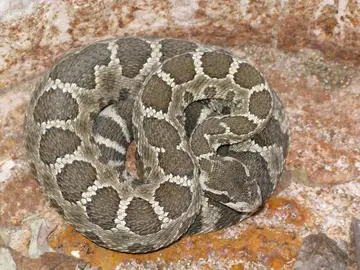
Western rattlesnake
Photo: NPS Staff · Public domain · Wikimedia Commons

Western rattlesnake

Crotalus oreganus

Venomous per Washington Department of Fish and Wildlife

Danger to people
“All rattlesnake bites should be considered life threatening.” Washington Department of Fish and Wildlife
Size
Varies by area and subspecies: up to 63 in. excluding rattle (Arizona); largest in the Northwest 59 in., most Washington adults around 2 ft; 18 to 36 in. average (Oregon); C. o. concolor rarely over 26 in. (Colorado).
How to recognize it
  • Rattle on the tail; broad triangular head; facial pits
  • Vertical pupils and heat-sensing pits near the nostrils
  • Strongly keeled scales
Where in Washington
Western rattlesnakes occur east of the Cascade Mountains in the East Cascades, Columbia Basin, Okanogan, and Blue Mountain ecoregions … Washington Natural Heritage Program, Washington Department of Fish and Wildlife, BLM and U.S. Forest Service
56 records by month.
What the sources say

Venom: “Caution: This is a venomous and potentially dangerous snake.” (Washington Department of Fish and Wildlife)

Range: Western rattlesnakes occur east of the Cascade Mountains in the East Cascades, Columbia Basin, Okanogan, and Blue Mountain ecoregions. The furthest west they have been documented is in the Columbia Gorge approximately 1 mile west of Dog Mountain in Skamania County.

Habitat: In Washington, western rattlesnakes primarily occur in shrubsteppe habitats but are also found in Oregon white oak, ponderosa pine and other open forest types. (Washington Natural Heritage Program, Washington Department of Fish and Wildlife, BLM and U.S. Forest Service)

Full Western rattlesnake guide

All snakes in the state: Washington snakes.

When snakes are seen in Washington

950 records (GBIF, CC0 and CC BY).

What official sources advise

Sources

  1. Western rattlesnake (Crotalus oreganus). Washington Department of Fish and Wildlife. undated page; checked November 3, 2026.
    Quoted passages (5)
    “This snake is common and widespread in eastern Washington.”
    “Caution: This is a venomous and potentially dangerous snake.”
    “In most of the Columbia Basin, western rattlesnakes emerge from their overwintering sites (hibernacula or dens) in April.”
    “Adults return to the overwintering sites starting in late September, although activity may continue until late October depending on location and temperatures.”
    “Rattlesnakes are active during the day when temperatures are moderate but switch to nocturnal activity during the hottest months of the year.”
  2. Washington State Herp Atlas: Checklist of Washington Amphibians and Reptiles (pp. 13-14). Washington Natural Heritage Program, Washington Department of Fish and Wildlife, BLM and U.S. Forest Service. Published 2009, revised 2017; checked November 3, 2026.
  3. Living with wildlife: Snakes. Washington Department of Fish and Wildlife. undated page; checked November 3, 2026.
    Quoted passages (2)
    “All rattlesnake bites should be considered life threatening.”
    “If you encounter a rattlesnake, move away:”
  4. GBIF.org occurrence records, human observations licensed CC0 1.0 or CC BY 4.0 only, accessed November 3, 2026. The datasets behind these counts are listed on our Sources page.