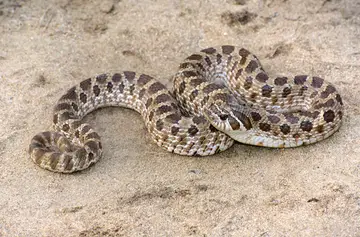
States Wildlife

Venomous Snakes in Wyoming: 2 Species & How to Tell

Last checked November 3, 2026 against official sources.

On this page
  1. The 2 venomous snakes
  2. Lookalikes
  3. When they are active
  4. If you are bitten or stung
  5. How to report
  6. About this list
  7. Sources

Wyoming has 2 venomous snakes named by official sources: Midget Faded Rattlesnake and Prairie Rattlesnake. Each one is labelled venomous by Wyoming Game and Fish Department and National Park Service.

The 2 venomous snakes of Wyoming

Recognize them from a distance; a photo cannot confirm that a snake is safe. Identifying animals safely.

Midget Faded Rattlesnake
Photo: Don F Becker · CC0 · Wikimedia Commons

Midget Faded Rattlesnake

Crotalus oreganus concolor

Venomous per Wyoming Game and Fish Department

Where in Wyoming
Range is restricted to the lower Green River Valley from the cities of Green River and Rock Springs south to the Utah-Wyoming state line. Wyoming Game and Fish Department, Nongame Section
Conservation
Wyoming Species of Greatest Conservation Need (NSS1, Tier I)
What the sources say

Venom: “Venom of this species is considered more potent than other closely related species (Baxter and Stone 1985).” (Wyoming Game and Fish Department)

Habitat: Rock outcrops in sagebrush desert communities. (Wyoming Game and Fish Department, Nongame Section)

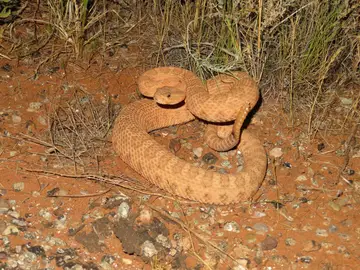
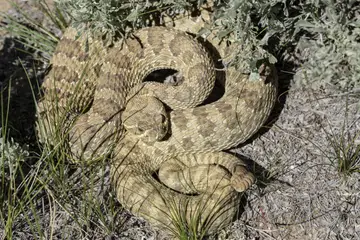
Prairie Rattlesnake
Photo: Cecelia Alexander · CC0 1.0 · iNaturalist

Prairie Rattlesnake

Crotalus viridis

Venomous per National Park Service

Danger to people
“Only dangerously venomous snake in the park.” National Park Service
Size
Usually about 3 to 4 feet; Montana gives 15 to 60 inches and NPS says up to 5 feet. Arizona gives a maximum of 28 to 64 inches (excluding rattle) depending on subspecies; in Colorado it is rarely over 39 inches.
How to recognize it
  • Rattle (or a button in newborns) at the tail tip
  • Head much broader than the neck, many small scales on top of the head, heat-sensing pit between eye and nostril
  • Vertical (cat-like) pupils
Where in Wyoming
In Wyoming, Prairie Rattlesnakes occur in all counties east of the Continental Divide and in Carbon County west of the Divide. Wyoming Game and Fish Department
Conservation
Wyoming Species of Greatest Conservation Need (NSS4, Tier III)
What the sources say

Venom: “The only venomous snake found at the park is the prairie rattlesnake.” (National Park Service)

Habitat: Plains, foothills, and scarp woodlands, especially near granite or limestone outcrops. (Wyoming Game and Fish Department, Nongame Section)

Full Prairie Rattlesnake guide

For 6 other snakes on Wyoming's list, no official source we use states whether it is venomous: Desert Striped Whipsnake, Plains Black-headed Snake, Plains Gartersnake, Plains Hog-nosed Snake, Red-bellied Snake and Smooth Greensnake. That does not make them harmless. Leave every snake alone.

See all 16 snakes, venomous and not, on Wyoming snakes.

Snakes people confuse

Prairie Rattlesnake or Western hognose snake?

Prairie Rattlesnake
Photo: Cecelia Alexander · CC0 1.0 · iNaturalist

Prairie Rattlesnake Venomous

Western hognose snake
Photo: Dean Hester · CC BY 4.0 · iNaturalist

Western hognose snake Not stated

The Montana Field Guide names the western hog-nosed snake as a lookalike and says that in Montana no other snake has rattles: a hognose has no rattle.

Photos show typical adults; individuals vary. Never get close to compare.

When venomous snakes are active in Wyoming

Records of snakes in Wyoming peak in June to August. They show when people record snakes, not how many there are (about month bars).

150 records of snakes in Wyoming by month (GBIF, CC0 and CC BY records).

If you are bitten or stung

Call 911 or Poison Help at 1-800-222-1222 right away. Poison Help connects you to your local poison center, any time of day.

Official advice from Wyoming Game and Fish Department:

How to report

Report mountain lion sightings to Wyoming Game and Fish at 1-877-WGFD-TIP (or the non-emergency police line). Rare or interesting nongame birds, mammals, amphibians and reptiles can be reported to the WGFD Nongame Section through its "Report an Observation" form. Wyoming Game and Fish Department
About this list

The species list comes from Reptiles in Wyoming (WGFD species list, data from WYNDD Data Explorer) (Wyoming Game and Fish Department, Last modified 01-22-2023; data 01-19-2024).

Venom labels come only from official sources and link to them; "Not stated" never means harmless. How labels work.

Sources

  1. Nongame Wildlife. Wyoming Game and Fish Department. no page date shown; checked November 3, 2026.
  2. Reptiles in Wyoming (species list). Wyoming Game and Fish Department. Last modified on 01-22-2023; checked November 3, 2026.
  3. Reptiles - Devils Tower National Monument. National Park Service. updated April 24, 2025; checked November 3, 2026.
    Quoted passages (3)
    “Although bullsnakes can mimic rattlesnakes - flattening their head, coiling their body and hissing - they are not venomous.”
    “Only one venomous species is present: the prairie rattlesnake.”
    “The only venomous snake found at the park is the prairie rattlesnake.”
  4. Atlas of Birds, Mammals, Amphibians, and Reptiles in Wyoming. Wyoming Game and Fish Department, Nongame Section. December 2021; checked November 3, 2026.
    Quoted passages (1)
    “Mimics rattlesnakes when threatened but harmless to humans.”
  5. Midget Faded Rattlesnake - Crotalus oreganus concolor (SWAP 2017 species account). Wyoming Game and Fish Department. 2017 (document footer; checked November 3, 2026.
    Quoted passages (2)
    “Venom of this species is considered more potent than other closely related species (Baxter and Stone 1985).”
    “The active period for this snake is typically from late April through September.”
  6. Reptiles - Grand Teton National Park. National Park Service. updated October 18, 2022; checked November 3, 2026.
    Quoted passages (1)
    “There are no species of venomous snakes in the park.”
  7. Prairie Rattlesnake - Yellowstone National Park. National Park Service. updated April 29, 2025; checked November 3, 2026.
    Quoted passages (1)
    “Only dangerously venomous snake in the park.”
  8. Prairie Rattlesnake - Crotalus viridis (Wyoming SWAP 2017 species account). Wyoming Game and Fish Department. 2017; checked November 3, 2026.
    Quoted passages (1)
    “…prairie dog burrows, or other abandoned mammal burrows and usually emerge in April or May.”
  9. Wendy, what should I do if I come across a rattlesnake? Wyoming Game and Fish Department. July 19, 2019; checked November 3, 2026.
    Quoted passages (2)
    “Have a reliable form of communication so you can call 911 immediately if you or someone you are with do get bitten by a rattlesnake.”
    “If you come across a rattlesnake DO NOT try to move it or kill it.”
  10. Hiking in rattlesnake country. Wyoming Game and Fish Department. undated page; checked November 3, 2026.
    Quoted passages (2)
    “Use a flashlight at night. Rattlesnakes are often active at night in the summer.”
    “Rattlesnakes are often active at night in the summer.”
  11. Mountain Lions in Wyoming. Wyoming Game and Fish Department. no page date shown; checked November 3, 2026.
    Quoted passages (1)
    “Please report sightings to Game and Fish at 1-877-WGFD-TIP or the non-emergency Police Department phone.”
  12. Amphibians and Reptiles. Wyoming Game and Fish Department. no page date shown; checked November 3, 2026.
    Quoted passages (1)
    “Rattlesnakes occur in many parts of Wyoming.”
  13. GBIF.org occurrence records, human observations licensed CC0 1.0 or CC BY 4.0 only, accessed November 3, 2026. The datasets behind these counts are listed on our Sources page.