Prairie Rattlesnake
Crotalus viridis · also called prairie rattler, green prairie rattlesnake, Hopi rattlesnake (Arizona subspecies) and western (prairie) rattlesnake (older usage) · Last checked November 3, 2026.
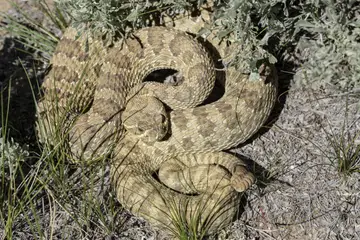
The prairie rattlesnake is a venomous rattlesnake of the Great Plains and western grasslands. It is tan, olive, greenish or brown with a row of dark blotches down the back that turn into rings near the tail, has a broad triangular head, vertical pupils and a rattle. It is dangerous: state wildlife agencies and the National Park Service call it venomous, and it is the only venomous snake in South Dakota (NPS) and in Theodore Roosevelt National Park in North Dakota. It usually avoids people, but bites are more likely if you provoke it or try to catch it. Official sources place it in Montana, Wyoming, North and South Dakota, Nebraska, Kansas, Colorado, Oklahoma, Texas (western third), New Mexico, northeastern Arizona, and very rarely in Iowa, where it is state endangered. Bullsnakes (gopher snakes) look and act like it but have no rattle. If bitten, call 911 or Poison Help at 1-800-222-1222. Arizona Game and Fish Department
On this page
Is the prairie rattlesnake dangerous?
Dangerous to people and pets; leave it alone. Arizona Game and Fish: it can deliver large amounts of potent venom; if encountered it should be left alone. NPS El Malpais: prairie rattlesnakes are venomous to people and pets. Colorado Parks and Wildlife: a rattlesnake bite is usually not fatal but can be very painful and should always be considered a medical emergency. NPS Wind Cave: bites are rarely fatal but require immediate medical attention. Arizona Game and Fish Department
“This rattlesnake is capable of delivering large amounts of potent venom. If encountered it should be left alone.”
Bites and stings: It usually avoids people. Colorado Parks and Wildlife says rattlesnakes give every chance to stay away before biting in self-defense and do not chase people; Wind Cave National Park says prairie rattlesnakes are not aggressive and avoid conflict if given plenty of space. It can strike about half its body length, so CPW advises at least five feet of distance. It may not rattle and may rely on camouflage instead. Arizona Game and Fish says a large percentage of bites happen when a snake is handled or abused. Young are born venomous. Never try to catch, kill, provoke or move one (CPW).
If someone is bitten or stung, call 911 or Poison Help at 1-800-222-1222.
How to identify a prairie rattlesnake
A photo or description can narrow it down, but cannot confirm what an animal is or that it is safe. Look from a distance and do not handle wild animals.
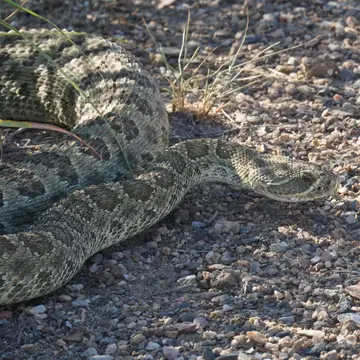
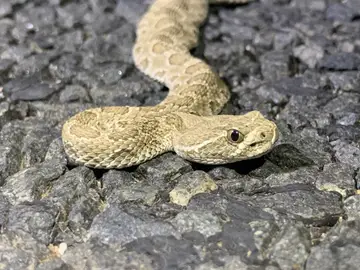
Size: Usually about 3 to 4 feet; Montana gives 15 to 60 inches and NPS says up to 5 feet. Arizona gives a maximum of 28 to 64 inches (excluding rattle) depending on subspecies; in Colorado it is rarely over 39 inches. Montana Natural Heritage Program (Montana State Library), Montana Field Guide
Colors: pale green to brown; olive, straw-yellow, gray-brown, pinkish or orange-brown (Arizona); greenish or grayish (Texas); light brown, gray or dark brown (Nebraska); belly pale yellow to white, unblotched. Pattern: a row of brown or black blotches, edged dark then light, down the back, merging into rings on the tail; smaller blotches on the sides; blotches on the sides; dark bar from the eye to the corner of the mouth; no black-and-white tail bands before the rattle (unlike the western diamondback).
Key features
- rattle (or a button in newborns) at the tail tip Arizona Game and Fish Department
- head much broader than the neck, many small scales on top of the head, heat-sensing pit between eye and nostril Colorado Parks and Wildlife
- vertical (cat-like) pupils Arizona Game and Fish Department
- triangular head, slit pupils and rattle (NPS Wind Cave) National Park Service
- the rattle is the surest sign: in Montana, no other snake has one Montana Natural Heritage Program (Montana State Library), Montana Field Guide
Young
Born live in late summer; young are marked like adults but brighter, and are born venomous.
Animals mistaken for the prairie rattlesnake
Prairie Rattlesnake or Bullsnake (gopher snake)?
Prairie Rattlesnake
Bullsnake (gopher snake) Pituophis catenifer
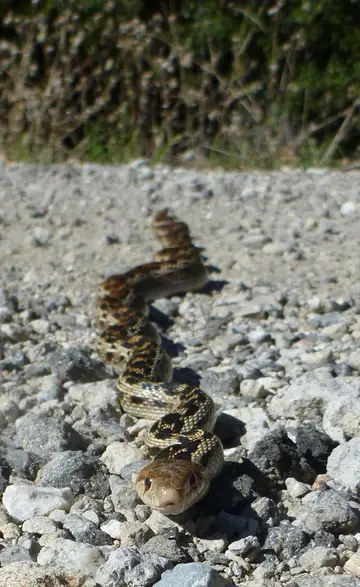

The bullsnake has no rattle, an oval or rounded head and large round pupils; the prairie rattlesnake has a triangular head, slit pupils and a rattle. Bullsnakes are often mistaken for rattlesnakes: when threatened they may coil, flatten the head, hiss and vibrate the tail in dry leaves to sound like a rattle, so do not judge by behavior or by head shape alone. National Park Service
Not venomous (NPS Devils Tower), though it can mimic a rattlesnake.
Prairie Rattlesnake or Western hognose snake?
Prairie Rattlesnake
Western hognose snake Heterodon nasicus
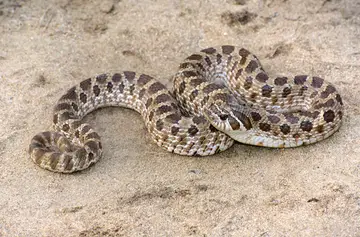
The Montana Field Guide names the western hog-nosed snake as a lookalike and says that in Montana no other snake has rattles: a hognose has no rattle. Montana Natural Heritage Program (Montana State Library), Montana Field Guide
Colorado Parks and Wildlife: a rear-fanged snake that is venomous but considered non-dangerous to humans.
Prairie Rattlesnake or Western diamondback rattlesnake?
Prairie Rattlesnake
Western diamondback rattlesnake Crotalus atrox
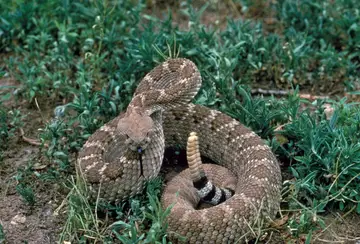

NPS El Malpais: the prairie rattlesnake is smaller and similarly colored, but has no black-and-white striping at the base of the rattle. National Park Service
Also venomous; NPS says to give the prairie rattlesnake equal respect.
Prairie Rattlesnake or Mojave rattlesnake?
Prairie Rattlesnake
Mojave rattlesnake Crotalus scutulatus
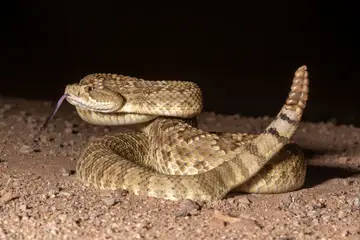
New Mexico's BISON-M notes that some southeastern Arizona grassland Mojave rattlesnakes look like prairie rattlesnakes. BISON-M
Also venomous and dangerous.
Where the prairie rattlesnake lives
- Native or listed
- Nonnative or not established
- No official record in our data
- 1–9
- 10–99
- 100–999
- 1,000+
On our state guides
- Arizona snakes
- Colorado snakes
- Idaho snakes
- Iowa snakes
- Kansas snakes
- Montana snakes
- Nebraska snakes
- New Mexico snakes
- North Dakota snakes
- Oklahoma snakes
- Oregon snakes
- South Dakota snakes
- Texas snakes
- Utah snakes
- Wyoming snakes
State boundaries: U.S. Census Bureau, cartographic boundary file cb_2024_us_state_20m.
When it is active
Active from about late March to April or May until fall, and inactive in winter dens. In hot summer weather mostly active at dusk and at night; by day in spring and on mild days. CPW advises extra caution around dawn and dusk. Colorado Parks and Wildlife
US open-licence records peak in May to July and September.
Habitat and habits
Habitat: Open, dry country: short- and mixed-grass prairie, plains grassland and sandhills, sagebrush and semidesert shrubland, badlands, foothills and ponderosa pine or pinyon-juniper woodland. Often near rock outcrops, south-facing slopes and prairie dog towns. In Colorado up to about 7,500 to 9,500 feet; in South Dakota's Black Hills rarely above 5,000 feet. Montana Natural Heritage Program (Montana State Library), Montana Field Guide
Behavior: An ambush predator that uses heat-sensing pits to find prey. Dens communally in winter, often in the same den year after year, and may range up to 7 miles from the den in summer. Usually timid and avoids confrontation, but may rattle if cornered.
Diet: Mostly small mammals (mice, ground squirrels, prairie dogs, chipmunks, rabbits), plus birds, lizards, amphibians and other snakes; killed with venom from an ambush.
Young: Bears live young (no eggs) in late summer to early fall, about 4 to 21 per litter (Montana, Wyoming; NPS gives 8 to 17, Nebraska 8 to 18). Females often breed every other year.
Legal status and reporting
Protection: State endangered in Iowa. Protected inside national parks, as all wildlife is. Colorado Parks and Wildlife: never try to catch, kill, provoke or move a rattlesnake. Iowa Legislature
Report: Not invasive. Wyoming Game and Fish asks that incidental observations be reported to its herpetology program. Wyoming Game and Fish Department
Questions about the prairie rattlesnake
Prairie rattlesnake
A venomous rattlesnake of the Great Plains and western grasslands: tan, olive, greenish or brown with dark blotches down the back that become rings near the tail, a triangular head, vertical pupils and a rattle. It is usually 3 to 4 feet long (up to about 5 feet). It usually avoids people, but bites happen when it is provoked or handled. Leave it alone and keep at least five feet away (CPW). If bitten, call 911 or Poison Help at 1-800-222-1222.
Prairie rattlesnake in south dakota
Yes. The National Park Service says the prairie rattlesnake is South Dakota's only venomous snake, and it is the only venomous snake at Badlands and Wind Cave. South Dakota Game, Fish and Parks says it is found on the southern end of the Mickelson Trail in the Black Hills but rarely above 5,000 feet. Wind Cave notes it in prairie dog towns and rocky areas.
Prairie rattlesnakes in colorado
Yes. Colorado Parks and Wildlife says the prairie rattlesnake is found throughout most of Colorado except the high mountains, up to about 7,500 to 9,500 feet, and is fairly common in many areas. CPW lists it among Colorado's venomous snakes. If you hear one, freeze, find it, then move at least five feet away; never try to catch, kill or move it. If bitten, call 911.
Prairie rattlesnakes in iowa
Yes, but very rare. Iowa DNR says Iowa has only four venomous snakes and that the prairie rattlesnake and copperhead are even rarer than the timber rattlesnake and massasauga. The prairie rattlesnake is listed as endangered in Iowa. The sources collected do not say where in Iowa it occurs.
Prairie rattlesnakes in kansas
Yes. The Kansas Department of Wildlife and Parks says the prairie rattlesnake is one of only four native venomous snakes in Kansas and is found in the western half of the state.
Prairie rattlesnakes in montana
Yes. The Montana Field Guide lists it as a native species that is relatively common in suitable habitat and widely distributed across parts of the state, favoring open, dry country, south-facing slopes and rock outcrops, and also ponderosa pine stands. It is a Montana Species of Greatest Conservation Need. No other Montana snake has a rattle.
Prairie rattlesnakes in wyoming
Yes. Wyoming Game and Fish says prairie rattlesnakes occur in all counties east of the Continental Divide and in Carbon County west of the Divide, and lists it as a Species of Greatest Conservation Need. At Devils Tower it is common and is the only venomous species.
Sources
- Online Field Guide species account: Prairie Rattlesnake (Crotalus viridis). Arizona Game and Fish Department. 2023; checked November 3, 2026.
Quoted passages (4)
“This rattlesnake is capable of delivering large amounts of potent venom. If encountered it should be left alone.”
“PRAIRIE RATTLESNAKE Crotalus viridis”
“On the end of the tail is a rattle composed of a series of loosely interlocking keratinous sections.”
“The pupils are vertically elliptical.”
- Prairie Rattlesnakes in the Badlands. National Park Service (Badlands National Park). updated April 16, 2021; checked November 3, 2026.
- Reptiles - Theodore Roosevelt National Park. National Park Service. updated January 6, 2021; checked November 3, 2026.
- Reptiles and Amphibians - Wind Cave National Park. National Park Service. updated January 25, 2023; checked November 3, 2026.
Quoted passages (2)
“Rattlesnakes can be identified by their triangular head, slit shaped pupils, and rattle.”
“Bullsnakes can be identified by their oval shaped head and large, round pupils.”
- Prairie Rattlesnake - Crotalus viridis (Montana Field Guide). Montana Natural Heritage Program (Montana State Library), Montana Field Guide. archived copy, captured September 9, 2026; checked November 3, 2026.
Quoted passages (6)
“…they range in length from 15 to 60 inches”
“No other snake in Montana has rattles (see Gophersnake and Western Hog-nosed Snake).”
“…the young are marked similarly to adults, but colors are brighter.”
“Prairie Rattlesnakes favor open and arid country but are also found in ponderosa pine stands and mixed grass-coniferous forests. They are more likely to be encountered on south-facing slopes and in areas with rock outcrops.”
“Prairie Rattlesnakes den communally, but range up to 7 miles from the dens during the summer.”
“Females give birth to 4 to 21 young in late summer”
- Prairie Rattlesnake - Crotalus viridis (State Wildlife Action Plan species account). Wyoming Game and Fish Department. 2017; checked November 3, 2026.
Quoted passages (2)
“The Prairie Rattlesnake’s diet consists of rodents such as ground squirrels, prairie dogs, chipmunks and cottontail rabbits, as well as amphibians, lizards, other snakes, and birds.”
“Incidental observations are encouraged to be reported to the herpetology program.”
- Rattlesnakes in North Dakota (wildlife note). North Dakota Game and Fish Department. undated page; checked November 3, 2026.
- Nebraska's Venomous Snakes (NEBRASKAland Magazine). Nebraska Game and Parks Commission. July 11, 2022; checked November 3, 2026.
- 2018 Weekly News 7-19-18 (teaser: Be Snake Savvy and Be Safe In the Outdoors). Kansas Department of Wildlife and Parks. archived copy, captured January 22, 2026; checked November 3, 2026.
- Species profile: Prairie Rattlesnake. Colorado Parks and Wildlife. undated page; checked November 3, 2026.
Quoted passages (2)
“Horny rattle or button on end of tail; numerous small scales on top of head; head much broader than neck; pit on each side of face between (but lower than) eye and nostril”
“During the coldest months of the year, they shelter in winter dens and usually resume activity in late March or early April.”
- Checklist of Oklahoma Amphibians and Reptiles. Sam Noble Oklahoma Museum of Natural History (SNOMNH) Herpetology, hosted by the Oklahoma Biological Survey, University of Oklahoma. PDF created 2014-09-09, modified 2016-06-06; checked November 3, 2026.
- Venomous Snake Safety (Texas Junior Naturalists). Texas Parks and Wildlife Department. undated page; checked November 3, 2026.
- BISON-M Species Booklet 030180: Prairie Rattlesnake (Crotalus viridis). New Mexico Department of Wildlife (BISON-M, with Natural Heritage New Mexico). updated December 22, 2025; checked November 3, 2026.
- 6 Cool Things You Should Know About Snakes (news release). Iowa Department of Natural Resources (Iowa DNR). October 28, 2014; checked November 3, 2026.
- Iowa Administrative Code 571-77.2(481B) Endangered and threatened animals. Iowa Legislature (rule of the Iowa Natural Resource Commission / DNR). [ARC 0267D, IAB 5/13/26, effective 6/17/26]; checked November 3, 2026.
Quoted passages (1)
“77.2(1) Endangered animal species: … Prairie Rattlesnake Crotalus viridis”
- Reptiles - Devils Tower National Monument. National Park Service. updated April 24, 2025; checked November 3, 2026.
- Reptiles - El Malpais National Monument. National Park Service. updated May 6, 2025; checked November 3, 2026.
Quoted passages (1)
“Although prairie rattlesnakes are smaller than western diamondback rattlesnakes, prairie rattlesnake coloration is similar with a range of green to brown with a series of brown or black blotches. No black and white striping is present at the base of the rattle.”
- BISON-M Species Booklet 030165: Mojave Rattlesnake. New Mexico Department of Wildlife (BISON-M). updated August 28, 2024; checked November 3, 2026.
Quoted passages (1)
“Some SE Arizona grassland Mojaves look like prairie rattlers (C. v. viridis)”
- George S. Mickelson Trail: Trail Safety. South Dakota Game, Fish and Parks. undated page; checked November 3, 2026.
- Quick Key to Amphibians and Reptiles of Colorado. Colorado Parks and Wildlife. archived copy, captured October 11, 2023; checked November 3, 2026.
- Iowa Wildlife Action Plan (2025 revision) - All Appendices (Appendix 3 amphibians, 4 reptiles, 5-6 birds, 7 mammals, 11 bumble bees, 16 T&E). Iowa Department of Natural Resources (Iowa DNR). Plan submitted to USFWS December 31, 2025 and approved; checked November 3, 2026.
- GBIF.org occurrence records, human observations licensed CC0 1.0 or CC BY 4.0 only, accessed November 3, 2026. The datasets behind these counts are listed on our Sources page.
- State boundaries: U.S. Census Bureau, cartographic boundary file cb_2024_us_state_20m.