Wolf spiders
Lycosidae · Last checked November 3, 2026.
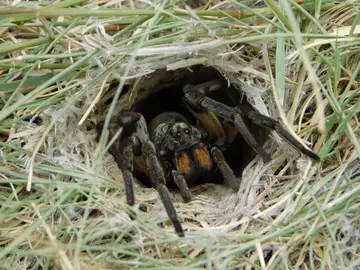

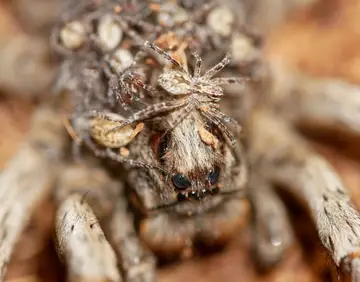
Wolf spiders (family Lycosidae) are hairy, usually brown, gray or black hunting spiders, often striped, that run down their prey instead of catching it in a web. Females carry their egg sac on their spinnerets and then carry the spiderlings on their back. Like nearly all spiders they have venom, but it is not considered dangerous: Penn State Extension says they bite if mishandled or trapped against the skin, causing pain, redness and possibly some swelling that usually goes away within 24 hours, with no serious medical consequences noted. Texas A&M AgriLife says they pose no danger to people or pets, but warns that people allergic to spider venom may react severely to any spider bite. Penn State counts about 240 species in the United States, and official guides from California to New York describe them. Penn State Extension
This page covers a family (Lycosidae), not a single species.
On this page
Are wolf spiders dangerous?
Penn State Extension: no serious medical consequences of wolf spider bites have been noted. Penn State Extension
“No serious medical consequences of these bites have been noted.”
Bites and stings: Penn State Extension: wolf spiders bite if mishandled or trapped next to the skin; typical reactions are initial pain and redness, possibly some local swelling, generally gone within 24 hours.
If someone is bitten or stung, call 911 or Poison Help at 1-800-222-1222.
How to identify wolf spiders
A photo or description can narrow it down, but cannot confirm what an animal is or that it is safe. Look from a distance and do not handle wild animals.
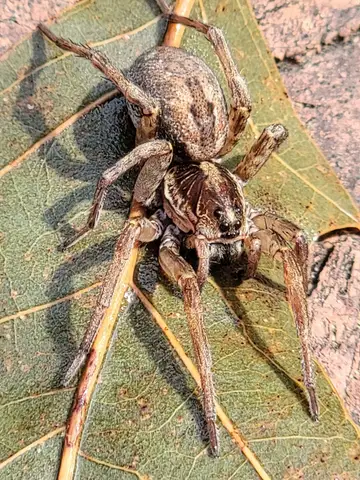
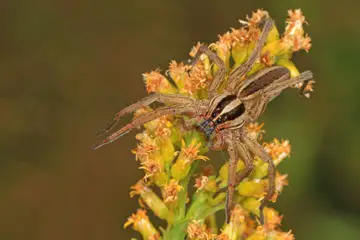

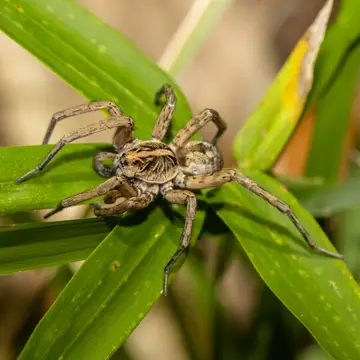
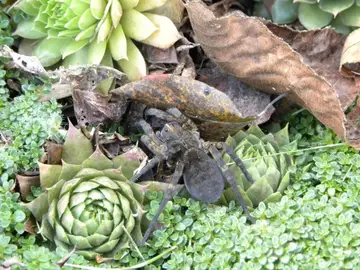
Size: Body length (legs not included) from 1/4 inch to 1 inch depending on species; males usually smaller than females (Missouri). Ohio's pirate wolf spiders are smaller: mature females may be only 1/8 inch (Ohio DNR). Some species reach about 2 inches (Clemson); the large Hogna carolinensis female is 22 to 35 mm (Penn State). Missouri Department of Conservation
Colors: Usually gray, brown, black or tan with dark brown or black markings, especially stripes; usually brown and black, may have lengthwise stripes. Pattern: Stripes or mottling on body and legs.
Key features
- Eight eyes: a front row of 4 small eyes, a middle pair of larger eyes, and a widely spaced rear pair on top of the head University of California Statewide IPM Program
- Long, hairy legs; hunt on the ground, no prey-catching web Virginia Cooperative Extension, Virginia Tech
- Eyes shine back (green) in a flashlight beam at night University of California Statewide IPM Program
- Female carries the egg sac attached to the spinnerets at the tip of the abdomen Virginia Cooperative Extension, Virginia Tech
- Only spiders in the world known to carry their young on their backs UF/IFAS Extension
Young
Spiderlings ride on the mother's abdomen, sometimes in several layers, for about a week before dispersing (Clemson); up to two weeks or more (Missouri)
Animals mistaken for wolf spiders
Wolf spiders or Brown recluse?
Wolf spiders
Brown recluse Loxosceles reclusa
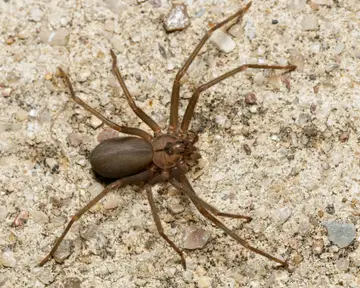
A brown recluse never has stripes or bands on its legs, or spots or multiple stripes on its abdomen (Virginia Cooperative Extension), so banded legs or stripes point to a wolf spider, not a recluse (University of Kentucky). Some wolf spiders have solid-colored legs (Penn State: Hogna carolinensis), so the definitive check is the eyes: a brown recluse has six eyes in three pairs in a semicircle, while most other spiders have eight (a good hand lens is needed); wolf spiders have 4 small eyes in a front row, a middle pair of larger eyes and a widely spaced rear pair (UC IPM). Recluses are also less hairy than wolf spiders (UF/IFAS). University of Kentucky Department of Entomology
Venomous and medically significant: CDC/NIOSH lists the brown recluse as a venomous spider of the United States; its venom can cause a severe lesion by destroying skin tissue (skin necrosis) that will require professional medical attention.
Wolf spiders or Fishing / nursery web spiders?
Wolf spiders
Fishing / nursery web spiders Pisauridae
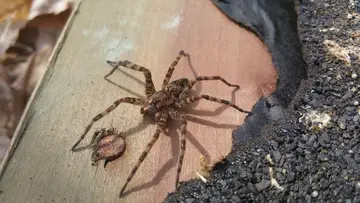

Fishing spiders carry egg sacs in their jaws, swim and walk on water, do not carry babies on their backs and lack the two large forward-facing eyes; nursery web spiders have smaller eyes and hold their legs more widely to the sides. Missouri Department of Conservation
Ohio DNR: fishing spiders are not considered dangerous to humans; they can bite if handled carelessly, and the consequences, while painful, are not serious.
Wolf spiders or Jumping spiders?
Wolf spiders
Jumping spiders Salticidae
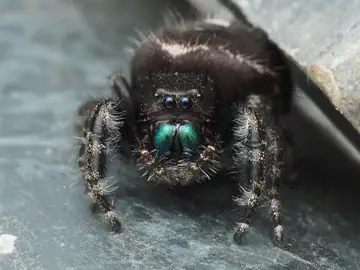
Both have enlarged central eyes, but wolf spiders have a row of four small eyes below the four larger ones; wolf spiders run smoothly on the ground, often at night, while jumpers hunt on plants by day, move jerkily and jump great distances. Missouri Department of Conservation
Texas A&M AgriLife: like most spiders, jumping spiders are not hazardous to humans and are unlikely to bite unless cornered or handled.
Wolf spiders or Tarantulas?
Wolf spiders
Tarantulas Theraphosidae
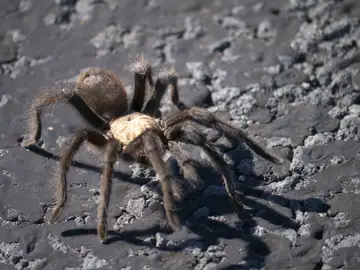

Tarantulas are much larger and heavier. Missouri Department of Conservation
Texas A&M AgriLife: tarantulas rarely bite and at worst the bite is less harmful than a bee sting (people allergic to spider venom may react severely to any spider bite); they may pierce the skin with their fangs if disturbed, and in American tarantulas the barbed abdominal hairs may irritate the skin.
Wolf spiders or Grass spiders?
Wolf spiders
Grass spiders Agelenidae
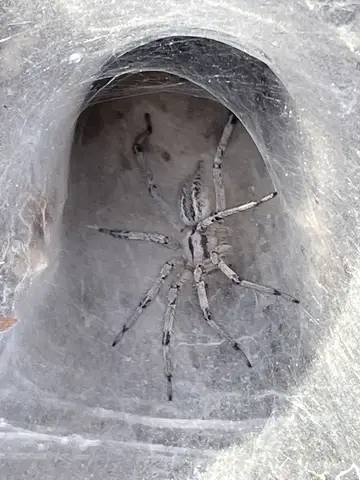
Grass spiders live in flat sheet webs with a funnel hole and have long spinnerets visible from above. Missouri Department of Conservation
Where wolf spiders live
- Native or listed
- Nonnative or not established
- No official record in our data
- 1–9
- 10–99
- 100–999
- 1,000+
State boundaries: U.S. Census Bureau, cartographic boundary file cb_2024_us_state_20m.
When it is active
Mainly active at night, but some are active by day, especially along streams and lakes; hunting in summer Clemson University Cooperative Extension, Home & Garden Information Center
US open-licence records for all wolf spiders (family Lycosidae) peak in April to September.
Habitat and habits
Habitat: Ground habitats: stream edges, gravel or sand bars, low vegetation, woodland leaf litter; some dig burrows or use cavities under rocks or logs; often enter homes Missouri Department of Conservation
Behavior: Do not spin webs to catch prey; they chase it down or wait for it. Rabidosa and Hogna species form webbing only as daytime shelter (Texas A&M); UC IPM says they make a small, thick web where they rest.
Diet: Mainly ground-dwelling insects and other spiders; houseflies, crickets, cockroaches, occasionally grasshoppers
Young: Egg sac may hold over 100 eggs (Clemson). In Hogna carolinensis and Tigrosa aspersa, mating is in autumn, males die before winter, females overwinter and make egg sacs in May or June; spiderlings hatch June-July (Penn State)
Questions about wolf spiders
Is a wolf spider poisonous?
Wolf spiders have venom, like nearly all spiders (Virginia Cooperative Extension: all spiders use venom to kill their prey), but it is not considered dangerous. Ohio DNR says the venom of Ohio's spiders has little effect on humans or pets and that the field wolf spider's bite is not considered dangerous. Penn State Extension says wolf spiders bite if mishandled or trapped against the skin, causing pain, redness and possibly some swelling that generally goes away within 24 hours, and that no serious medical consequences have been noted. Texas A&M AgriLife says people allergic to spider venom may react severely to any spider bite. If someone has a bad reaction, call 911 or Poison Help at 1-800-222-1222.
Is a wolf spider dangerous to humans?
Not considered dangerous. Texas A&M AgriLife Extension says wolf spiders pose no danger to people or pets, Ohio DNR says the field wolf spider's bite is not considered dangerous, and Penn State Extension notes no serious medical consequences from their bites. They can bite if handled or trapped against the skin, and anyone allergic to spider venom may react severely to any spider bite (Texas A&M AgriLife).
Wolf spider bite
Penn State Extension: bites happen when the spider is mishandled or trapped next to the skin; typical reactions are initial pain and redness, possibly some local swelling, generally gone within 24 hours. For a severe reaction, call 911 or Poison Help at 1-800-222-1222.
Wolf spider vs brown recluse
Check the eyes: a brown recluse has six eyes in three pairs, while wolf spiders have eight, with a front row of four small eyes (a good hand lens is needed). A brown recluse never has stripes or bands on its legs or multiple stripes on its abdomen (Virginia Cooperative Extension), so bands or stripes point to a wolf spider; but some wolf spiders have solid-colored legs (Penn State), so leg color alone does not prove a recluse. UC IPM says a recluse has uniformly colored legs without spines and a body no more than 3/8 inch long. CDC/NIOSH lists the brown recluse as venomous; its venom can destroy skin tissue and the lesion requires professional medical attention.
Wolf spider with babies on back
This is normal wolf spider behavior: after the eggs hatch, the spiderlings climb onto the mother's abdomen and ride there for about a week (Clemson) or up to two weeks or more (Missouri) before dispersing. UF/IFAS says wolf spiders are the only spiders known to carry their young on their backs.
Wolf spider web
Wolf spiders do not spin webs to catch prey; they run it down or wait for it. Texas A&M AgriLife says Rabidosa and Hogna species make webbing only as a daytime shelter, and UC IPM says wolf spiders make a small, thick web where they rest.
Wolf spider size
Body length (legs not included) runs from about 1/4 inch to 1 inch depending on species (Missouri); Ohio's tiny pirate wolf spiders may be only 1/8 inch (Ohio DNR), and some species reach about 2 inches (Clemson). Penn State gives 22 to 35 mm for Hogna carolinensis females.
Is a wolf spider a tarantula?
No. Wolf spiders are family Lycosidae. Missouri Department of Conservation lists tarantulas as a similar group that is much larger and heavier.
Is a wolf spider a jumping spider?
No. Missouri Department of Conservation says that, unlike jumping spiders, wolf spiders have a row of four small eyes below the four larger ones, run smoothly over the ground and often hunt at night. Jumpers hunt on plants by day, move jerkily and jump great distances.
Fishing spider vs wolf spider
Fishing spiders carry their egg sacs in their jaws, swim and walk on water, do not carry babies on their backs and lack the two large forward-facing eyes (Missouri). NY DEC says nursery web spiders have smaller eyes and hold their legs more widely to the sides.
Wolf spider florida
Yes, wolf spiders live in Florida: UF/IFAS includes them among common Florida spiders. UF/IFAS says the only spiders native to or established in Florida with medically significant venom are the widow spiders.
Sources
- Wolf Spiders. Penn State Extension. updated September 8, 2025; checked November 3, 2026.
Quoted passages (2)
“No serious medical consequences of these bites have been noted.”
“Both of these spiders are found in similar habitats and have similar habits. … Mating occurs in the autumn, and the males die before the onset of winter. The fertilized females overwinter in protected locations, including human-made structures, and produce egg cocoons the following May or June. The spiderlings hatch in June and July and will attain only half of their full size by the following winter.”
- Wolf Spiders (MDC Field Guide). Missouri Department of Conservation. undated page; checked November 3, 2026.
Quoted passages (8)
“Length (not including legs): from ¼ inch to 1 inch (varies by species; males are usually smaller than females).”
“These solitary, wandering spiders live in a variety of ground habitats: stream edges, gravel or sand bars, low vegetation, and woodland leaf litter. Some dig burrows or tunnel into natural cavities under flat rocks or logs; some have no home at all.”
“Ground-dwelling insects and other spiders make up the bulk of their diet.”
“Wolf spiders, with their excellent vision and superb running abilities, chase down and grab their prey. Also, they can hold still and wait for insects to crawl near enough to catch. They do not spin webs to catch their prey.”
“Fishing spiders, such as the dark fishing spider, carry their egg sacs in their jaws, swim in and walk on water, don't carry their babies on their backs, and don't have the two large forward-facing eyes.”
“The eye configuration is similar to that of jumping spiders: The two center eyes of the top row are enlarged. But unlike jumpers, wolf spiders have a row of four small eyes below the four larger ones. Also, wolf spiders run smoothly over the ground and often hunt at night, while jumpers hunt in plants during the day, move jerkily, and jump great distances.”
“Tarantulas are much larger and heavier.”
“Grass spiders live in webs that look like flattened sheets with a funnel hole; also, the spinnerets at the hind end are long and easily seen from above.”
- Spiders (E-408 6/06), Jackman, Brown, Engler & Merchant. Texas A&M AgriLife Extension Service. 6/06; checked November 3, 2026.
- Spiders of Medical Concern in Virginia (ENTO-73NP / ENTO-346NP). Virginia Cooperative Extension, Virginia Tech (T.A. Dellinger, E. Day). Publication Date August 1, 2025; checked November 3, 2026.
Quoted passages (3)
“All spiders use venom to kill their prey, but many spiders are not nearly as aggressive or dangerous as they are presented in urban legends and the media.”
“Wolf spiders are large, hairy, active predators with long legs. … These are ground dwelling spiders that hunt their prey and do not spin webs.”
“Females carry their egg sac attached to their spinnerets at the tip of their abdomen.”
- Pest Notes: Brown Recluse and Other Recluse Spiders (UC ANR Publication 7468). University of California Statewide IPM Program (UC ANR, Cooperative Extension). 2018-11; checked November 3, 2026.
- Common spiders brochure (11 species and groups). NYSDEC, text by Cornell University Department of Entomology, reprinted from New York State Conservationist. June 2007; checked November 3, 2026.
- Pest Notes: Spiders (UC ANR Publication 7442). University of California Statewide IPM Program (UC ANR, Cooperative Extension). 2020-10; checked November 3, 2026.
Quoted passages (2)
“Have a distinctive pattern of eyes: 4 small eyes in front in a straight row, one middle pair of larger eyes, and one rear pair of widely spaced eyes on top of the head.”
“They can be found at night by using a flashlight; their eyes reflect green.”
- ENY2080 An Introduction to Some Common and Charismatic Florida Spiders (Powell & Taylor). UF/IFAS Extension (EDIS). Original publication date February 2023; checked November 3, 2026.
Quoted passages (1)
“Wolf spiders are the only spiders in the world known to carry their offspring on their backs.”
- Wolf Spiders (HGIC 2450). Clemson University Cooperative Extension, Home & Garden Information Center. Published May 2, 2001 (HGIC 2450; checked November 3, 2026.
Quoted passages (2)
“There can be several layers of spiderlings holding onto each other. The young only stay on the mother’s abdomen for about a week before they disperse.”
“Wolf spiders are mainly active at night, feeding during early evening hours, but they also are found active during the day along streams and lakes.”
- Brown Recluse Spider (Entfact 631). University of Kentucky Department of Entomology (Cooperative Extension). page 'Revised: 3/26'; checked November 3, 2026.
Quoted passages (1)
“The banding on the legs of this wolf spider is one indication that it is not a brown recluse. A more definitive diagnostic feature is the eye pattern -- brown recluses have a semi-circular arrangement of six eyes (three groups of two) while most other spiders have 8 eyes. Seeing this feature requires a good quality hand lens.”
- Common Spiders of Ohio Field Guide (Publication 5140). Ohio Department of Natural Resources, Division of Wildlife (text by Richard A. Bradley, Ph.D.). PUBLICATION 5140; checked November 3, 2026.
- Venomous Spiders at Work. CDC/NIOSH. archived copy, captured October 6, 2026; checked November 3, 2026.
- GBIF.org occurrence records, human observations licensed CC0 1.0 or CC BY 4.0 only, accessed November 3, 2026. The datasets behind these counts are listed on our Sources page.
- State boundaries: U.S. Census Bureau, cartographic boundary file cb_2024_us_state_20m.