Jumping spiders
Salticidae · also called jumper, bold jumper, zebra jumper and salticid · Last checked November 3, 2026.
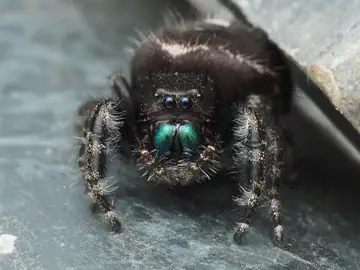
Jumping spiders (family Salticidae) are small, compact, often hairy and boldly colored spiders with two very large forward-facing eyes. They hunt by day without webs, stalking and leaping onto insects. Like most spiders they have venom, but extension sources say they are not medically important: they are shy, rarely bite unless handled or cornered, and a bite usually causes only minor, short-lived pain, itching or swelling. People allergic to spider venom may react more severely. Official sources describe them around homes and gardens across much of the US. Penn State Extension
This page covers a family (Salticidae), not a single species.
On this page
Are jumping spiders dangerous?
Not medically significant: jumping spiders do not have a medically significant bite (Penn State Extension) and are not hazardous to humans (Texas A&M AgriLife). Penn State Extension
“Like other jumping spider species, these small, boldly patterned spiders do not have a medically significant bite and are considered beneficial to have around.”
Bites and stings: Rare. Penn State: bold jumpers generally do not bite when handled; when bites occur, minor pain, itching, swelling and redness may last one to two days. Texas A&M: at worst less harmful than a bee sting, but people allergic to spider venom may react severely.
If someone is bitten or stung, call 911 or Poison Help at 1-800-222-1222.
How to identify jumping spiders
A photo or description can narrow it down, but cannot confirm what an animal is or that it is safe. Look from a distance and do not handle wild animals.
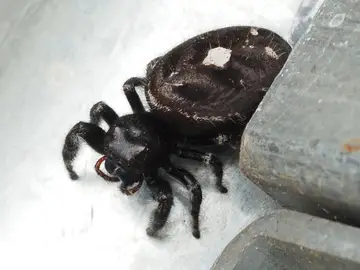
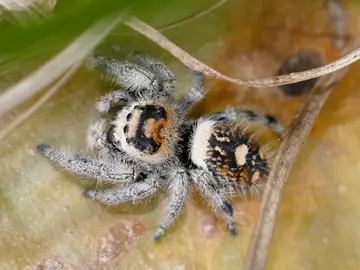
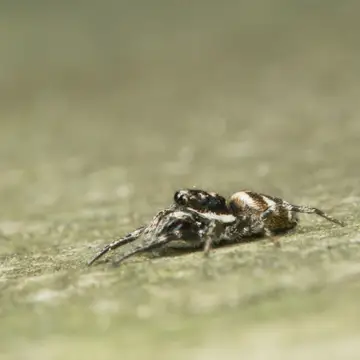
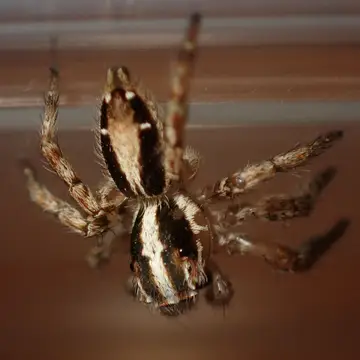
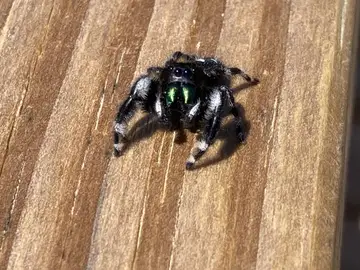
Size: Small: zebra jumper 4-6.4 mm; bold jumper (one of the largest, genus Phidippus) females 8-19 mm, males 6-13 mm. Penn State Extension
Colors: many colors; often bold black-and-white bands, velvety red abdomens or metallic jaws; bold jumper: black with white, yellow or orange spots and iridescent green jaws. Pattern: zebra jumper: white stripes on a dark body.
Key features
- two very large forward-facing front eyes (all jumping spiders) UF/IFAS Extension
- eight eyes, one large pair in front; stocky body Texas A&M AgriLife Extension Service
- no web; leaps on prey and trails a silk safety line Texas A&M AgriLife Extension Service
- turns to look at you NYSDEC, text by Cornell University Department of Entomology, reprinted from New York State Conservationist
Young
Bold jumper young have orange spots that turn white in adults.
Animals mistaken for jumping spiders
Jumping spiders or Wolf spiders?
Jumping spiders
Wolf spiders Lycosidae
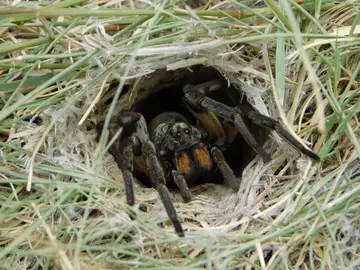

Virginia Cooperative Extension: wolf spiders are large, hairy hunters with long legs, usually brown with darker stripes or mottling on the body and legs. Virginia Cooperative Extension, Virginia Tech
Virginia Cooperative Extension lists wolf spiders under 'Species Often Mistaken as Being Dangerous'.
Jumping spiders or Black widow?
Jumping spiders
Black widow Latrodectus
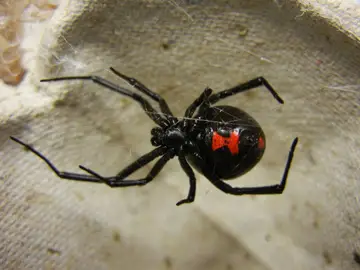

UF/IFAS: widow spiders have characteristic red markings on their large round abdomens and build a messy cobweb where they usually hang upside down. UF/IFAS Extension
Venomous and medically significant: UF/IFAS says widow spiders have medically significant venom, meaning people may require medical care if bitten.
Where jumping spiders live
- Native or listed
- Nonnative or not established
- No official record in our data
- 1–9
- 10–99
- 100–999
- 1,000+
State boundaries: U.S. Census Bureau, cartographic boundary file cb_2024_us_state_20m.
When it is active
Daytime (they need daylight to hunt). Bold jumpers overwinter nearly mature, become adults in April-May and lay eggs in June-July (Penn State, Pennsylvania). Penn State Extension
US open-licence records for all jumping spiders (family Salticidae) peak in April to July and September.
Habitat and habits
Habitat: Outdoors on plants and man-made structures; around homes on windowsills, tree trunks, deck railings and under stones; bold jumpers occasionally wander into buildings and houses. Virginia Cooperative Extension, Virginia Tech
Behavior: Active daytime hunters with good eyesight that stalk prey and attack in a fast leap; male jumping spiders court females by moving their brightly colored jaws, palps or leg tufts (NY DEC); the bold jumper is territorial (Texas A&M AgriLife).
Diet: Insects and other spiders, caught by stalking and leaping; the large regal jumping spider occasionally takes small frogs or lizards but mostly eats insects.
Young: Bold jumper female suspends her eggs in a silken sheet in her retreat; eggs in June-July.
Legal status and reporting
Invasive status: Most are native; some species are introduced, e.g. the zebra jumper from Eurasia (Penn State) and the pantropical jumper on Louisiana's invasive species list (LDWF). Penn State Extension
Questions about jumping spiders
Jumping spider bite
Bites are uncommon. Penn State Extension says bold jumpers generally do not bite even when handled, and bites cause minor pain, itching, swelling and redness for one to two days. Texas A&M AgriLife says the bite is at worst less harmful than a bee sting, but people allergic to spider venom may react severely. For any severe reaction, call 911 or Poison Help at 1-800-222-1222.
Jumping spider food
In the wild they eat insects and other spiders, which they stalk and leap on in daylight (NY DEC). The large regal jumping spider occasionally takes small frogs or lizards, but UF/IFAS says its diet is mostly insects.
Is a wolf spider a jumping spider?
No. They are different families: jumping spiders are Salticidae and wolf spiders are Lycosidae (Virginia Cooperative Extension). Texas A&M AgriLife notes jumping spiders hunt during the day and wolf spiders hunt at night.
Are there jumping spiders in pennsylvania?
Yes. Penn State Extension says the bold jumper is the most commonly encountered jumping spider in and around Pennsylvania homes.
Are there jumping spiders in virginia?
Yes. Virginia Cooperative Extension's Virginia spider guide says jumping spiders are commonly found outdoors on plants and man-made structures.
Sources
- Bold Jumper Spider. Penn State Extension. updated September 8, 2025; checked November 3, 2026.
Quoted passages (3)
“P. audax is a black, hairy spider measuring 8 to 19 millimeters for the females and 6 to 13 millimeters for the males.”
“In contrast to many other hunting spiders, jumping spiders require daylight to hunt their prey.”
“The P. audax female suspends her eggs in a silken sheet within her retreat.”
- Zebra Jumper. Penn State Extension. updated January 19, 2026; checked November 3, 2026.
Quoted passages (2)
“Like other jumping spider species, these small, boldly patterned spiders do not have a medically significant bite and are considered beneficial to have around.”
“Zebra jumpers are a non-native jumping spider that was introduced from Eurasia.”
- Spiders (E-408 6/06), Jackman, Brown, Engler & Merchant. Texas A&M AgriLife Extension Service. 6/06; checked November 3, 2026.
Quoted passages (4)
“Jumping spiders have eight eyes, with one large pair in the front.”
“Jumping spiders put out a line of webbing when they jump and can sometimes be seen dangling from this silken dragline after a leap that fails.”
“It is black with three spots on the back of the abdomen; these spots are orange in immatures and white in adults.”
“They are active hunters during the day, have good eyesight, and rely primarily on movement to locate prey. They stalk their prey before attacking in a fast leap.”
- ENY2080 An Introduction to Some Common and Charismatic Florida Spiders (Powell & Taylor). UF/IFAS Extension (EDIS). Original publication date February 2023; checked November 3, 2026.
Quoted passages (3)
“Thus, most spiders are venomous (with a few exceptions, see Uloboridae), but few have venom of concern to humans.”
“Like all jumping spiders (i.e., all members of the family Salticidae), Habronattus have enlarged, forward-facing eyes (known as the anterior median eyes) and exceptional vision”
“Widow spiders have characteristic red markings on their large round abdomens. They build a messy cobweb where they usually hang upside down”
- Spiders of Medical Concern in Virginia (ENTO-73NP / ENTO-346NP). Virginia Cooperative Extension, Virginia Tech (T.A. Dellinger, E. Day). Publication Date August 1, 2025; checked November 3, 2026.
Quoted passages (2)
“Jumping spiders are commonly found outdoors on plants and manmade structures.”
“Wolf spiders are large, hairy, active predators with long legs. They are typically colored brown with various patterns of darker stripes or mottling on the body and the legs”
- Common spiders brochure (11 species and groups). NYSDEC, text by Cornell University Department of Entomology, reprinted from New York State Conservationist. June 2007; checked November 3, 2026.
Quoted passages (2)
“Jumping spiders have excellent vision and will often turn to look at you as you approach.”
“They hunt during the day, eating insects and other spiders.”
- GBIF.org occurrence records, human observations licensed CC0 1.0 or CC BY 4.0 only, accessed November 3, 2026. The datasets behind these counts are listed on our Sources page.
- State boundaries: U.S. Census Bureau, cartographic boundary file cb_2024_us_state_20m.