Tarantulas
Theraphosidae · also called Texas brown tarantula, Oklahoma brown tarantula, Missouri tarantula and desert tarantulas · Last checked November 3, 2026.
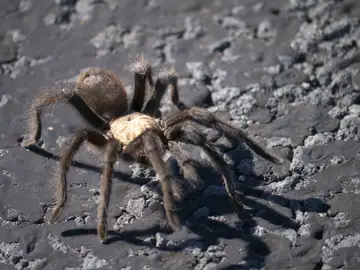

Tarantulas are large, hairy, burrowing spiders. Like almost all spiders they have venom, but official sources say the bite is not medically significant for people, something like a bee sting, though it can be painful; Texas A&M AgriLife adds that people allergic to spider venom may react severely to any spider bite. Their abdominal hairs can irritate skin and are dangerous in the eyes. In the US they live mainly in the South-Central and Southwest states: official sources confirm Arizona, California, Missouri, New Mexico, Oklahoma, Louisiana and Texas. Florida has one small introduced population. Missouri Department of Conservation
This page covers a family (Theraphosidae), not a single species.
On this page
Are tarantulas dangerous?
Missouri Department of Conservation: tarantulas are not aggressive to humans and their venom has no medical significance for people, something like a bee sting. Arizona Poison and Drug Information Center: when provoked enough they bite, and the fangs can cause painful puncture wounds.
Bites and stings: Rarely, and usually only when provoked or handled. The bite can cause painful puncture wounds. Official sources compare it to a bee sting or say it is less harmful than one, but Texas A&M AgriLife says people allergic to spider venom may react severely to any spider bite.
If someone is bitten or stung, call 911 or Poison Help at 1-800-222-1222.
How to identify tarantulas
A photo or description can narrow it down, but cannot confirm what an animal is or that it is safe. Look from a distance and do not handle wild animals.
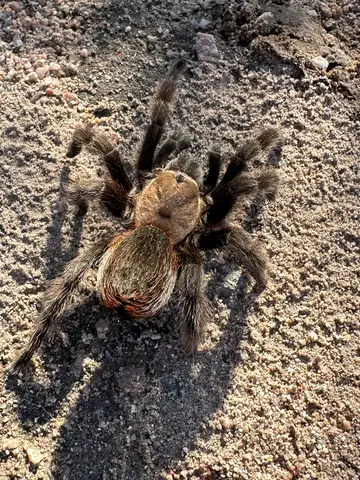
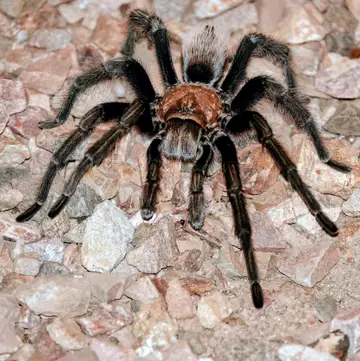
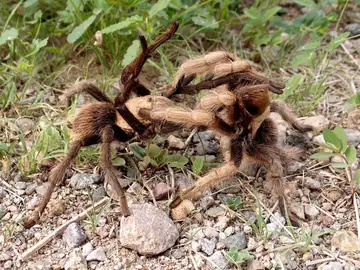
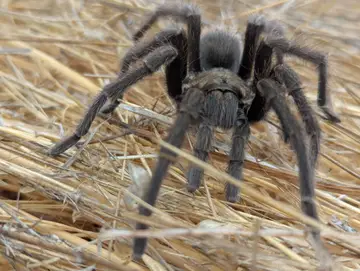

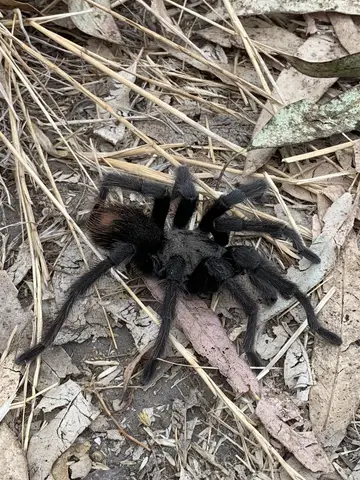
Size: Texas brown tarantula: body length about 2 inches in females and 1.5 inches in males; leg span 4 to 5 inches. Arizona: adults 2 to 4 inches.
Colors: Light to dark brown, with the abdomen and legs densely covered in hair; texas brown tarantula: uniformly dark chocolate brown with reddish hairs on the carapace; florida (introduced Mexican redrump): entirely black except long red to reddish-brown hairs on top of the abdomen.
Key features
- Stocky and hairy; Missouri's largest spider. Missouri Department of Conservation
- Does not spin webs to catch prey; lives in a silk-lined burrow. Missouri Department of Conservation
- When provoked, rears up on its back legs and shows its fangs. Oklahoma Department of Wildlife Conservation
Where tarantulas live
- Native or listed
- Nonnative or not established
- No official record in our data
- 1–9
- 10–99
- 100–999
- 1,000+
State boundaries: U.S. Census Bureau, cartographic boundary file cb_2024_us_state_20m.
When it is active
Nocturnal. Wandering males are seen in late summer and fall in Missouri, usually starting in September in Oklahoma, June to October in Arizona, and for a few weeks in early summer in Texas; in Louisiana, females and particularly males may become more active during the spring and summer mating season.
US open-licence records for all tarantulas (family Theraphosidae) peak in July to October.
Habitat and habits
Habitat: Burrows in dry rocky glades (Missouri), sandy uplands under rocks and logs (Louisiana), and on or in the ground in the Southwest.
Behavior: Shy and quick to avoid people; much more likely to flee and hide than attack.
Diet: Insects such as crickets and grasshoppers; in Arizona also cockroaches and newborn mice.
Young: Females guard egg cases in the burrow; young stay with the mother about a week. Females may live more than 30 years; males far less.
Legal status and reporting
Protection: Missouri: illegal to collect tarantulas from public land without a permit. Louisiana ranks the Texas brown tarantula S3 (rare); that is a conservation rank, and the LDWF page does not say it is legally protected. New Mexico: BISON-M lists A. hentzi as not protected by the State of New Mexico.
Invasive status: Florida: the introduced Mexican redrump is established locally; UF/IFAS says it would be irresponsible to assume it will not harm native wildlife, and eradication has been attempted. UF/IFAS Extension
Questions about tarantulas
Are there tarantulas in florida?
No native tarantula is stated for Florida. One non-native species, the Mexican redrump tarantula, has a small established population in a citrus grove area in St. Lucie County, first found in 1996 (UF/IFAS).
Are there tarantulas in texas?
Yes. Texas A&M AgriLife says most Texas tarantulas are in the genus Aphonopelma.
Are there tarantulas in california?
Yes. UC IPM says California tarantula bites are not likely to be serious, at worst similar to a bee sting.
Are there tarantulas in arizona?
Yes. University of Arizona Extension says 30 species are known to live in Arizona.
Are there poisonous tarantulas in arizona?
Arizona tarantulas are venomous, but UA Extension says they bite only when seriously provoked and there are no records of serious harm to humans from their bites. The Arizona poison center says bites are unlikely to cause problems other than pain, and the hairs cause itching and a rash. Call 911 or Poison Help 1-800-222-1222.
Are there tarantulas in missouri?
Yes. The Texas brown tarantula, apparently the only native species, lives mainly in south and central Missouri on dry rocky glades.
Are there tarantulas in oklahoma?
Yes. ODWC says the Oklahoma brown tarantula can be seen throughout Oklahoma, most commonly in the southwest.
Are there tarantulas in louisiana?
Yes, but rarely seen. LDWF says the Texas brown tarantula occurs in central to north-central Louisiana and westward to Texas.
What states have tarantulas?
Official sources used here confirm tarantulas in Arizona, California, Louisiana, Missouri, New Mexico, Oklahoma and Texas. The Oklahoma agency adds Kansas and Arkansas. Florida has one introduced local population. Other states were not checked; this is not a complete list.
Sources
- Texas Brown Tarantula (Field Guide). Missouri Department of Conservation. undated page; checked November 3, 2026.
Quoted passages (3)
“The Texas brown tarantula is a stocky, hairy species and is Missouri's largest spider.”
“…tarantulas don't spin webs to catch their prey … where they spend their days in silk-lined burrows in abandoned rodent or reptile tunnels or in other natural cavities”
“Females secure their egg cases in silken webbing attached to the inner walls of their burrows, and they guard the eggs until they hatch. Often, the young stay with the mother for about a week before dispersing. … Females may live for more than 30 years”
- Pest Notes: Spiders (UC ANR Publication 7442). University of California Statewide IPM Program (UC ANR, Cooperative Extension). 2020-10; checked November 3, 2026.
- LDWF species profile: Texas Brown Tarantula. archived copy, captured August 22, 2023; checked November 3, 2026.
- Backyard Gardener #90: Tarantulas. University of Arizona Cooperative Extension, Yavapai County. dated March 26, 2023; checked November 3, 2026.
- Brown Tarantula (Field Guide). Oklahoma Department of Wildlife Conservation. undated page; checked November 3, 2026.
Quoted passages (1)
“If provoked enough, the tarantula will stand on its back legs and show its fangs to try intimidating whatever is threatening it.”
- Spiders (E-408 6/06), Jackman, Brown, Engler & Merchant. Texas A&M AgriLife Extension Service. 6/06; checked November 3, 2026.
- BISON-M species booklet: Tarantula, Aphonopelma hentzi (SpeciesID 300160). New Mexico Department of Wildlife (BISON-M, with Natural Heritage New Mexico). updated January 31, 2023; checked November 3, 2026.
- Mexican Redrump Tarantula, Brachypelma vagans (EENY287). UF/IFAS Extension (authors: Florida Dept. of Agriculture and Consumer Services, Division of Plant Industry). original May 2003; checked November 3, 2026.
Quoted passages (1)
“…it would be irresponsible to assume that they will not have a deleterious effect on native wildlife. With this in mind, eradication … has been attempted, so far unsuccessfully.”
- Bees, Spiders & Other Bugs. Arizona Poison and Drug Information Center (University of Arizona College of Pharmacy). 2026 (footer copyright; checked November 3, 2026.
- GBIF.org occurrence records, human observations licensed CC0 1.0 or CC BY 4.0 only, accessed November 3, 2026. The datasets behind these counts are listed on our Sources page.
- State boundaries: U.S. Census Bureau, cartographic boundary file cb_2024_us_state_20m.