Fishing spider
Dolomedes · also called Dark fishing spider (Dolomedes tenebrosus), Six-spotted / spotted fishing spider (Dolomedes triton), Striped fishing spider (Dolomedes scriptus) and White-banded fishing spider (Dolomedes albineus) · Last checked November 3, 2026.
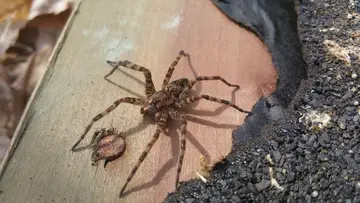

Fishing spiders (genus Dolomedes) are large, brown, hairy spiders that do not spin webs to catch prey. Most live at the edges of ponds, streams and swamps, where they run across the water surface and can catch insects, tadpoles and small fish; the dark fishing spider often lives in woods far from water and sometimes wanders into homes. Like most spiders they have venom, but extension and state wildlife sources say they are not considered dangerous to people: bites are rare, and are typically no worse than a bee or wasp sting, except in people who are sensitive to spider venom. Official sources confirm them in states including Maine, Pennsylvania, Ohio, Michigan, Wisconsin, Missouri, North Carolina, Mississippi and Florida. Penn State Extension
This page covers a genus (Dolomedes), not a single species.
On this page
Is the fishing spider dangerous?
Not considered dangerous to humans (Ohio DNR); not particularly dangerous to people or pets (Michigan State University Extension); venom not dangerously toxic to humans (NC State Extension). Ohio Department of Natural Resources, Division of Wildlife
“Despite their formidable appearance, fishing spiders are not considered dangerous to humans.”
Bites and stings: Rare; the spiders are shy and run away. A bite is painful, typically no more severe than a bee or wasp sting, but people sensitive to spider venom can react more strongly.
If someone is bitten or stung, call 911 or Poison Help at 1-800-222-1222.
How to identify a fishing spider
A photo or description can narrow it down, but cannot confirm what an animal is or that it is safe. Look from a distance and do not handle wild animals.
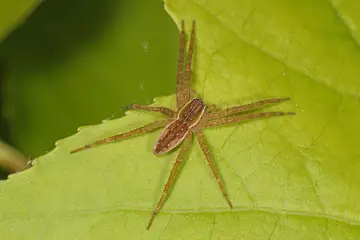

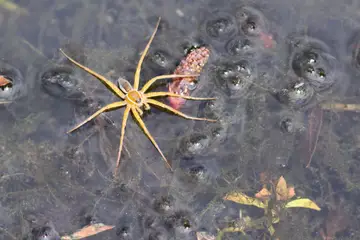
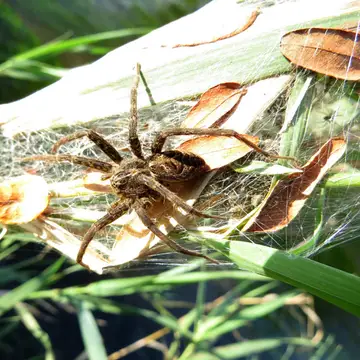
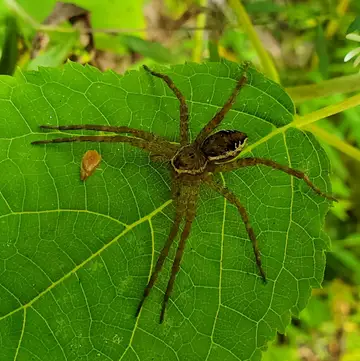
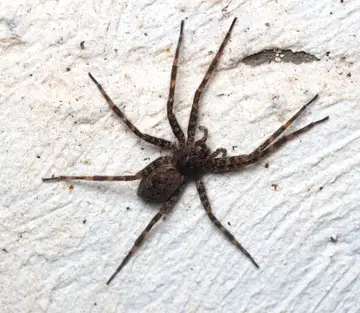
Size: Large. Dark fishing spider females about 5/8 to 1 inch body length (15-26 mm), males 1/4 to 1/2 inch; with legs up to about 3 1/2 inches, and Ohio DNR gives a leg span of up to four inches. Six-spotted (spotted) fishing spider females about 3/4 inch body length, males about 1/2 inch (MDC). Ohio Department of Natural Resources, Division of Wildlife
Colors: Brownish gray to dark brown, with black and lighter brown markings (dark fishing spider); mottled black and brown with dark W-shaped marks on the abdomen (dark fishing spider); six-spotted fishing spider: dark with a pale whitish-yellow stripe around the carapace and pairs of small white spots down the abdomen. Pattern: Banded legs; striped fishing spider has white W markings on the rear of the abdomen.
Key features
- Does not build a web to catch prey; often rests head-down or vertically on tree trunks, wood or stone Missouri Department of Conservation
- Legs typically held almost straight out Missouri Department of Conservation
- Runs on the water surface and can dive underwater Missouri Department of Conservation
- Females carry the large egg sac in their jaws Ohio Department of Natural Resources, Division of Wildlife
Young
Spiderlings hatch into a 'nursery web' of leaves tied together by the female, who guards them; a brood can number 1,000 or more.
Animals mistaken for the fishing spider
Fishing spider or Wolf spiders?
Fishing spider
Wolf spiders Lycosidae
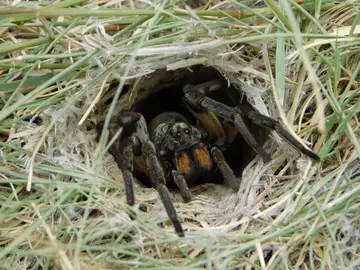

With a hand lens: fishing spiders' front four eyes form a curved row (outer two higher), wolf spiders' front four are in a straight, forward-facing row. Fishing spiders carry the egg sac in their jaws and build a nursery web; wolf spiders carry the egg sac behind them on the spinnerets and carry spiderlings on their backs. NC State Extension
NC State Extension covers both groups together: venom not dangerously toxic to humans.
Fishing spider or Brown recluse?
Fishing spider
Brown recluse Loxosceles reclusa
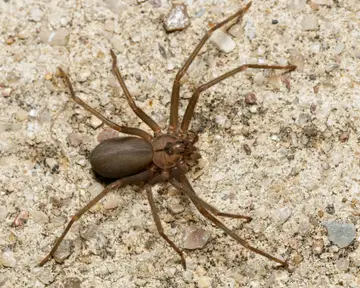
A recluse has six eyes (most spiders have eight), a dark violin shape on the head (not always reliable), long slender legs, and is less hairy than fishing spiders. UF/IFAS Extension
Medically important: Penn State lists the brown recluse among the most medically important spiders.
Where the fishing spider lives
- Native or listed
- Nonnative or not established
- No official record in our data
- 1–9
- 10–99
- 100–999
- 1,000+
State boundaries: U.S. Census Bureau, cartographic boundary file cb_2024_us_state_20m.
When it is active
Spring through early fall. Penn State Extension says mature dark fishing spiders are found early May through September; the Ohio DNR gives adult seasons of about May to late September (chocolate-brown fishing spider). They overwinter as nearly mature spiders under stones, bark or in buildings, so large individuals can appear early in spring.
US open-licence records for all fishing spiders (genus Dolomedes) peak in April to August.
Habitat and habits
Habitat: Most species live at ponds, slow or quiet streams, swamps and other damp places; the dark fishing spider is often found in woods far from water and can wander into buildings near woods.
Behavior: Shy and fast; they usually run from people. They hunt by ambush or stalking rather than with webs, sense prey through vibrations on the water surface, and can dive and stay underwater for a while. Dark fishing spiders hunt mostly at night.
Diet: Mainly insects and other invertebrates; can also catch tadpoles, small fish and other small vertebrates.
Young: The female carries the egg sac in her jaws, then ties leaves together into a nursery web where the young hatch, and guards them. Females often kill and eat males before, during or after mating.
Questions about the fishing spider
Fishing spider bite
Bites are rare because fishing spiders are shy and run away. Extension sources say a bite is painful but typically no more severe than a bee or wasp sting, except in people who are sensitive to spider venom. Ohio DNR says they are not considered dangerous to humans. If someone has a serious reaction, call 911 or Poison Help at 1-800-222-1222.
Fishing spider size
Dark fishing spider females are about 5/8 to 1 inch long in the body (15-26 mm) and males about 1/4 to 1/2 inch; with legs they reach about 3 1/2 inches, and Ohio DNR gives a leg span of up to four inches.
Fishing spider vs wolf spider
They look alike: both are large, brown and hairy. With a hand lens, a fishing spider's front four eyes form a curved row, while a wolf spider's front four are in a straight row facing forward. Fishing spiders carry the egg sac in their jaws and build a nursery web; wolf spiders carry the egg sac on their spinnerets and carry babies on their backs. NC State says neither has venom that is dangerously toxic to humans.
Fishing spider michigan
Yes. Michigan State University Extension says fishing spiders were brought to its diagnostic lab and to the Kalamazoo office, calls the dark fishing spider 'one of our largest spiders' that sometimes gets into homes, and says fishing spiders are not particularly dangerous to people or pets.
Fishing spider nc
Yes. NC State Extension says fishing spiders and wolf spiders are the largest non-web-building spiders in North Carolina, and that their venom is not dangerously toxic to humans.
Fishing spider ohio
Yes. Ohio DNR's Common Spiders of Ohio field guide includes several fishing spiders and calls the common fishing spider one of the largest spiders in Ohio; it says fishing spiders are not considered dangerous to humans.
Fishing spider pa
Yes. Penn State Extension lists the fishing spider among commonly encountered Pennsylvania spiders and says bites are typically no more severe than a bee or wasp sting.
Fishing spider wisconsin
Yes. The UW-Green Bay Cofrin Center for Biodiversity says the dark fishing spider is the largest spider in northeast Wisconsin.
Sources
- Fishing Spider (Insect Advice from Extension). Penn State Extension. updated January 19, 2026; checked November 3, 2026.
Quoted passages (1)
“The young are guarded by the female in a nursery web and may number 1,000 or more.”
- Fishing Spiders (Home and Garden IPM fact sheet). University of Maine Cooperative Extension. published 2019-03-21; checked November 3, 2026.
- Common Spiders of Ohio Field Guide (Publication 5140). Ohio Department of Natural Resources, Division of Wildlife. Publication 5140, publication date 7/12; checked November 3, 2026.
Quoted passages (3)
“Despite their formidable appearance, fishing spiders are not considered dangerous to humans.”
“With a leg span of up to four inches (20 cm), this is one of the largest spiders in Ohio.”
“Like all members of the fishing spider family (pisauridae), female chocolate-brown fishing spiders carry their egg case held in the fangs.”
- Fishing Spiders and Wolf Spiders. NC State Extension. Publication date Sept. 11, 2017; checked November 3, 2026.
Quoted passages (1)
“With a hand lens it is possible to see the eyes of fishing spiders are on top of the carapace (first body segment) and the front four are arranged with the outer two higher than the inner two. On the other hand, four of the eyes of wolf spiders are definitely on top, but the front four are arranged in a straight line, visible from the top, but definitely facing forward.”
- Aquatic Spiders (Field Guide). Missouri Department of Conservation. undated page; checked November 3, 2026.
Quoted passages (1)
“They are able to run across the surface of water much like water striders and will dive for prey, including small tadpoles or aquatic insects.”
- Fishing spiders (MSU Crop Advisory Team Alerts archive). Michigan State University Extension. June 11, 2010; checked November 3, 2026.
- Fishing spiders, Dolomedes (Econotes). Cofrin Center for Biodiversity, University of Wisconsin-Green Bay. 2005 Econote; checked November 3, 2026.
- Dark Fishing Spider, Bug's Eye View Vol. 8, No. 25. Mississippi State University Extension Service. 2022 (newsletter volume/issue; checked November 3, 2026.
- Dark Fishing Spider (Field Guide). Missouri Department of Conservation. undated page; checked November 3, 2026.
Quoted passages (2)
“This is not a web-building spider; instead, it is often found resting upside down or vertically on wood or stone surfaces.”
“The legs, typically held almost straight out, are often banded with brown and a darker color.”
- ENY2080 An Introduction to Some Common and Charismatic Florida Spiders. UF/IFAS Extension (EDIS). Original publication date February 2023; checked November 3, 2026.
Quoted passages (2)
“Thus, most spiders are venomous (with a few exceptions, see Uloboridae), but few have venom of concern to humans.”
“Recluses can be distinguished from other commonly encountered spiders by having only 6 eyes (unlike the more usual pattern of 8 eyes) and a dark violin-shaped pattern on their relatively flat cephalothorax (head), though the violin pattern is not always consistent and should not be relied upon for identification. They also have long, slender legs and are relatively less hairy than other spiders that they are commonly confused with (e.g., wolf spiders [Figure 7], fishing spiders [Figure 11], and male southern house spiders [Figure 6a]).”
- Commonly Encountered Pennsylvania Spiders. Penn State Extension. undated page; checked November 3, 2026.
- Fishing spider (What insect is this?). University of Minnesota Extension. undated page; checked November 3, 2026.
- Wolf Spiders (Field Guide). Missouri Department of Conservation. undated page; checked November 3, 2026.
- GBIF.org occurrence records, human observations licensed CC0 1.0 or CC BY 4.0 only, accessed November 3, 2026. The datasets behind these counts are listed on our Sources page.
- State boundaries: U.S. Census Bureau, cartographic boundary file cb_2024_us_state_20m.