This page lists 2 spiders.
2 are venomous by official accounts.
Not every species: no complete official list of Michigan spiders exists, so this page covers the ones state and Extension sources name. How lists are built.
Which spiders can hurt you
Official sources single out these spiders in Michigan, in their own words:
Venomous, medically important. “…is a medically important arachnid whose bite can cause severe necrosis in a small number of cases.” Michigan State University Extension
Ticks (arachnids, not spiders)
Official sources single out these ticks in Michigan, in their own words:
Body about 7 to 12 mm (about 3/8 inch); females average about 9 mm and males about 8 mm. UC IPM says a recluse body is not more than 3/8 inch long.
How to recognize it
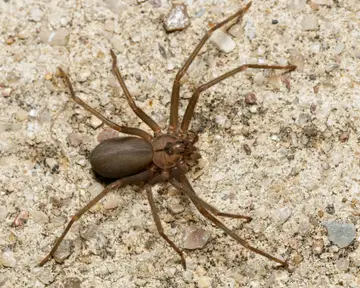
Six equal-sized eyes in three pairs. UC IPM calls this the most definitive feature, since most spiders have eight eyes.
The violin mark alone is not a reliable way to identify it
UC IPM's five-point check: six eyes in pairs, evenly colored finely haired abdomen, no spines on the legs, evenly colored legs, body no more than 3/8 inch
Where in Michigan
Isolated populations confirmed in Genesee, Hillsdale and Ingham counties (2011), Tecumseh (Lenawee Co., 2015), Ann Arbor (Washtenaw Co., 2016), Davison (Genesee Co. … Michigan State University Extension
What the sources say
Venom: “The brown recluse spider, Loxosceles reclusa (Sicariidae), is a medically important arachnid whose bite can cause severe necrosis in a small number of cases. However, most recluse bites are minor with no necrosis.” (Michigan State University Extension)
Range: Isolated populations confirmed in Genesee, Hillsdale and Ingham counties (2011), Tecumseh (Lenawee Co., 2015), Ann Arbor (Washtenaw Co., 2016), Davison (Genesee Co., 2017)
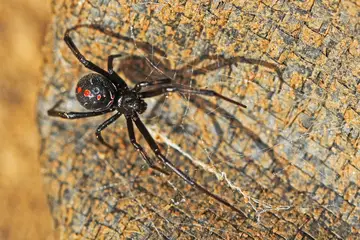
Venom: “Only two dangerous groups of venomous spiders - the widow spiders, and the Brown Recluse (fiddleback or violin spider) and its kin - are of medical importance in the United States.” (Michigan State University Cooperative Extension Service)
Habitat: It occurs in marginal land where the vegetation is rather sparse, often hiding in old stumps, hollow logs, under fallen fence posts, abandoned animal burrows or piles of dead tree branches and other debris. (Michigan State University Cooperative Extension Service)
When spiders are active in Michigan
Records of spiders in Michigan peak in June to September. They show when people record spiders, not how many there are (about month bars).
JanFebMarAprMayJunJulAugSepOctNovDec
2,150 records of spiders in Michigan by month (GBIF, CC0 and CC BY records).
If you are bitten or stung
Call 911 or Poison Help at 1-800-222-1222 right away. Poison Help connects you to your local poison center, any time of day.
Rarely. MSU Extension has confirmed a few isolated populations north of the native range (Genesee, Hillsdale, Ingham, Lenawee and Washtenaw counties, 2011-2017). Michigan State University Extension
“In 2011, I reported the discovery of three isolated populations of brown recluse spiders in Michigan ’s Genesee, Hillsdale and Ingham counties.”
“Only two dangerous groups of venomous spiders - the widow spiders, and the Brown Recluse (fiddleback or violin spider) and its kin - are of medical importance in the United States.”
“The degree of severity of the symptoms depends a great deal on the sensitivity and age of the victim, with small children being most severely affected.”
“The brown recluse spider, Loxosceles reclusa (Sicariidae), is a medically important arachnid whose bite can cause severe necrosis in a small number of cases. However, most recluse bites are minor with no necrosis.”
“…is a medically important arachnid whose bite can cause severe necrosis in a small number of cases.”
“In 2011, I reported the discovery of three isolated populations of brown recluse spiders in Michigan ’s Genesee, Hillsdale and Ingham counties.”
Tick Borne Illnesses in Michigan (MSU Extension Bulletin E-2765). Michigan Department of Community Health; Michigan Department of Natural Resources; Michigan Department of Agriculture; Michigan State University Extension. Issued 2001; checked November 3, 2026.Quoted passages (2)
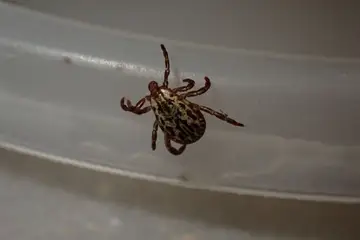
“American Dog tick, Dermacentor variabilis. This tick is the most common tick in the state and is found throughout Michigan.”
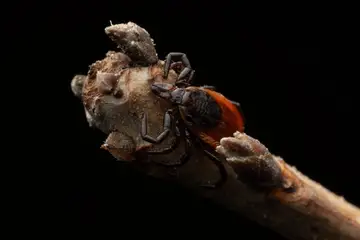
“…people and animals by the bite of an infected Ixodes scapularis tick.”