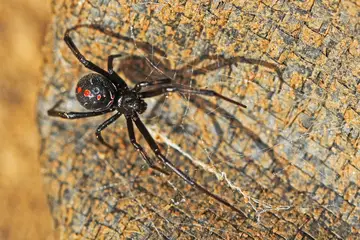
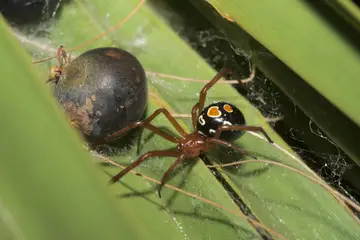
MSU Extension (1970): the Northern Widow can be found throughout the Lower Peninsula, mostly outdoors in stumps, logs and debris.
Michigan State University Cooperative Extension Service: “In Michigan the Northern Widow, (Latrodectus variolus,) can be collected throughout the Lower Peninsula.” Source
Rarely. MSU Extension has confirmed a few isolated populations north of the native range (Genesee, Hillsdale, Ingham, Lenawee and Washtenaw counties, 2011-2017). Michigan State University Extension
Venom: “Only two dangerous groups of venomous spiders - the widow spiders, and the Brown Recluse (fiddleback or violin spider) and its kin - are of medical importance in the United States.” (Michigan State University Cooperative Extension Service)
Habitat: It occurs in marginal land where the vegetation is rather sparse, often hiding in old stumps, hollow logs, under fallen fence posts, abandoned animal burrows or piles of dead tree branches and other debris. (Michigan State University Cooperative Extension Service)
Official presence. 15 states where a state list or official source names it. Gray means no official record in our data, not that it is absent.
Native or listed
Nonnative or not established
No official record in our data
Observation records. Open-licence records on GBIF for the three US black widows (Latrodectus mactans, L. variolus and L. hesperus) in 44 states. Records are sightings people shared, not confirmation that a population lives there.
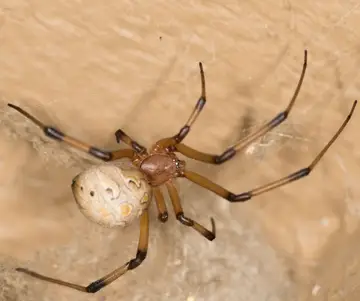
Chocolate brown and never has red on the belly; slightly smaller than a mature western black widow (about 3/8 in body length); egg sac looks like a cotton ball with indistinct margins. Caution: UC IPM says a black widow's hourglass can be almost imperceptible or, rarely, completely absent, so a lack of red alone does not rule out a black widow.
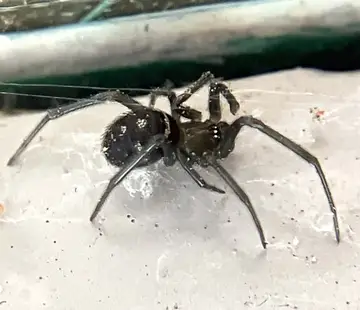
No red hourglass and not pure black; looks purplish-brown in bright light, and larger ones have a light T-shaped mark on the abdomen. Caution: a black widow's hourglass can rarely be almost or completely absent (UC IPM), so a lack of red alone does not rule out a black widow.
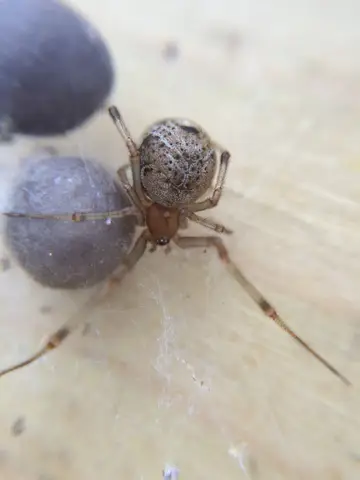
Usually a mottled mix of tan, brown and gray, with a lengthwise stripe and diagonal side stripes; colour varies from almost white to almost black, and very dark ones are flat black rather than shiny black. Mature females are smaller than mature female western black widows (about 3/8 in body length). The egg sac is covered in silk bumps, like a very large pollen grain; UC IPM calls the egg sac a much surer way to confirm a brown widow. Caution: brown widows also have a red hourglass on the underside (UF/IFAS), and a mature brown widow looks very similar to an immature western black widow (UC IPM).
Penn State Extension: the female common house spider is 5 to 6 mm long with a yellowish-brown carapace and a dirty-white to brown abdomen with gray chevrons; its legs are yellow with darker rings at the end of each segment.
Black bears: appreciate from a distance; remove birdfeeders, grease-splattered grills and outdoor pet food, and put garbage out on the day of pickup. A bear in the yard is no reason to panic; scare it off with noise. Michigan Department of Natural Resources
“In Michigan the Northern Widow, (Latrodectus variolus,) can be collected throughout the Lower Peninsula.”
“Only two dangerous groups of venomous spiders - the widow spiders, and the Brown Recluse (fiddleback or violin spider) and its kin - are of medical importance in the United States.”
“The degree of severity of the symptoms depends a great deal on the sensitivity and age of the victim, with small children being most severely affected.”
“Spotting a bear on your trail camera or wandering through your backyard is no reason to panic. You do not need to call local authorities or the DNR. This is natural bear behavior. You can scare the bear off by yelling, blowing an air horn or banging pots and pans.”
Tick Borne Illnesses in Michigan (MSU Extension Bulletin E-2765). Michigan Department of Community Health; Michigan Department of Natural Resources; Michigan Department of Agriculture; Michigan State University Extension. Issued 2001; checked November 3, 2026.Quoted passages (1)
“…variabilis ticks (commonly called wood ticks or dog ticks) are most abundant in spring and early summer. Ixodes scapularis, (Black Legged ticks) are most abundant from spring through the summer, and into the warm months of the fall.”