Green iguana
Iguana iguana · also called iguana and common iguana · Last checked November 3, 2026.
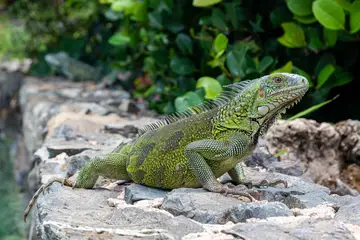

The green iguana is a large non-native lizard. Males can grow over 5 to 6 feet long including the tail. It has a row of spikes down the neck, back and tail, and a large throat flap (dewlap). Despite the name, adults can be green, olive, brown, nearly black or orange. It comes from Central and South America. USGS says green iguanas are established in Florida, Hawaii and Texas, and in Puerto Rico and the U.S. Virgin Islands. In Florida, FWC calls it invasive. UF/IFAS says iguanas are not usually aggressive towards people or pets but can become hazards, and FWC says they can spread Salmonella through their droppings, though UF/IFAS says there is no scientific evidence that wild green iguanas in Florida pass diseases to people. In Hawaii it is illegal to import, possess or transport iguanas. UF/IFAS Extension
On this page
Is the green iguana dangerous?
UF/IFAS: not usually aggressive towards people or pets, but can become serious hazards (e.g. darting into roads, falling from trees in severe cold snaps). FWC: can transmit Salmonella to people through contact with water or surfaces contaminated by their droppings. UF/IFAS adds that captive green iguanas are known carriers of E. coli and Salmonella, but there is no scientific evidence that wild green iguanas in Florida transmit pathogens to humans. UF/IFAS Extension
“Although the iguanas are not usually aggressive towards people or pets, in some cases they can become serious hazards, as several news articles have reported.”
No official source we use states whether this animal is venomous. That does not mean it is harmless: do not handle it.
How to identify a green iguana
A photo or description can narrow it down, but cannot confirm what an animal is or that it is safe. Look from a distance and do not handle wild animals.
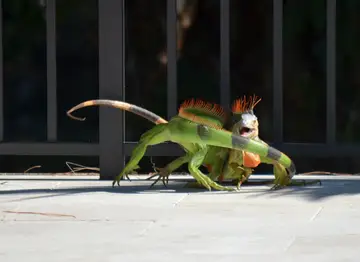
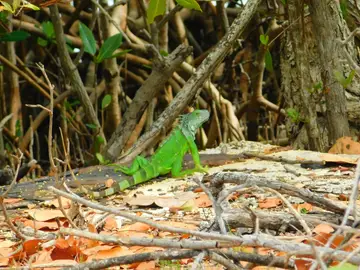
Size: Males over 5 feet (FWC) to over 6 feet (UF/IFAS) including the tail, up to 17 lb; females about 5 feet, usually under 7 lb. Tail up to three quarters of total length. Hatchlings about 7 inches excluding the tail. FWC
Colors: green, sometimes brown or almost black; some adults orange or pink at times; hatchlings bright green; adults bold to dull green, olive or brown; breeding males orange. Pattern: dark black rings on the tail.
Key features
- row of spike-like scales on neck, back and part of the tail (always present in adults, whatever their colour) UF/IFAS Extension
- dewlap (throat flap) and a large round scale at the rear of the jaw UF/IFAS Extension
- long tail, short legs, long toes and sharp claws UF/IFAS Extension
Young
Juveniles are bright green; hatchlings about 7 inches excluding the tail.
Animals mistaken for the green iguana
Green iguana or Black spiny-tailed iguana?
Green iguana
Black spiny-tailed iguana Ctenosaura similis
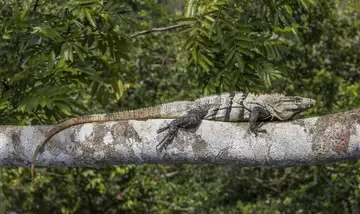

Rings of sharp, pointed scales on the tail (green iguanas have relatively smooth tails); shorter back spines; no enlarged round scale at the rear of the jaw; adults usually brown or gray with dark bands. UF/IFAS Extension
Green iguana or Mexican spiny-tailed iguana?
Green iguana
Mexican spiny-tailed iguana Ctenosaura pectinata
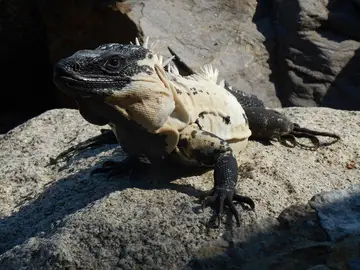

UF/IFAS says it looks almost identical to the black spiny-tailed iguana (the two are hard even for scientists to tell apart), and that spiny-tailed iguanas have rings of pointed scales on their tails, which green iguanas, with their relatively smooth tails, lack. UF/IFAS Extension
Green iguana or Knight anole?
Green iguana
Knight anole Anolis equestris
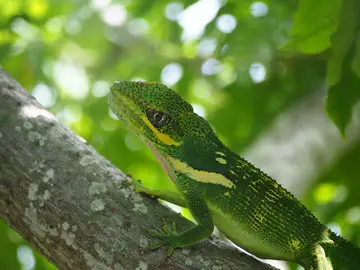

Can be confused with a hatchling green iguana; knight anoles have yellow or white stripes under the eyes and on the shoulders, a more arrow-shaped head and no round scale at the rear of the jaw. UF/IFAS Extension
Where the green iguana lives
- Native or listed
- Nonnative or not established
- No official record in our data
- 1–9
- 10–99
- 100–999
- 1,000+
On our state guides
State boundaries: U.S. Census Bureau, cartographic boundary file cb_2024_us_state_20m.
When it is active
Active by day, often basking; sleeps in trees, rock crevices or burrows at night. UF/IFAS Extension
US open-licence records peak in January to April, June and December.
Habitat and habits
Habitat: On the ground, in shrubs and trees, almost always near water; suburbs, urban areas, canal banks, mangroves and pinelands. Shelters in burrows, culverts, drainage pipes and debris piles. FWC
Behavior: Excellent climbers and swimmers; when startled they dive into water. In cold snaps (30-40 F) they become stiff and may fall from trees.
Diet: Mostly plants: shoots, leaves, flowers and fruit, including many ornamentals. Adults sometimes eat bird eggs and dead animals; juveniles also eat insects and tree snails.
Young: Lays about 10-70 eggs in nest burrows (UF/IFAS; FWC gives 14-76); eggs incubate 2-3 months. In Florida breeding is December-April with hatchlings in summer. Lifespan: up to 10 years in the wild and 19 in captivity (FWC); UF/IFAS says 15-20 years in the absence of predators or competitors.
Legal status and reporting
Protection: Not protected in Florida except by anti-cruelty law (FWC). FWC
Invasive status: Florida: FWC calls it an invasive species and has added it to Florida's Prohibited species list. Hawaii: illegal to import, possess or transport; all Iguanidae are on Hawaii's injurious wildlife list. Louisiana: on the state invasive species list (Tier 3). FWC
Report: Florida: report sightings at IveGot1.org or with the free IveGot1 app (FWC prefers this for iguanas). Hawaii: call the state pest hotline 643-PEST (7378); illegal animals can be surrendered under the state's amnesty program. FWC
Questions about the green iguana
Are there iguanas in florida?
Yes. FWC says green iguanas are an invasive species in Florida. Populations stretch along the Atlantic Coast (Broward, Martin, Miami-Dade, Monroe and Palm Beach counties) and the Gulf Coast (Collier and Lee counties). Iguanas reported farther north are likely escaped or released pets.
What states have iguanas?
USGS says green iguana populations are established in Hawaii, Florida and Texas, as well as Puerto Rico and the U.S. Virgin Islands. Louisiana's wildlife agency also lists the green iguana as a non-native species known to occur there.
Is it illegal to kill an iguana?
In Florida, FWC says green iguanas are not protected except by anti-cruelty law and can be humanely killed on private property with landowner permission. FWC encourages landowners to remove them. Captured iguanas cannot be released elsewhere in Florida. Rules elsewhere were not checked.
Is it legal to kill iguanas?
In Florida, FWC says yes on private property with landowner permission, as long as it is done humanely: green iguanas are protected only by anti-cruelty law. This answer covers Florida only.
Are wild iguanas dangerous?
UF/IFAS says green iguanas are not usually aggressive towards people or pets, but they can become hazards, for example by darting into roads or falling from trees in severe cold snaps. FWC says they can spread Salmonella through contact with water or surfaces contaminated by their droppings; UF/IFAS says captive iguanas are known carriers of Salmonella but there is no scientific evidence that wild green iguanas in Florida transmit pathogens to people. No official source checked says whether they are venomous.
Are there iguanas in hawaii?
Yes, on O'ahu (Hawaii Department of Agriculture), and USGS lists Hawaii among states with established populations. It is illegal to import, possess or transport iguanas in Hawaii; report sightings to 643-PEST (7378).
Are there green iguanas in hawaii?
Yes. USGS says green iguanas are established in Hawaii, and HDOA says they are found on O'ahu, where possessing them is illegal.
Are there iguanas in texas?
USGS lists Texas among states with established green iguana populations but does not say where in Texas. No Texas Parks and Wildlife statement was collected.
Are there green iguanas in texas?
Yes, according to USGS, which lists Texas among states with established green iguana populations. No locality is given.
Are there wild iguanas in louisiana?
LDWF's 2025 State Wildlife Action Plan lists the green iguana on the Louisiana Invasive Species List (Tier 3: non-native species currently known to occur in Louisiana). No locality is given, and USGS does not list Louisiana as having an established population.
Are iguanas illegal?
It depends on the state. In Hawaii it is illegal to import, possess or transport iguanas. In Florida, green iguanas are on the Prohibited species list, and a permit is required to keep pets owned before the rule took effect. Other states' rules were not checked.
Invasive species florida iguana
FWC says green iguanas are not native to Florida and are considered invasive because of their impacts on native wildlife. They damage landscaping and dig burrows that can erode seawalls and canal banks.
Are there native iguanas in florida?
No. FWC says green iguanas are not native to Florida. UF/IFAS describes the spiny-tailed iguanas found in Florida as introduced too.
Green iguana size
Males can grow over 5 feet long and weigh up to 17 pounds (FWC); UF/IFAS says males can exceed 6 feet including the tail. Females reach about 5 feet and usually stay under 7 pounds.
Green iguana diet
Mostly plants: shoots, leaves, flowers and fruit, including ornamental plants. Adults sometimes eat bird eggs and dead animals, and juveniles also eat insects and tree snails (FWC).
Green iguana lifespan
FWC says up to 10 years in the wild and 19 years in captivity; UF/IFAS says 15-20 years without predators or competitors.
Green iguana florida
An invasive lizard in South Florida, most common near the coast and along canals. FWC asks the public to report sightings (IveGot1), and UF/IFAS especially wants reports from outside the known range.
Are there wild iguanas in Alabama, Arizona, California, Georgia and South Carolina?
USGS lists established green iguana populations only in Hawaii, Florida and Texas (plus Puerto Rico and the U.S. Virgin Islands). these states is not on that list, and no official source from these states checked reports wild green iguanas.
Iguanas in nc
USGS lists established green iguana populations only in Hawaii, Florida and Texas (plus Puerto Rico and the U.S. Virgin Islands). North Carolina is not on that list, and no official North Carolina source checked reports wild green iguanas.
Sources
- Florida's Introduced Reptiles: Green Iguana (Iguana iguana) (WEC440). UF/IFAS Extension (EDIS). original publication July 2021; checked November 3, 2026.
Quoted passages (11)
“Although the iguanas are not usually aggressive towards people or pets, in some cases they can become serious hazards, as several news articles have reported.”
“No matter their color, adult green iguanas always have a prominent row of spike-like scales on their back.”
“Green iguanas (Iguana iguana) of all ages have a large flap of skin, called a dewlap, hanging from their throat and a large, round scale at the rear of their jaw.”
“They have long tails but relatively short legs with long toes and sharp claws for climbing.”
“As their common name suggests, green iguanas are usually green, and juveniles are particularly bright green (Figure 1).”
“When startled, they are quick to dive into water (8), only crawling back on land after the perceived threat has passed (Figure 11).”
“They are active during the day and are frequently seen on the ground or in trees and shrubs warming themselves in the sun (basking).”
“They lay approximately 10 to 70 eggs in these nest burrows, and the eggs incubate for 2–3 months with-out parental care (8).”
“As their name implies, spiny-tailed iguanas have rings of sharp, pointed scales on their tails (Figure 8) that are not present on green iguanas.”
“This species looks almost identical to the black spiny-tailed iguana, and the two can be difficult for scientists to distin-guish (9, 10).”
“But knight anoles have yellow or white stripes under their eyes and on their shoulders. Green iguanas do not have stripes under their eyes or on their shoulders.”
- Green Iguana (species profile). Florida Fish and Wildlife Conservation Commission (FWC). archived copy, captured October 9, 2024; checked November 3, 2026. Archived copy.
Quoted passages (5)
“Male green iguanas can grow to over five feet in length and weigh up to 17 pounds. Females can also reach five feet in length but usually do not exceed seven pounds.”
“Green iguanas can live on the ground, in shrubs, or in trees in a variety of habitats including suburban developments, urban areas, small towns, and agricultural areas.”
“Green iguanas feed on a wide variety of vegetation, including shoots, leaves, blossoms and fruits of plants such as nickerbean, firebush, jasmine, orchids, roses, Washington fan palms, hibiscuses, garden greens, squashes and melons.”
“Green iguanas were added to Florida’s Prohibited species list.”
“Like all nonnative reptile species, green iguanas are not protected in Florida except by anti-cruelty law and can be humanely killed on private property with landowner permission.”
- FAQ: Are there invasive reptiles other than Burmese pythons in the United States that people should be concerned about? U.S. Geological Survey. archived copy, captured May 19, 2026; checked November 3, 2026. Archived copy.
- Alligator Lizard Found on Christmas Tree in Hilo and Iguana Captured in Waimanalo (NR19-22). Hawaii Department of Agriculture (now Department of Agriculture & Biosecurity). posted Nov 27, 2019; checked November 3, 2026.
- Report Nonnative Species. Florida Fish and Wildlife Conservation Commission (FWC). archived copy, captured October 25, 2026; checked November 3, 2026. Archived copy.
Quoted passages (1)
“Reporting nonnatives using the IveGot1 app or the IveGot1 website is preferred for lower priority species, such as small nonnative lizards and iguanas.”
- 2025 Louisiana State Wildlife Action Plan. Louisiana Department of Wildlife and Fisheries. 2025 plan; checked November 3, 2026.
- GBIF.org occurrence records, human observations licensed CC0 1.0 or CC BY 4.0 only, accessed November 3, 2026. The datasets behind these counts are listed on our Sources page.
- State boundaries: U.S. Census Bureau, cartographic boundary file cb_2024_us_state_20m.