Gila monster
Heloderma suspectum · also called Gila monster lizard · Last checked November 3, 2026.
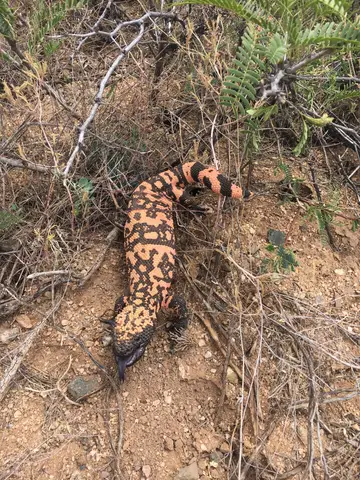
The Gila monster is a large, heavy-bodied lizard with beadlike scales and a black and pink, orange or yellow pattern. It is venomous: the National Park Service says it is the only venomous lizard found in the United States, and a bite is a serious, painful medical emergency. It lives in the deserts of western and southern Arizona and southwestern New Mexico, and in parts of the Mojave Desert in Nevada, Utah and California. It spends most of its life underground and is not aggressive unless harassed or captured. It is protected by state law wherever it occurs. US National Park Service
On this page
Is the Gila monster dangerous?
Gila monsters are venomous. The National Park Service calls a bite a serious and painful medical emergency that always needs a trip to the emergency room.
Bites and stings: Yes, if handled or harassed. NPS says it has no fangs and cannot strike, so a bite always happens when someone puts a body part near its mouth. It may hold on and chew.
If someone is bitten or stung, call 911 or Poison Help at 1-800-222-1222.
How to identify a Gila monster
A photo or description can narrow it down, but cannot confirm what an animal is or that it is safe. Look from a distance and do not handle wild animals.
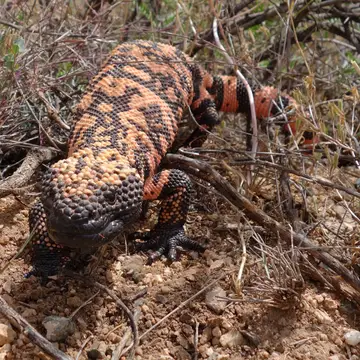
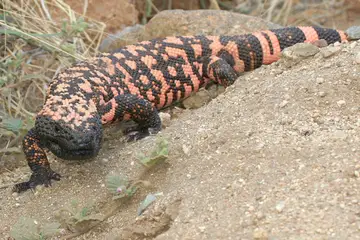
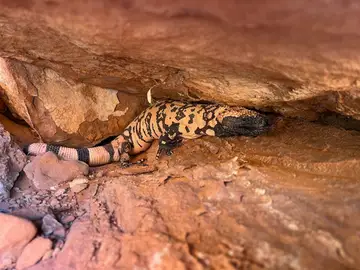
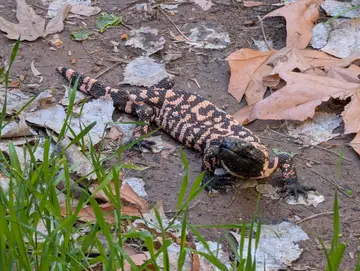
Size: NPS: up to 22 inches (560 mm) long and over a pound (450 g), the largest lizard in the United States. AZGFD: up to 14 inches from snout to vent. NDOW lists 18-24 inches and 2-4 lb.
Colors: Black bands or a black net pattern on a peach, orange, yellow or pink background; black snout. Pattern: Banded in northwestern Arizona; netted (reticulated) or mottled in south-central and southeastern Arizona.
Key features
- Hard, rounded, beadlike scales; dark forked tongue; short fat tail Arizona Game and Fish Department
- Short, stout legs with long, sharp-clawed toes; big head and round tail US National Park Service
Young
Young are banded everywhere in Arizona.
Animals mistaken for the Gila monster
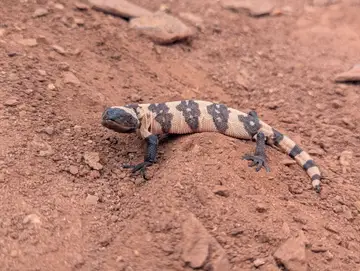
Gila monster or Western banded gecko?
Gila monster
Western banded gecko Coleonyx variegatus
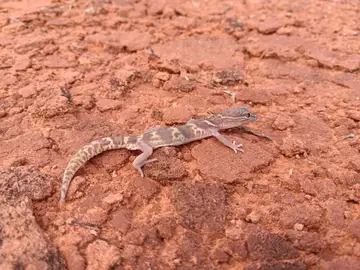
NPS says Gila monster hatchlings are sometimes confused with the banded gecko, a small, thin-skinned lizard. Hatchlings are much larger than an adult banded gecko. US National Park Service
Where the Gila monster lives
- Native or listed
- Nonnative or not established
- No official record in our data
- 1–9
- 10–99
- 100–999
- 1,000+
On our state guides
State boundaries: U.S. Census Bureau, cartographic boundary file cb_2024_us_state_20m.
When it is active
Active by day in spring and fall, at night in the hot summer months; hibernates in winter and late fall Arizona Game and Fish Department
US open-licence records peak in April to May and July to August.
Habitat and habits
Habitat: Desertscrub up into lower woodland. Most common above the flats in rocky drainages, bajadas, hillsides and mountain slopes. Arizona Game and Fish Department
Behavior: Slow and spends most of its time in burrows; above-ground activity may total just 3 weeks a year. Not aggressive unless harassed or captured.
Diet: Nestling mammals and birds, bird and reptile eggs, lizards and carrion. It stores fat in its tail.
Young: AZGFD: mates in spring and summer and lays 2 to 12 eggs in summer; hatchlings emerge the following spring. Other official counts differ: NPS says usually 4 to 5 eggs, NDOW about 12.
Legal status and reporting
Protection: Protected by state law in every state where it occurs (NPS). In Arizona it is illegal to harass, harm, pursue, hunt, shoot, wound, kill, trap, capture or collect one. New Mexico lists it as state endangered, and Nevada lists it as State Protected.
Questions about the Gila monster
What states have gila monsters?
NPS says Gila monsters occur in Arizona, California, Nevada, Utah and New Mexico (and Mexico), and are protected by state law in each.
Are there gila monsters in arizona?
Yes. AZGFD says they are found across most of western and southern Arizona, from just above sea level near Yuma to over 5,500 feet.
Are there gila monsters in california?
Yes. CDFW's complete species list for California includes the Gila monster, and NPS lists California among the states where it occurs.
Are there gila monsters in texas?
NPS lists the states where Gila monsters occur as Arizona, California, Nevada, Utah and New Mexico. Texas is not among them, and no official source we checked places it in Texas.
Are there gila monsters in new mexico?
Yes, in the southwest corner of the state. New Mexico Wildlife says they are well established in Hidalgo and Grant Counties, and they are state endangered there.
Are gila monsters protected?
Yes. NPS says they are protected by state law in every state where they occur. Federal and state protections make it illegal to possess or relocate one (dead or alive), or to harass, injure or kill one.
Are gila monsters illegal?
Wild Gila monsters are protected. In Arizona it is against state law to harass, harm, hunt, kill, capture or collect one. NPS says they are protected by state law in every state where they occur.
Gila monster bite
NPS says the Gila monster is the only venomous lizard found in the United States, and a bite is a serious and painful medical emergency. Call 911 or Poison Help at 1-800-222-1222.
Sources
- Gila Monster - Saguaro National Park. U.S. National Park Service. August 19, 2026; checked November 3, 2026.
Quoted passages (2)
“Short, stout legs possess long toes with sharp claws used in digging and climbing.”
“This may seem small, but hatchlings are considerably larger than the size of an adult Banded Gecko (Coleonyx variegatus), a little, thin-skinned lizard with which it is sometimes confused.”
- Online Field Guide species account: Gila Monster (Heloderma suspectum). Arizona Game and Fish Department. 2023; checked November 3, 2026.
Quoted passages (7)
“The scales on the upper surfaces are hard, rounded, and bead-like. The tongue is dark and forked.”
“Young from all parts of the state are banded.”
“Biotic communities ranging from Arizona’s desertscrubs into the lower reaches of Great Basin Conifer Woodland and Madrean Evergreen Woodland are home to this lizard. It is most commonly found above the flats in rocky drainages and on rugged bajadas, hillsides, and mountain slopes.”
“The Gila Monster is a carnivore that feeds on nestling mammals, nestling birds, the eggs of birds and reptiles, lizards, and carrion. It stores fat in its tail.”
“The relatively slow moving and lethargic Gila Monster spends most of its time in underground burrows. … Its total surface activity may add up to just 3 weeks per year. … It is not aggressive unless it is harassed or captured.”
“It is diurnal in spring and fall and nocturnal during the hot summer months. During the cold months of winter and late fall it hibernates in an underground shelter.”
“Mating takes place in spring and summer and eggs are laid in summer. Clutch size ranges from 2 to 12 eggs. Hatchlings emerge from the nest the following spring.”
- Gila Monster (Heloderma suspectum) Recovery Plan. New Mexico Department of Wildlife (formerly New Mexico Department of Game and Fish). 5 April 2017; checked November 3, 2026.
- Complete List of Amphibian, Reptile, Bird and Mammal Species in California. California Department of Fish and Wildlife (CWHR Program). 2016-05 (document dated "May, 2016"; checked November 3, 2026.
- BISON-M species search export: Squamata. New Mexico Department of Wildlife (BISON-M). database queried November 3, 2026; checked November 3, 2026.
- GBIF.org occurrence records, human observations licensed CC0 1.0 or CC BY 4.0 only, accessed November 3, 2026. The datasets behind these counts are listed on our Sources page.
- State boundaries: U.S. Census Bureau, cartographic boundary file cb_2024_us_state_20m.