Chuckwalla (common chuckwalla)
Sauromalus ater · also called common chuckwalla and western chuckwalla · Last checked November 3, 2026.
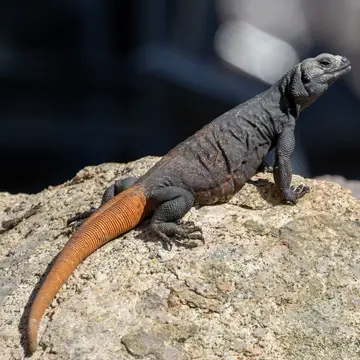
The chuckwalla is a large, flat, heavy-bodied plant-eating lizard of rocky deserts in the Southwest, with loose folds of skin on its neck and sides and a thick, blunt tail. Adults are about 11 to 16.5 inches long. Males are often black on the head and legs with orange-red, gray or black bodies and pale tails; females are gray-brown or mottled and may keep bands, and young are cross-banded. When threatened it squeezes into a rock crevice and inflates itself so it cannot be pulled out. It lives in southern Nevada and Utah, western Arizona and eastern California. Arizona Game and Fish Department
On this page
Is the chuckwalla dangerous?
Bites and stings: No official source checked describes chuckwalla bites.
No official source we use states whether this animal is venomous. That does not mean it is harmless: do not handle it.
How to identify a chuckwalla
A photo or description can narrow it down, but cannot confirm what an animal is or that it is safe. Look from a distance and do not handle wild animals.
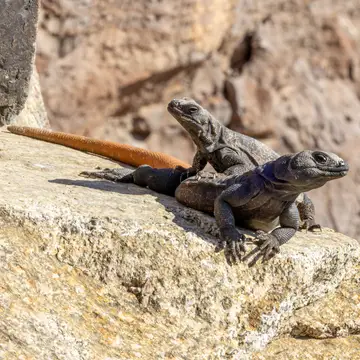
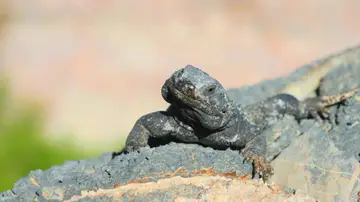

Size: Adults 11 to 16.5 inches (28 to 42 cm) long (AZGFD); up to 9 inches snout to vent. NPS gives up to 20 inches. AZGFD calls it the largest native iguanid in the US. Arizona Game and Fish Department
Colors: Males: black head, shoulders and limbs; body orange-red across most of Arizona (black south of Phoenix, pale gray at Glen Canyon); tail pale gray to cream (orange on South Mountain, Phoenix); females gray-brown with faint mottling or crossbars. Pattern: Young and some adults banded (crossbands on body and tail).
Key features
- Flat, wide body with loose skin folds on neck and sides; flattened broad head; tail blunt at the tip and broad at the base Arizona Game and Fish Department
- Small, granular body scales (Gila monster has large bead-like scales) Arizona Game and Fish Department
- Larger and stockier than other US iguanid lizards, without head spines or enlarged scales along the back Arizona Game and Fish Department
Young
Pale gray with distinct black crossbands on the body and tail.
Animals mistaken for the chuckwalla
Chuckwalla (common chuckwalla) or Gila monster?
Chuckwalla (common chuckwalla)
Gila monster Heloderma suspectum
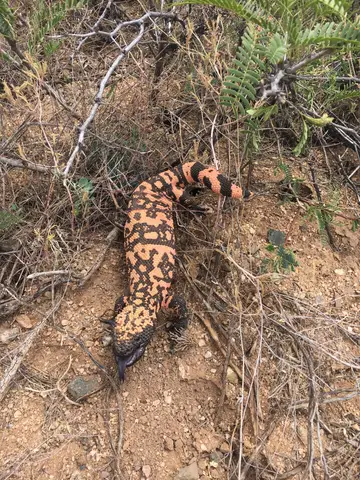
AZGFD: the chuckwalla has small granular body scales; the Gila monster has large bead-like scales. NPS: the Gila monster has bright orange to salmon-pink bands over black skin and a swollen tail. Arizona Game and Fish Department
Venomous. NPS: perhaps the only venomous lizard in the US; it bites when threatened and can move surprisingly fast, though it is not considered particularly dangerous and will prefer to avoid you rather than engage in a confrontation. Call 911 or Poison Help 1-800-222-1222.
Chuckwalla (common chuckwalla) or Desert iguana?
Chuckwalla (common chuckwalla)
Desert iguana Dipsosaurus dorsalis
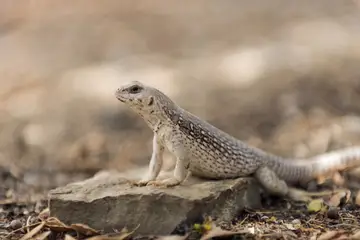

Arizona Game and Fish: the desert iguana has a small, blunt head, a long tail and short, stocky limbs, with a single row of enlarged, pointed scales down the middle of the back. Arizona Game and Fish Department
Where the chuckwalla lives
- Native or listed
- Nonnative or not established
- No official record in our data
- 1–9
- 10–99
- 100–999
- 1,000+
On our state guides
State boundaries: U.S. Census Bureau, cartographic boundary file cb_2024_us_state_20m.
When it is active
Diurnal; basks on rocks by day and is inactive in cold temperatures or extreme heat. Arizona Game and Fish Department
US open-licence records peak in March to May.
Habitat and habits
Habitat: Rocky desert: boulder fields, rock outcrops on hillsides and slopes, cliffs and lava fields, mostly in Sonoran and Mojave desertscrub with creosote bush, from near sea level to about 6,000 feet. Arizona Game and Fish Department
Behavior: Active by day, basking on boulders. When threatened it retreats into a rock crevice and inflates itself with air until it is wedged in. Males hold territories and do 'push-ups' and head-bobs.
Diet: Mainly plants: leaves, buds, flowers (NPS notes yellow flowers such as brittlebush) and fruit, including cactus fruit; occasionally insects.
Young: Mates in spring (May to June); lays one clutch of 5 to 16 eggs underground in summer (June to August). Females may lay only every second year.
Legal status and reporting
Federal: USFWS ECOS lists Sauromalus ater as a 'Species of Concern' (not an ESA listing). The Endangered San Esteban Island chuckwalla is a different species (Sauromalus varius). ECOS
Protection: Arizona: no state status (AZGFD abstract, last revised 2009). Utah: Special Concern/Conservation Taxa per BISON-M's status field. Joshua Tree National Park asks visitors not to disturb chuckwallas. AZGFD says pet-trade collecting and rock-breaking by collectors damage populations and habitat. Arizona Game and Fish Department
Questions about the chuckwalla
Chuckwalla
A large, flat, plant-eating desert lizard (about 11 to 16.5 inches) of rocky areas in southern Nevada and Utah, western Arizona and eastern California. It basks on boulders by day and, when threatened, wedges itself into a rock crevice by inflating its body.
Sources
- Online Field Guide species account: Common Chuckwalla (Sauromalus ater). Arizona Game and Fish Department. 2023; checked November 3, 2026.
Quoted passages (6)
“A large (up to 229 mm or 9″ from snout to vent) flat and wide lizard with loose folds of skin on the neck and sides of the body. … The head is flattened and broad. The tail is blunt on the end and broad at the base.”
“The small, granular body scales of this lizard distinguish it from the Gila Monster which has large bead-like scales.”
“Young are pale gray with distinct black crossbands on the body and tail.”
“This crevice-dweller is found in rocky habitats such as boulder fields, outcroppings on hillsides and slopes, and lava fields. … It is found at elevations ranging from near sea level along the Colorado River to about 6,000′.”
“This lizard is primarily herbivorous. It feeds on a variety of annuals and some perennial plants. It also occasionally supplements its diet with insects.”
“The Common Chuckwalla is a diurnal rock crevice-dweller. It is often seen basking on boulders, outcroppings, and rock piles. When threatened it retreats into a rock crevice and inflates itself with air until it becomes securely wedged.”
- Sauromalus ater (Common Chuckwalla) Animal Abstract, Heritage Data Management System. Arizona Game and Fish Department. Last revision 2009-02-10 per revision list; checked November 3, 2026.
Quoted passages (5)
“The species is the largest native iguanid in the U.S. The adult length is 11-16.5 in (28-42 cm).”
“The species differs from other U.S. iguanid lizards in being larger and more robust, lacking extended toe tips, lacking head spines and enlarged middorsal scales”
“They bask on rocks during the day. They are inactive in cold temperatures or extreme heat.”
“Mating occurs from May to June. Chuckwalla laid one clutch of 5-16 eggs from June to August; the eggs are laid underground. … Females may only lay eggs every second year.”
“STATE STATUS: None”
- Lizards (Organ Pipe Cactus National Monument). National Park Service. updated September 2, 2023; checked November 3, 2026.
- Common Chuckwalla (Grand Canyon-Parashant National Monument). National Park Service. updated February 8, 2019; checked November 3, 2026.
- USFWS ECOS species report export (JSON), scientific-name query. U.S. Fish and Wildlife Service (ECOS). live query 2026-11-03; checked November 3, 2026.
- Online Field Guide species account: Desert Iguana (Dipsosaurus dorsalis). Arizona Game and Fish Department. 2023; checked November 3, 2026.
Quoted passages (1)
“A large (up to 146 mm or 5.75″ from snout to vent) lizard with a small, blunt head, a long tail, and short, stocky limbs. The tail is taller than it is wide. A single row of enlarged, pointed, protruding scales runs down the midline of the back.”
- GBIF.org occurrence records, human observations licensed CC0 1.0 or CC BY 4.0 only, accessed November 3, 2026. The datasets behind these counts are listed on our Sources page.
- State boundaries: U.S. Census Bureau, cartographic boundary file cb_2024_us_state_20m.