Desert iguana
Dipsosaurus dorsalis · Last checked November 3, 2026.
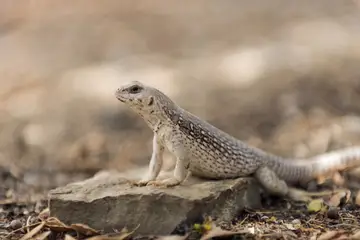

The desert iguana is a mostly plant-eating lizard of creosote-bush flats in the Southwest, up to 5.75 inches from snout to vent, with a small blunt head, long tail and a row of enlarged scales down the middle of its back. It is gray-brown with white spots and reddish-brown markings. It lives in southern Nevada, southwestern and far western Arizona, California (including Joshua Tree and Death Valley national parks) and the southwest corner of Utah. Arizona Game and Fish Department
On this page
Is the desert iguana dangerous?
No official source we use states whether this animal is venomous. That does not mean it is harmless: do not handle it.
How to identify a desert iguana
A photo or description can narrow it down, but cannot confirm what an animal is or that it is safe. Look from a distance and do not handle wild animals.
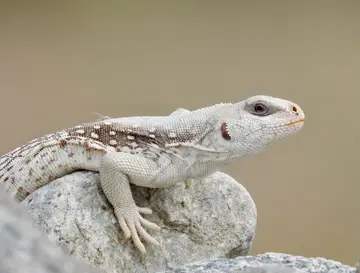
Size: Up to 5.75 inches (146 mm) snout to vent; NDOW says the tail is usually longer than the body. Total length not stated. Arizona Game and Fish Department
Colors: Back gray-brown with white spots; lower sides cream with reddish-brown spots; underside pale cream. Pattern: Reddish-brown netlike markings on the back become bands on the tail.
Key features
- A single row of enlarged, pointed scales down the middle of the back Arizona Game and Fish Department
- Small, blunt head; tail taller than wide; short, stocky limbs Arizona Game and Fish Department
- Adults have two large rust patches on the belly during breeding season Arizona Game and Fish Department
Where the desert iguana lives
- Native or listed
- Nonnative or not established
- No official record in our data
- 1–9
- 10–99
- 100–999
- 1,000+
On our state guides
State boundaries: U.S. Census Bureau, cartographic boundary file cb_2024_us_state_20m.
When it is active
Active by day, often through midday heat when other lizards shelter. Hibernates in winter and late fall. Arizona Game and Fish Department
US open-licence records peak in March to May.
Habitat and habits
Habitat: Creosote-dominated flats with sandy soil and room to run; less often in rockier Sonoran Desert uplands. In Death Valley, mesquite hummocks with fine sandy soil and low canyons and washes up to 3,000 feet. NDOW says it is not usually found away from creosote bushes. Arizona Game and Fish Department
Behavior: Flees in a burst of speed, often to a burrow, and often climbs creosote bushes to reach the flowers. When cornered it wedges into a tight space and inhales to expand its body.
Diet: Adults are mostly plant-eaters: leaves, buds and flowers, especially creosote flowers, with occasional insects and carrion. Insects may be a larger part of the juvenile diet.
Young: Mates in spring and early summer and lays up to 8 eggs in late spring or summer.
Legal status and reporting
Federal: USFWS ECOS lists it as a 'Species of Concern' (not an ESA listing). US Fish and Wildlife Service
Protection: Nevada: NDOW lists it as a Priority Species and shows 'Unprotected', non-game. Utah: on the UDWR Sensitive Species List as of the 2003 report; current status not confirmed. Arizona: AZGFD's species list (Oct 2026) gives state rank S4; an older BISON-M entry (last updated before June 2007) gives S5. No Arizona protected status was found. Nevada Department of Wildlife
Questions about the desert iguana
Are desert iguanas dangerous?
No official source checked calls the desert iguana venomous or dangerous, and none describes its bites. NPS says the Gila monster is perhaps the only venomous lizard in the US. Official sources do not state that the desert iguana is safe to handle.
Are there iguanas in arizona?
Yes, the desert iguana, in the desertscrubs of southwestern and far western Arizona. AZGFD says it is in the same family as the large green iguanas of Mexico and South America.
Are there iguanas in california?
The desert iguana is on California's official species list, and NPS reports it at Joshua Tree and Death Valley. This answer covers only the desert iguana.
Sources
- Online Field Guide species account: Desert Iguana (Dipsosaurus dorsalis). Arizona Game and Fish Department. 2023; checked November 3, 2026.
Quoted passages (9)
“A large (up to 146 mm or 5.75″ from snout to vent) lizard with a small, blunt head, a long tail, and short, stocky limbs.”
“A single row of enlarged, pointed, protruding scales runs down the midline of the back.”
“…a small, blunt head, a long tail, and short, stocky limbs. The tail is taller than it is wide.”
“Adults have two large, rust patches on the belly during breeding season.”
“This lizard is primarily an inhabitant of creosotebush dominated flatlands … Usually found in relatively open areas with sandy soil and plenty of room to run.”
“Adults are primarily herbivorous. It also occasionally feeds on insects and carrion. Insects might make up a greater percentage of the diet of juveniles.”
“This speedy lizard flees with an explosive burst of speed and often seeks shelter in a burrow when frightened. Primarily a ground dweller but often climbs into the branches of the creosotebush to reach the small yellow flowers (a favorite food item).”
“This heat tolerant diurnal lizard often remains active through mid-day when high temperatures force other lizards to seek shelter. It hibernates during the cold months of winter and late fall.”
“The Desert Iguana mates in spring and early summer and lays a clutch of up to 8 eggs in late spring or summer.”
- Desert Iguana. Nevada Department of Wildlife. page dateModified 2021-10-23; checked November 3, 2026.
- Lizards (Organ Pipe Cactus National Monument). National Park Service. updated September 2, 2023; checked November 3, 2026.
- Complete List of Amphibian, Reptile, Bird and Mammal Species in California. California Department of Fish and Wildlife (CWHR Program). 2016-05 (document dated "May, 2016"; checked November 3, 2026.
- Vertebrate Information Compiled by the Utah Natural Heritage Program (Publication 03-45). Utah Division of Wildlife Resources. archived copy, captured October 19, 2020; checked November 3, 2026. Archived copy.
- Reptiles (Death Valley National Park). National Park Service. updated January 17, 2021; checked November 3, 2026.
- Lizards (Joshua Tree National Park). National Park Service. updated February 28, 2015; checked November 3, 2026.
- USFWS ECOS species report export, scientific-name queries. U.S. Fish and Wildlife Service. live query 2026-11-03; checked November 3, 2026.
- GBIF.org occurrence records, human observations licensed CC0 1.0 or CC BY 4.0 only, accessed November 3, 2026. The datasets behind these counts are listed on our Sources page.
- State boundaries: U.S. Census Bureau, cartographic boundary file cb_2024_us_state_20m.