Wheel bug
Arilus cristatus · also called Wheeled assassin bug · Last checked November 3, 2026.
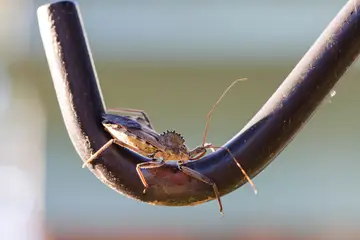

The wheel bug is North America's largest assassin bug: a gray to brown, long-legged true bug about 1 to 1 1/2 inches long with a raised, cogwheel-shaped crest on its back. It hunts other insects and is considered beneficial in gardens. It is venomous to its prey and can give people a very painful bite (described as worse than a bee sting) if handled, so official sources say not to handle it. It has been reported from Rhode Island west to California and south to Texas and Florida. Missouri Department of Conservation
On this page
Is the wheel bug dangerous?
Missouri Department of Conservation lists the wheel bug as venomous and says handling it is not recommended because it can inflict a very painful bite; UF/IFAS says its bite can be more severe than a bee sting and that nymphs and adults should be avoided or handled with caution.
Bites and stings: Yes, when handled, crushed or slapped at. The bug injects saliva through its beak; the pain is immediate and intense and is described as equal to or worse than a bee, wasp or hornet sting. It is not aggressive and bites only when mishandled.
If someone is bitten or stung, call 911 or Poison Help at 1-800-222-1222.
How to identify a wheel bug
A photo or description can narrow it down, but cannot confirm what an animal is or that it is safe. Look from a distance and do not handle wild animals.
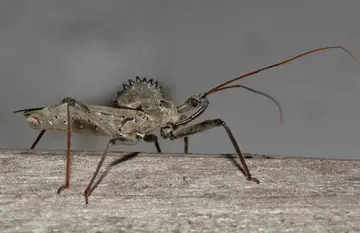

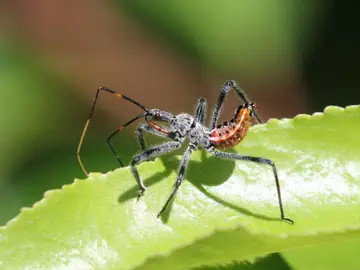
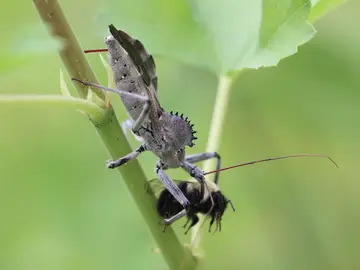
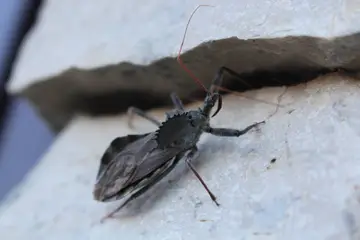

Size: Adults usually 1 to 1 1/4 inches long (UF/IFAS); up to 1 1/2 inches (Missouri, Kentucky). Females are larger than males.
Colors: Adults gray or brownish (light gray, bluish-gray or grayish-brown); UF describes the overall color as dark brown; fine yellowish hairs over most of the body with scattered tiny white patches; wing membrane iridescent bronze. Pattern: Raised semicircular crest with 8 to 12 teeth on the back of the thorax, like half a cogwheel; wings fold flat over the back, making an X pattern at rest.
Key features
- The cogwheel crest: the only insect species in the United States with such a crest EDIS / Ask IFAS
- Long legs and antennae, narrow head, large eyes and a stout beak held at the front of the head
- When disturbed, adults may push out a bright orange-red scent gland from the rear
Young
Nymphs are bright red (or red and black) with black legs and have no crest; they can look antlike or spiderlike. Later nymphs turn gray like adults. Eggs look like tiny brown bottles with white stoppers, laid on end in a glued hexagonal cluster.
Animals mistaken for the wheel bug
Wheel bug or Kissing bug (conenose bug)?
Wheel bug
Kissing bug (conenose bug) Triatoma spp.
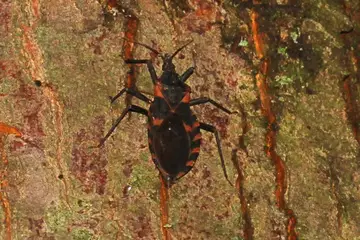

Kissing bugs have the same long head but no crest on the back, and have orange (or red) and black markings along the edge of the abdomen, which sticks out past the wings.
Kissing bugs bite people to feed on blood and can carry the parasite that causes Chagas disease (see kissing-bug page). CDC says wheel bugs do not carry that parasite.
Wheel bug or Other assassin bugs (e.g., milkweed assassin bug)?
Wheel bug
Other assassin bugs (e.g., milkweed assassin bug) Reduviidae, e.g. Zelus longipes
The wheel bug is the largest North American assassin bug and the only US insect with a cogwheel crest; other assassin bugs lack the crest.
Clemson Extension: assassin bugs can deliver a painful bite if handled carelessly, caused by toxic saliva.
Wheel bug or Western conifer seed bug (a leaf-footed bug)?
Wheel bug
Western conifer seed bug (a leaf-footed bug) Leptoglossus occidentalis
Leaf-footed bugs have an expanded, leaf-like section on the hind legs and no cogwheel crest; the wheel bug is the only US insect with such a crest.
Where the wheel bug lives
- Native or listed
- Nonnative or not established
- No official record in our data
- 1–9
- 10–99
- 100–999
- 1,000+
On our state guides
State boundaries: U.S. Census Bureau, cartographic boundary file cb_2024_us_state_20m.
When it is active
Active by day. Nymphs appear in spring; adults from midsummer through fall (Kentucky, Missouri); in Florida adults peak in June and July and some live into winter. In Texas adults may fly on warm winter days.
US open-licence records peak in May to July and October.
Habitat and habits
Habitat: Flowers, gardens, trees, shrubs, meadows and grassy areas; sometimes on buildings. Favored spots include goldenrod, sunflowers, locust trees, citrus and pecan groves and forest, shade and fruit trees.
Behavior: A secretive hunter that flies noisily and clumsily. Considered beneficial because it eats many pest insects. Active by day, but often found at lights at night where it hunts insects drawn to the light.
Diet: Other insects, especially caterpillars and sawfly larvae, plus beetles, stink bugs (including the brown marmorated stink bug), aphids and also lady beetles and honey bees. It injects a paralyzing saliva and sucks out the prey's liquefied insides.
Young: One generation a year. Adults mate in autumn; females lay clusters of 42 to 182 bottle-shaped brown eggs on tree trunks, twigs or other objects, usually 4 feet or lower. Eggs overwinter and hatch in spring; nymphs pass through five stages over about three months.
Questions about the wheel bug
Wheel bug bite
Wheel bugs bite only when handled, crushed or slapped at. They inject saliva through the beak, and the pain is immediate and intense; it has been described as worse than a bee, wasp or hornet sting. UF/IFAS says pain is often followed by numbness for several days and the bite usually takes about two weeks to heal. Official sources say not to handle them. Call 911 or Poison Help at 1-800-222-1222.
Wheel bug assassin bug
Yes. The wheel bug belongs to the assassin bug family (Reduviidae) and is the largest assassin bug in North America, up to about 1 1/2 inches long.
Wheel bug vs assassin bug
The wheel bug is one kind of assassin bug. What sets it apart from the other roughly 150 North American assassin bugs is its size and the cogwheel-shaped crest on its back; UF/IFAS says it is the only insect in the US with such a crest. Only adults have the crest.
Wheel bug vs kissing bug
Both are assassin bugs with long heads, and wheel bugs are the bug most often mistaken for kissing bugs. Kissing bugs have no crest and have orange (or red) and black markings along the edge of the abdomen. Wheel bugs eat insects; kissing bugs feed on animal blood. CDC says wheel bugs do not carry the parasite that causes Chagas disease.
Wheel bug nymph
Nymphs are bright red with black markings and black legs and have no crest; they can look like ants or spiders. Older nymphs turn darker or gray like the adults. Nymphs appear in spring and become adults around midsummer. UF/IFAS says nymphs as well as adults should be avoided or handled with caution.
Wheel bug eggs
Eggs look like tiny brown bottles with white stoppers, about 1/8 inch long. They are laid on end in a glued, six-sided cluster of 42 to 182 eggs, usually 4 feet or lower on tree trunks, twigs, shrubs or other objects. They are laid in fall, survive the winter and hatch in spring.
Wheel bug florida
Yes. UF/IFAS says the wheel bug occurs throughout Florida. In Florida, adults are reported most in June and July, and some live into the winter in central and southern Florida.
Wheel bug ohio
Yes. Ohio State University Extension reports wheel bugs in Ohio, with adults out on trees and shrubs by late summer (September posts). OSU says they should not be handled because of their painful bite.
Wheel bug texas
Yes. Texas Parks and Wildlife's 'Learn About Texas Insects' includes the wheel bug and notes it may be seen flying on warm winter days. Texas A&M AgriLife says its bite is immediately and intensely painful if it is picked up and handled carelessly.
Sources
- Wheel Bug (Field Guide). Missouri Department of Conservation. undated page; checked November 3, 2026.
- Wheel Bug, Arilus cristatus (Linnaeus) (EENY086/IN243, Featured Creatures). University of Florida IFAS Extension (EDIS / Ask IFAS). undated page; checked November 3, 2026.
Quoted passages (1)
“This is the only insect species in the United States with such a crest.”
- ENY-215 Stinging or Venomous Insects and Related Pests. UF/IFAS Extension (EDIS). Original Jan 1996; checked November 3, 2026.
- They're Wheel Bugs, NOT Kissing Bugs (BYGL). Ohio State University Extension. published 2020-09-17; checked November 3, 2026.
- Wheel bugs and other assassin bugs (Insects in the City, ENT-1003). Texas A&M AgriLife Extension Service. published 2010-06-08; checked November 3, 2026.
- Look Closely: Kissing Bug Look-Alikes (BYGL). Ohio State University Extension. published 2025-09-18; checked November 3, 2026.
- How Chagas Disease Spreads. Centers for Disease Control and Prevention. February 4, 2026; checked November 3, 2026.
- ENTFACT-705: The Wheel Bug. University of Kentucky Cooperative Extension (Entomology). Issued 7/96; checked November 3, 2026.
- Big Wheel Bugs are Rolling Along (BYGL). Ohio State University Extension. published 2016-09-02; checked November 3, 2026.
- Learn About Texas Insects. Texas Parks and Wildlife Department. PWD BK P4000-043 3/99; checked November 3, 2026.
- GBIF.org occurrence records, human observations licensed CC0 1.0 or CC BY 4.0 only, accessed November 3, 2026. The datasets behind these counts are listed on our Sources page.
- State boundaries: U.S. Census Bureau, cartographic boundary file cb_2024_us_state_20m.