Kissing bug
Triatoma (subfamily Triatominae, family Reduviidae); Paratriatoma also occurs in the US · also called Triatomine bug, Conenose bug, Cone-nose bug and Chinches · Last checked November 3, 2026.
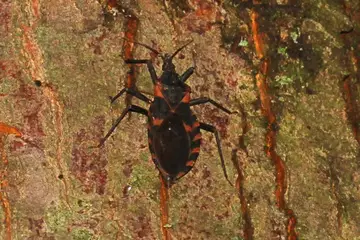

Kissing bugs (triatomine or conenose bugs) are blood-feeding insects that bite people and animals at night, often on the face. They can carry the parasite that causes Chagas disease, which spreads through the bug's feces, not the bite itself. CDC says eleven species have been found in the southern United States, where the disease is present but not regularly spread by the bugs. In some people, repeated bites can cause severe allergic reactions. CDC
This page covers a genus (Triatoma (subfamily Triatominae, family Reduviidae); Paratriatoma also occurs in the US), not a single species.
On this page
Is the kissing bug dangerous?
Chagas disease spreads through triatomine bugs infected with the T. cruzi parasite. People get infected through contact with the bugs' droppings (poop), or by accidentally rubbing the feces into open wounds, eyes or mouth. CDC
“Chagas disease spreads through triatomine bugs that are infected with the T. cruzi parasite. … People get Chagas disease through contact with the droppings (poop) of the bugs or by accidentally rubbing the feces into open wounds, eyes, or mouth.”
Bites and stings: Yes. Kissing bugs feed on blood, mostly at night. Bites are painless at first but may itch and swell, and they can cause severe allergic reactions in some people.
No official source we use states whether this animal is venomous. That does not mean it is harmless: do not handle it.
If someone is bitten or stung, call 911 or Poison Help at 1-800-222-1222.
How to identify a kissing bug
A photo or description can narrow it down, but cannot confirm what an animal is or that it is safe. Look from a distance and do not handle wild animals.
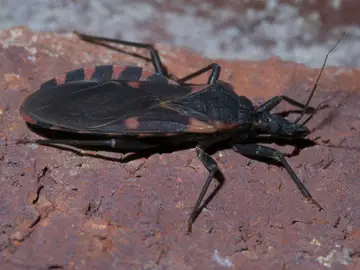

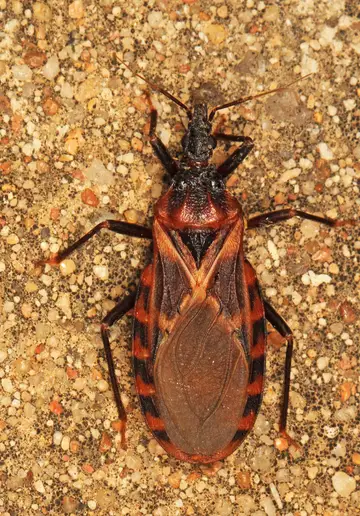
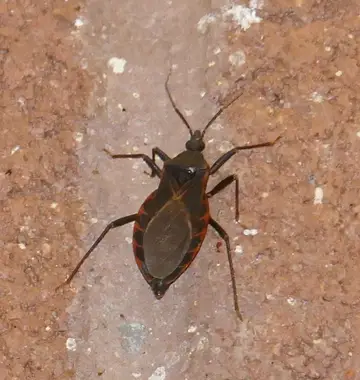
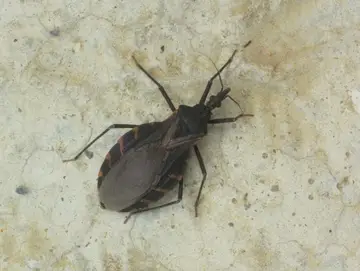


Size: Adults are 1/2 to 1 1/4 inches long, usually about the size of a US quarter. Texas Department of State Health Services
Colors: Dark brown or black; most US species have orange or red stripes, or solid orange to light brown, around the outer edge of the body. Pattern: Orange or red and black bands along the edge of the abdomen, which LSU AgCenter calls diagnostic.
Key features
- Long, thin, cone-shaped head Texas Department of State Health Services
- Long, thin legs with no bulging parts Texas Department of State Health Services
- Straight, needle-like mouthpart tucked under the head Texas Department of State Health Services
- Slightly flattened body Texas Department of State Health Services
Young
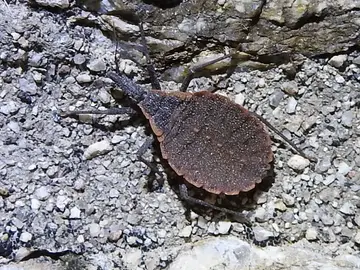
Nymphs have no wings, a teardrop shape and a pointed head, and range from poppy-seed size to almost 1 inch.
Animals mistaken for the kissing bug
Kissing bug or Wheel bug?
Kissing bug
Wheel bug Arilus cristatus
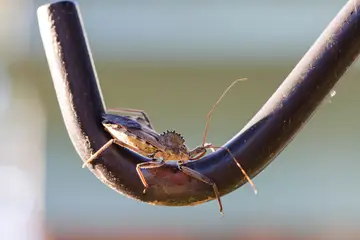

Kissing bugs have the same long head as the wheel bug, but no crest, and they have orange and black markings where the abdomen sticks out past the folded wings. The wheel bug is gray, about 1 1/4 inches long, with a cog-like crest on top of the thorax. Texas A&M AgriLife Extension Service
Does not carry the Chagas parasite (CDC). Texas A&M AgriLife Extension says the wheel bug will bite if picked up and handled carelessly, and the bite is immediately and intensely painful.
Kissing bug or Other assassin bugs?
Kissing bug
Other assassin bugs Reduviidae (non-triatomine)
No red or orange bands on the abdomen and a shorter, rounder head. Usually seen outdoors in the daytime. LSU AgCenter
Texas DSHS: look-alikes occasionally bite and their bites may be painful, but they do not pose a risk for T. cruzi transmission; only kissing bugs are known to transmit the parasite.
Kissing bug or Western corsair?
Kissing bug
Western corsair Rasahus thoracicus
Similar in shape, but the western corsair has an orange and black body with an orange spot on each wing. It feeds mainly on other insects. Unlike kissing bugs, it can give a very painful bite if picked up. University of California Statewide IPM Program
Painful bite (UC IPM); does not carry the Chagas parasite (CDC).
Kissing bug or Leaf-footed bugs?
Kissing bug
Leaf-footed bugs Coreidae
Rounder head, larger size, and an enlarged hind tibia (a segment of the hind leg). LSU AgCenter
Does not carry the Chagas parasite (CDC).
Kissing bug or Bed bugs?
Kissing bug
Bed bugs Cimex lectularius
Kissing bugs are larger and darker, adults have wings, and they have a longer, pointed cone-shaped head. University of California Statewide IPM Program
Bed bugs also feed on blood (UC IPM); their danger is not covered by the sources checked.
Where the kissing bug lives
- Native or listed
- Nonnative or not established
- No official record in our data
- 1–9
- 10–99
- 100–999
- 1,000+
State boundaries: U.S. Census Bureau, cartographic boundary file cb_2024_us_state_20m.
When it is active
Adults are most active in warmer months, May to October (Texas). In Arizona, adults disperse mainly May through July. Texas Department of State Health Services
US open-licence records for all US kissing bugs (genera Triatoma and Paratriatoma) peak in June to July.
Habitat and habits
Habitat: Outdoors: under porches, among rocks, under cement, in rock, wood or brush piles, in rodent nests and burrows, dog houses and kennels, and chicken coops. Indoors (uncommon in US homes): near pet beds, rodents, and beds and mattresses. CDC
Behavior: Hides during the day and feeds on blood at night.
Diet: Blood from people, wild and domestic animals, and pets. Nymphs and adults both feed on blood.
Young: Five wingless nymph stages before adulthood. They live 1 to 2 years.
Legal status and reporting
Report: If a kissing bug has bitten someone or is found inside your home, contact your local health department. In Texas, DSHS can arrange testing. Do not touch the bug with bare hands and avoid crushing it. Texas Department of State Health Services
Questions about the kissing bug
Kissing bug bite
Kissing bugs bite at night to feed on blood, often on the face. The bite is painless at first but may itch, swell and leave a welt. Some people have severe allergic reactions; call 911 for symptoms of a severe allergic reaction. The Chagas parasite is not passed by the bite itself but through the bug's feces getting into the bite, eyes or mouth.
Kissing bug bite mark
UC IPM says bites usually come in groups on the face, neck, arms or legs, and may swell and turn reddish to purple. Bites can be confused with spider or other bug bites.
Kissing bug disease
Chagas disease, caused by the parasite Trypanosoma cruzi. It spreads through contact with infected bugs' droppings and can be life-threatening without treatment. CDC says it is present in the US but not regularly spread by the bugs here. If you have had contact with a kissing bug, talk to your doctor (Texas DSHS).
Kissing bug locations
CDC says eleven species have been found in the southern United States. Most reports come from Arizona, California, New Mexico and Texas, and Hawaii has also had reports (Texas DSHS). In the Southeast, LSU AgCenter lists species from Alabama to the Carolinas, Tennessee and Texas.
Kissing bug texas
Seven species are found across Texas, with the most variety in central Texas. Texas DSHS cites research suggesting about one in two Texas kissing bugs carry the Chagas parasite. If one is found in the home or has bitten someone, contact the health department.
Kissing bug california
Yes. UC IPM says the western bloodsucking conenose (Triatoma protracta) is the most important species in California, with T. rubida also present. They are most common in the foothills around the Central Valley and in the foothills and deserts of Southern California.
Kissing bug florida
LSU AgCenter's table of southeastern species lists three in Florida: Triatoma sanguisuga, T. lecticularia and T. rubrofasciata.
Kissing bug vs assassin bug
Kissing bugs are a blood-feeding group within the assassin bug family (UC IPM). Other assassin bugs lack the red or orange bands on the abdomen, have a shorter, rounder head, and are usually seen outdoors in the daytime; kissing bugs are mainly nocturnal and can be found indoors (LSU AgCenter). Texas DSHS says only kissing bugs are known to transmit the Chagas parasite.
Wheel bug vs kissing bug
CDC lists the wheel bug among bugs commonly confused with kissing bugs and says it does not carry the Chagas parasite. Texas A&M AgriLife Extension says both have a long head, but the kissing bug has no crest and has orange and black markings where the abdomen extends past the folded wings; the wheel bug is gray with a cog-like crest on its back. The wheel bug's bite is immediately and intensely painful if it is handled.
Sources
- How Chagas Disease Spreads. CDC (National Center for Emerging and Zoonotic Infectious Diseases). archived copy, captured October 13, 2026; checked November 3, 2026.
Quoted passages (3)
“Chagas disease spreads through triatomine bugs that are infected with the T. cruzi parasite. … People get Chagas disease through contact with the droppings (poop) of the bugs or by accidentally rubbing the feces into open wounds, eyes, or mouth.”
“Beneath porches … Between rocky structures … Under cement … In rock, wood, brush piles, or beneath bark … In rodent nests or animal burrows … In outdoor dog houses or kennels … In chicken coops or houses … In the United States, triatomine bugs rarely infest homes because houses are well-sealed and have plastered walls. … If these bugs are inside, they are often found near where pets sleep, where rodents are present, or around beds and bedrooms, especially under or near mattresses or nightstands.”
“These bugs hide in walls and roofs during the day and come out to feed on blood at night.”
- About Chagas Disease. CDC (National Center for Emerging and Zoonotic Infectious Diseases). archived copy, captured October 21, 2026; checked November 3, 2026.
- Kissing Bugs & Chagas Disease: What You Need to Know. Texas Department of State Health Services. undated page; checked November 3, 2026.
Quoted passages (10)
“Adult kissing bugs range in size, but are usually about the size of a U.S. quarter. … Size – adult kissing bugs are one half to one-and-a-quarter inches long”
“Head shape – kissing bug heads are long-thin; narrow at the tip and widen slightly to where they attach to the body”
“Legs – kissing bug legs are long and thin, with no bulging parts.”
“Kissing bugs have noticeable mouthparts that appear as a large black needle attached to the head; when tucked under the body, the needle-like mouthpart is completely straight.”
“Kissing bugs are slightly flat and have very long, thin heads when compared to other similar related bugs.”
“Kissing bug nymphs (immature, young insects) are smaller than adults, and range in size from the size of a poppy seed to almost 1 inch long. They have a ‘tear-drop’ body shape, with a pointy head and rounded bottom. … Nymphs do not have wings, so they can walk, but they cannot fly.”
“Kissing bugs develop into adults after a series of five life stages as nymphs, and both nymphs and adults feed on blood. Kissing bugs feed on humans as well as wild and domestic animals and pets.”
“Adult kissing bugs are mostly active in the warmer months, from May to October.”
“They can live between one to two years from when they hatch out of the egg, through all five of the immature nymph stages, until they become adults and eventually die.”
“If you find a kissing bug that has bitten a person or is inside your home, contact your local health department. In Texas, the State Health Department can help you get kissing bugs tested if found in your home or are suspected to have bitten someone. … Never touch a kissing bug with bare hands and avoid crushing it.”
- What You Should Know About Kissing Bugs (az1992). University of Arizona Cooperative Extension. September 2025 (revised; checked November 3, 2026.
- Pest Notes: Conenose Bugs. University of California Statewide IPM Program (UC ANR Cooperative Extension). updated 07/2013; checked November 3, 2026.
Quoted passages (2)
“…looks somewhat similar in shape to conenose bugs but has an orange and black body with an orange spot on each wing (Figure 3). The western corsair feeds primarily on other insects and doesn’t seek warm-blooded animals or require a blood meal in order to reproduce. In contrast to kissing bugs, if you pick up a corsair, it can inflict a most painful bite.”
“Conenose bugs are easily distinguished from another bloodsucking true bug group, bed bugs (Pest Notes: Bed Bugs), by their larger size, darker color (bed bugs are brown to orange), presence of wings in the adult stage, and a more oblong shape with pointy (conenose) head.”
- Wheel bugs and other assassin bugs (ENT-1003). Texas A&M AgriLife Extension Service (Insects in the City). page modified 2016-01-14; checked November 3, 2026.
Quoted passages (1)
“Adult wheel bugs are gray and approximately 3 cm (1 ¼ inches) long. Its name comes from the distinctive, cog-like crest arising from the top of the thorax, or middle section, of the wheel bug’s body (see photo). … Cone nosed bugs have the same elongated head as the wheel bug, but can be distinguished from wheel bugs by their lack of a crest and by their orange and black markings where the abdomen extends laterally past the folding wings.”
- Kissing Bugs of Louisiana: Biology, Identification and Prevention (AG0426r1). LSU AgCenter (Louisiana Cooperative Extension Service). April 2026 4/26'; checked November 3, 2026.
Quoted passages (2)
“Other members of Reduviidae Lacking red/orange bands on the abdomen; pos-sesses shorter and rounder head; solitary when mature … Assassin bugs are commonly encountered outdoors during the day, whereas kissing bugs can be found both outdoors and indoors and are mainly nocturnal.”
“Leaf-footed bugs (Coreidae) Rounder head; larger size; enlarged hind tibia”
- GBIF.org occurrence records, human observations licensed CC0 1.0 or CC BY 4.0 only, accessed November 3, 2026. The datasets behind these counts are listed on our Sources page.
- State boundaries: U.S. Census Bureau, cartographic boundary file cb_2024_us_state_20m.