Ohio has 3 venomous snakes named by official sources: Eastern Copperhead, Massasauga and Timber Rattlesnake. Each one is labelled venomous by Ohio Department of Natural Resources, Division of Wildlife.
The 3 venomous snakes of Ohio
Recognize them from a distance; a photo cannot confirm that a snake is safe. Identifying animals safely.
Venom: “Copperheads have the dubious distinction of having bitten more people in the United States than any other venomous snake … Ohio has only three species of venomous snakes, two of which have rattles at the end of the tail.” (Ohio Department of Natural Resources, Division of Wildlife)
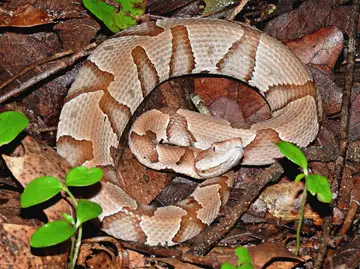
Range: Copperheads are widely scattered throughout most of unglaciated Ohio. Although they occupy a variety of habitats from floodplains to ridge tops, they show a marked preference for the rocky, wooded hillsides of southeastern Ohio.
Habitat: Copperheads are widely scattered throughout most of unglaciated Ohio. Although they occupy a variety of habitats from floodplains to ridge tops, they show a marked preference for the rocky, wooded hillsides of southeastern Ohio. They are not as averse to civilization as the timber rattlesnake, but copper- heads tend to stay away from well-settled areas. (Ohio Department of Natural Resources, Division of Wildlife)
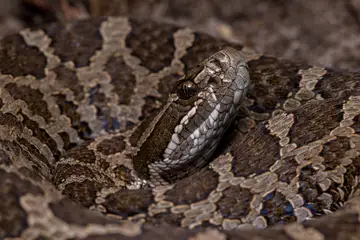
Venom: “This is still a venomous snake, however, and should be treated with utmost caution and respect. … Ohio has only three species of venomous snakes, two of which have rattles at the end of the tail.” (Ohio Department of Natural Resources, Division of Wildlife)
Habitat: Historically recorded in more than 30 Ohio counties, the se- cretive massasauga swamp rattlers are widely scattered and rarely seen. Originally, these rattlers prob- ably inhabited all the scattered prairies of glaciated Ohio, but extensive farming has drastically reduced their numbers. Colonies still persist in bogs, swamps, and wet prairies within glaciated Ohio. (Ohio Department of Natural Resources, Division of Wildlife)
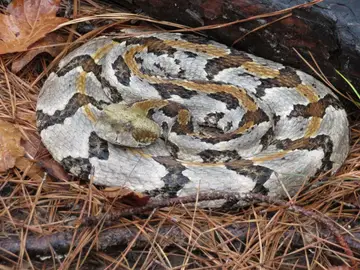
Venom: “By virtue of their large size, timber rattlesnakes are the most dangerous snakes in northeastern America. … Ohio has only three species of venomous snakes, two of which have rattles at the end of the tail.” (Ohio Department of Natural Resources, Division of Wildlife)
Habitat: Remnant colonies persist in widely scattered areas in southern unglaciated Ohio. They prefer dry, wooded hill country where they prey on a variety of small warm-blooded animals. (Ohio Department of Natural Resources, Division of Wildlife)
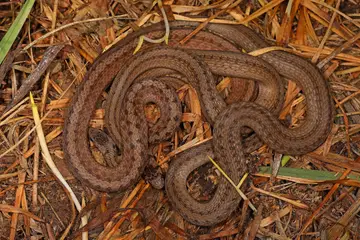
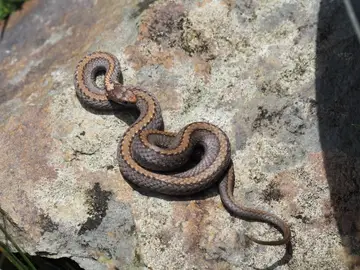
Copperheads have bold hourglass-shaped bands, and young copperheads under about 12 inches have bright yellow tail tips. Brown snakes have small spots, not hourglass bands.
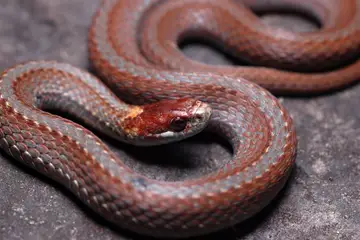
Brown Snake (Dekay's Brownsnake) or Red-bellied Snake?
Missouri: red-bellied snakes are sometimes mistaken for young copperheads. Copperheads are stout-bodied with hourglass-shaped markings on the back, vertical pupils, a sensory pit between each nostril and eye and, sometimes, especially in young copperheads, a yellow tail tip.
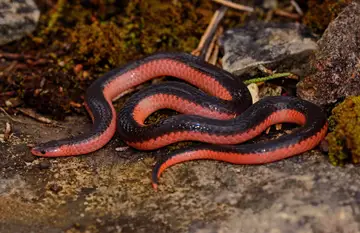
Massachusetts: look at the neck; the wormsnake has no constriction between the head and body. Connecticut also lists it as confused with the redbelly snake.
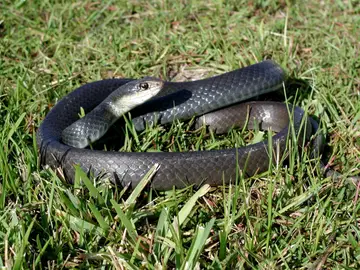
Black Racer or Timber rattlesnake?
Photo: Everglades NPS from Homestead, Florida, United States · Public domain · Wikimedia Commons
Call 911 or Poison Help at 1-800-222-1222 right away. Poison Help connects you to your local poison center, any time of day.
Official advice from Ohio Department of Natural Resources, Division of Wildlife:
Venomous snakebite: call 911 or Poison Help at 1-800-222-1222. ODNR: get the person to a hospital immediately; Poison Help can tell you the nearest hospital that treats snakebites. Ohio Department of Natural Resources, Division of Wildlife
ODNR Division of Wildlife: 1-800-WILDLIFE (Wildlife headquarters and district offices are listed in the 2018 Reptiles of Ohio guide). An older undated ODNR brochure (Pub 115) asks people to report timber rattlesnake sightings by mail to the Division of Wildlife, 360 E. State Street, Athens, OH 45701; that address may be out of date. Ohio Department of Natural Resources, Division of Wildlife
“Ohio’s wealth of natural resources includes almost 50 types of reptiles.”
“Ohio has only three species of venomous snakes, two of which have rattles at the end of the tail.”
“The belly has a black and white checkerboard pattern.”
“A Y-shaped or V-shaped light-colored blotch is usually present on the nape of the neck.”
“Copperheads have the dubious distinction of having bitten more people in the United States than any other venomous snake … Ohio has only three species of venomous snakes, two of which have rattles at the end of the tail.”
“Because the amount of venom injected during a bite is not enough to seriously hurt a healthy adult, the bite is rarely fatal. However, it is extremely painful, and, like a honeybee sting, has the potential to produce a life-threatening allergic reaction.”
“This is still a venomous snake, however, and should be treated with utmost caution and respect. … Ohio has only three species of venomous snakes, two of which have rattles at the end of the tail.”
“Although the venom is highly toxic, a typical bite does not deliver large enough quantities to be lethal. This is still a venomous snake, however, and should be treated with utmost caution and respect.”
“By virtue of their large size, timber rattlesnakes are the most dangerous snakes in northeastern America. … Ohio has only three species of venomous snakes, two of which have rattles at the end of the tail.”
“By virtue of their large size, timber rattlesnakes are the most dangerous snakes in northeastern America.”
“Get the victim to a hospital immediately! Call the Poison Help hotline (1-800-222-1222) to find the nearest hospital capable of treating snake bites.”
“Prevention is the best method for dealing with snakebites. Learn how to distinguish venomous from nonvenomous snakes and learn where to find – and therefore how to avoid – the venomous ones.”
“Gray ratsnakes often hibernate in rock crevices in the company of other snakes, such as copperheads and rattlesnakes.”
“For more information about Ohio’s native wildlife, please contact the Division of Wildlife: 1-800-WILDLIFE (1-800-750-0750 Ohio Relay TTY only)”
“Ohio has only three species of venomous snakes, two of which have rattles at the end of the tail. The third species is the Northern copper-head.”
“Remnant colonies persist in widely scattered areas in southern unglaciated Ohio.”