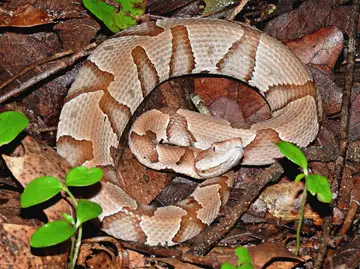
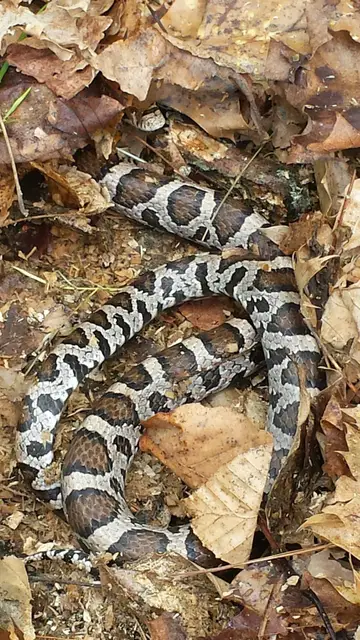
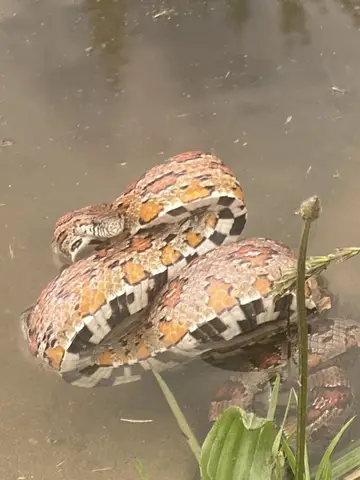
ODNR: copperheads are widely scattered through most of unglaciated Ohio, especially the rocky, wooded hillsides of southeastern Ohio. ODNR status: uncommon.
Ohio Department of Natural Resources, Division of Wildlife: “Copperheads are widely scattered throughout most of unglaciated Ohio.” Source
Venom: “Copperheads have the dubious distinction of having bitten more people in the United States than any other venomous snake … Ohio has only three species of venomous snakes, two of which have rattles at the end of the tail.” (Ohio Department of Natural Resources, Division of Wildlife)
Range: Copperheads are widely scattered throughout most of unglaciated Ohio. Although they occupy a variety of habitats from floodplains to ridge tops, they show a marked preference for the rocky, wooded hillsides of southeastern Ohio.
Habitat: Copperheads are widely scattered throughout most of unglaciated Ohio. Although they occupy a variety of habitats from floodplains to ridge tops, they show a marked preference for the rocky, wooded hillsides of southeastern Ohio. They are not as averse to civilization as the timber rattlesnake, but copper- heads tend to stay away from well-settled areas. (Ohio Department of Natural Resources, Division of Wildlife)
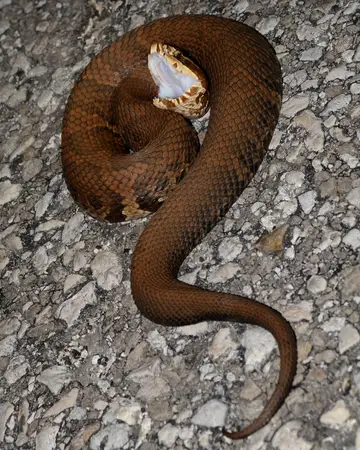
Also venomous. Juvenile cottonmouths have many dark spots and speckles inside their dark crossbands (copperhead bands have none or at most one). The Florida Museum says adult Florida cottonmouths are typically uniformly dark, but SCDNR says cottonmouth color ranges from dark brown and black to olive drab and yellow-tan, so a pale snake is not ruled out. The copperhead's eye is not obscured by the dark facial band typical of the cottonmouth. Cottonmouths are almost always associated with wetlands.
Photo: U.S. Fish and Wildlife Service - Midwest Region · Public domain · Wikimedia Commons
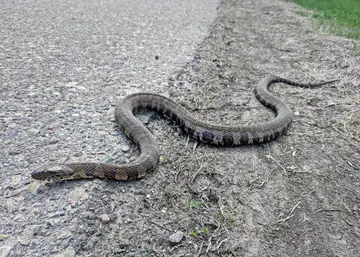
Northern water snake
Its dark bands form a 'reverse hourglass': wider across the back and narrower on the sides (the copperhead's are narrow on the back, wide on the sides). Older water snakes can look solid dark.
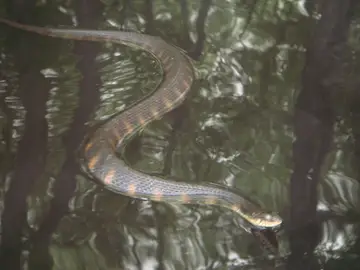
Florida Museum, for Florida: crossbands (in the Southern Watersnake, on juveniles) are darker, narrower and much more numerous than a copperhead's; pupils are round; dark vertical lines on the sides of the face near the mouth, which copperheads lack. Large adults are typically uniformly dark brown or black.
Milk snake blotches are outlined in black and widest across the middle of the back; belly is a black-and-white checkerboard (copperhead belly is mottled white to gray).
“Copperheads are widely scattered throughout most of unglaciated Ohio.”
“Copperheads have the dubious distinction of having bitten more people in the United States than any other venomous snake … Ohio has only three species of venomous snakes, two of which have rattles at the end of the tail.”
“Because the amount of venom injected during a bite is not enough to seriously hurt a healthy adult, the bite is rarely fatal. However, it is extremely painful, and, like a honeybee sting, has the potential to produce a life-threatening allergic reaction.”
“Gray ratsnakes often hibernate in rock crevices in the company of other snakes, such as copperheads and rattlesnakes.”
“Ohio has only three species of venomous snakes, two of which have rattles at the end of the tail. The third species is the Northern copper-head.”
“Remnant colonies persist in widely scattered areas in southern unglaciated Ohio.”