States Wildlife

Are there black widows in Ohio?

Last checked November 3, 2026 against official sources.

On this page
  1. The answer
  2. More official answers
  3. Which ones
  4. Where in the US
  5. Lookalikes
  6. Official advice
  7. Sources

Yes.

ODNR: northern and southern black widows occur but are not nearly as common as in the southern states; most frequent in the southern unglaciated portions. Only females pose a bite risk.

Ohio Department of Natural Resources, Division of Wildlife: “These infamous spiders are not nearly as common in Ohio as they are in the southern states. Within our state they occur most frequently in the southern unglaciated portions.” Source

How we answer questions

  • Are there brown recluse spiders in Ohio?

    Rarely. ODNR: very rare. Only nine specimens from three localities out of more than 24,400 Ohio Spider Survey records, no verified outdoor records, and the few records come from inside buildings. Most spiders sent in as brown recluses are misidentified harmless spiders. Ohio Department of Natural Resources, Division of Wildlife

The 3 on Ohio's list

No confirmed photo of False Black Widow

False Black Widow

Steatoda borealis

Not stated

Venom
No official source we use states whether this animal is venomous. That does not mean it is harmless: do not handle it.
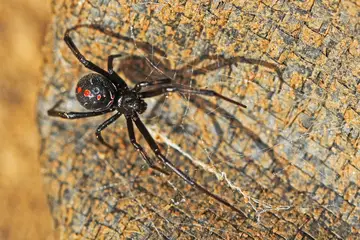
Northern Black Widow
Photo: Judy Gallagher · CC BY 2.0 · Wikimedia Commons

Northern Black Widow

Latrodectus variolus

Venomous per Ohio Department of Natural Resources, Division of Wildlife

Where in Ohio
Within our state they occur most frequently in the southern unglaciated portions. Ohio Department of Natural Resources, Division of Wildlife
What the sources say

Venom: “Only the females pose a bite risk. Their bite can be serious, and anyone bitten should seek medical attention immediately.” (Ohio Department of Natural Resources, Division of Wildlife)
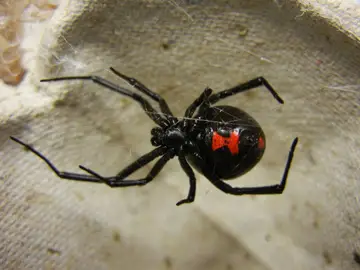
Southern Black Widow
Photo: Shenrich91 · CC BY-SA 3.0 · Wikimedia Commons · resized

Southern Black Widow

Latrodectus mactans

Venomous per Ohio Department of Natural Resources, Division of Wildlife

Where in Ohio
Within our state they occur most frequently in the southern unglaciated portions. Ohio Department of Natural Resources, Division of Wildlife
What the sources say

Venom: “Only the females pose a bite risk. Their bite can be serious, and anyone bitten should seek medical attention immediately.” (Ohio Department of Natural Resources, Division of Wildlife)

All spiders in the state: Ohio spiders.
Where black widow spiders live in the US

Texas: on an official sourceCalifornia: on an official sourceGeorgia: on an official sourceVirginia: on an official sourceTennessee: on an official sourceLouisiana: on an official sourceNew York: on an official sourceFlorida: on an official sourceOhio: on an official sourceNorth Carolina: on an official sourcePennsylvania: on an official sourceSouth Carolina: on an official sourceNew Mexico: on an official sourceAlabama: on an official sourceArizona: on an official source
Official presence. 15 states where a state list or official source names it. Gray means no official record in our data, not that it is absent.
  • Native or listed
  • Nonnative or not established
  • No official record in our data
Texas: 385 recordsCalifornia: 1,057 recordsKentucky: 61 recordsGeorgia: 48 recordsWisconsin: 1 recordOregon: 28 recordsMissouri: 40 recordsVirginia: 127 recordsTennessee: 41 recordsLouisiana: 16 recordsNew York: 12 recordsIdaho: 17 recordsFlorida: 51 recordsIllinois: 12 recordsMontana: 10 recordsMaryland: 63 recordsDistrict of Columbia: 3 recordsOhio: 22 recordsNebraska: 13 recordsWashington: 27 recordsSouth Dakota: 3 recordsArkansas: 24 recordsMississippi: 27 recordsColorado: 174 recordsNorth Carolina: 87 recordsUtah: 154 recordsOklahoma: 65 recordsWyoming: 4 recordsWest Virginia: 5 recordsIndiana: 16 recordsMassachusetts: 350 recordsNevada: 43 recordsPennsylvania: 10 recordsSouth Carolina: 32 recordsHawaii: 2 recordsRhode Island: 5 recordsConnecticut: 1 recordMichigan: 3 recordsDelaware: 104 recordsNew Mexico: 106 recordsAlabama: 32 recordsKansas: 11 recordsNew Jersey: 48 recordsArizona: 225 records
Observation records. Open-licence records on GBIF for the three US black widows (Latrodectus mactans, L. variolus and L. hesperus) in 44 states. Records are sightings people shared, not confirmation that a population lives there.
  • 1–9
  • 10–99
  • 100–999
  • 1,000+

Black widow spiders: identification, range and danger

What else it could be

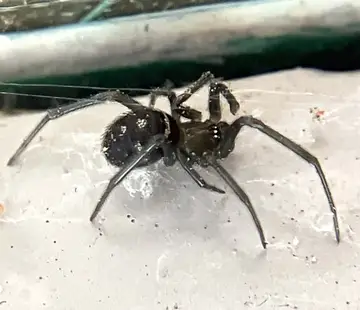
  • False black widow
    Photo: Ken Kneidel · CC0 1.0 · iNaturalist

    False black widow

    Chocolate brown and never has red on the belly; slightly smaller than a mature western black widow (about 3/8 in body length); egg sac looks like a cotton ball with indistinct margins. Caution: UC IPM says a black widow's hourglass can be almost imperceptible or, rarely, completely absent, so a lack of red alone does not rule out a black widow.

  • False black widow (Steatoda borealis)

    No red hourglass and not pure black; looks purplish-brown in bright light, and larger ones have a light T-shaped mark on the abdomen. Caution: a black widow's hourglass can rarely be almost or completely absent (UC IPM), so a lack of red alone does not rule out a black widow.
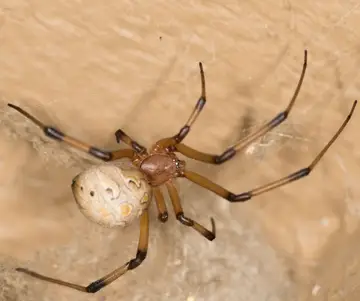
  • Brown widow
    Photo: Jesse Rorabaugh · CC0 1.0 · iNaturalist

    Brown widow

    Usually a mottled mix of tan, brown and gray, with a lengthwise stripe and diagonal side stripes; colour varies from almost white to almost black, and very dark ones are flat black rather than shiny black. Mature females are smaller than mature female western black widows (about 3/8 in body length). The egg sac is covered in silk bumps, like a very large pollen grain; UC IPM calls the egg sac a much surer way to confirm a brown widow. Caution: brown widows also have a red hourglass on the underside (UF/IFAS), and a mature brown widow looks very similar to an immature western black widow (UC IPM).
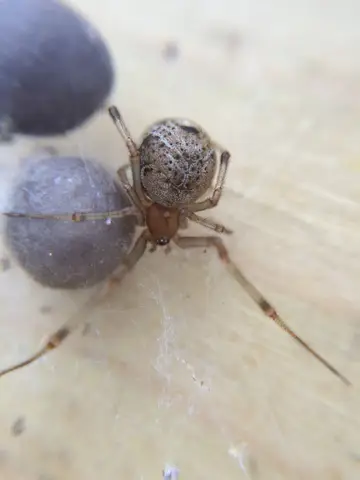
  • Common house spider
    Photo: Erin Lalime · CC BY 4.0 · iNaturalist

    Common house spider

    Penn State Extension: the female common house spider is 5 to 6 mm long with a yellowish-brown carapace and a dirty-white to brown abdomen with gray chevrons; its legs are yellow with darker rings at the end of each segment.
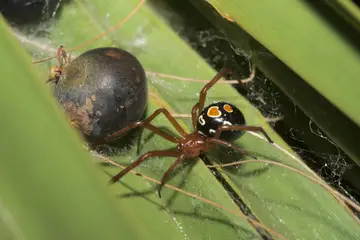
  • Red widow
    Photo: Stevenklioze00 · CC BY-SA 4.0 · Wikimedia Commons · resized

    Red widow

When spiders are seen in Ohio

6,871 records (GBIF, CC0 and CC BY).

What official sources advise

Other questions about Ohio

Sources

  1. Common Spiders of Ohio Field Guide (Publication 5140). Ohio Department of Natural Resources, Division of Wildlife (text by Richard A. Bradley, Ph.D.). PUBLICATION 5140; checked November 3, 2026.
    Quoted passages (4)
    “These infamous spiders are not nearly as common in Ohio as they are in the southern states. Within our state they occur most frequently in the southern unglaciated portions.”
    “Only the females pose a bite risk. Their bite can be serious, and anyone bitten should seek medical attention immediately.”
    “Their bite can be serious, and anyone bitten should seek medical attention immediately.”
    “Brown recluse is represented by only nine specimens from three localities out of over 24,400 records in the Ohio Spider Survey database.”
  2. Ticks and Tick-Borne Diseases (HYG-2073). Ohio State University Extension (Ohioline); co-authors from the Ohio Department of Health. June 6, 2013; checked November 3, 2026.
    Quoted passages (1)
    “One or more life stages may be active during every month of the year (Figure 4), depending on temperature. Because of this year-long activity, preventative measures should be taken outdoors where the tick occurs, even during autumn and winter.”
  3. GBIF.org occurrence records, human observations licensed CC0 1.0 or CC BY 4.0 only, accessed November 3, 2026. The datasets behind these counts are listed on our Sources page.