Coral snakes
Micrurus and Micruroides (family Elapidae): US coral snakes Micrurus fulvius, Micrurus tener, Micruroides euryxanthus · also called coralsnake, eastern coral snake, harlequin coral snake and harlequin coralsnake · Last checked November 3, 2026.
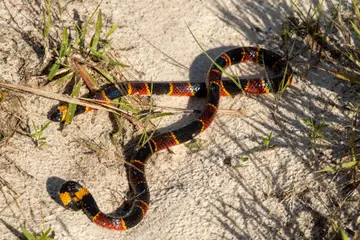
Coral snakes are slender, shiny snakes ringed in red, yellow and black, with a black snout; in US coral snakes the red rings touch the yellow rings. They are venomous: CDC/NIOSH lists coral snakes among the venomous snakes of the United States, and they belong to the same family as cobras. They are secretive, spend much of their time underground or under leaf litter, are not aggressive, and bites are rare and usually happen when one is picked up or pinned. Three species live in the US: the eastern (harlequin) coral snake from southeastern North Carolina to Florida and eastern Louisiana, the Texas coral snake in the southeastern half of Texas, and the Sonoran coral snake in southern Arizona and far southwestern New Mexico. If bitten, call 911 or Poison Help at 1-800-222-1222. CDC / NIOSH
This page covers a family (Micrurus and Micruroides (family Elapidae): US coral snakes Micrurus fulvius, Micrurus tener, Micruroides euryxanthus), not a single species.
On this page
Are coral snakes dangerous?
Venomous and dangerous: Georgia DNR says coral snakes have a dangerously potent, mainly neurotoxic venom that could lead to paralysis and respiratory or cardiac failure. Bites are rare. Do not handle or touch. Georgia DNR Wildlife Resources Division
“Being elapids, they have a dangerously potent venom, comprised mainly of neurotoxins which affects the connections between the brain and muscles, and could eventually lead to paralysis and respiratory or cardiac failure.”
Bites and stings: Not aggressive; bites are rare and usually happen when the snake is grabbed, pinned or handled. Coral snakes have short fixed fangs at the front of the mouth and can bite anywhere on the body (the idea that they can only bite small spots such as a finger web is a myth, per Georgia DNR and Mississippi DWFP). The venom is mainly neurotoxic and can cause paralysis and respiratory failure.
If someone is bitten or stung, call 911 or Poison Help at 1-800-222-1222.
How to identify coral snakes
A photo or description can narrow it down, but cannot confirm what an animal is or that it is safe. Look from a distance and do not handle wild animals.
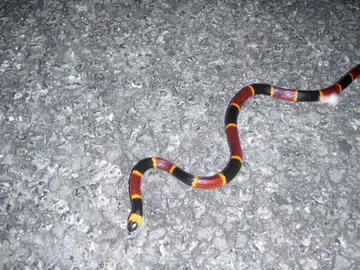
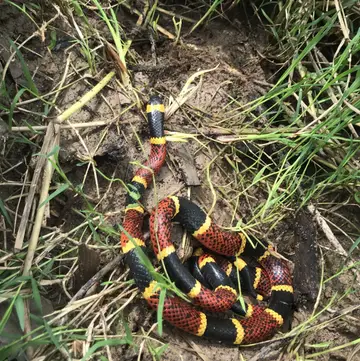
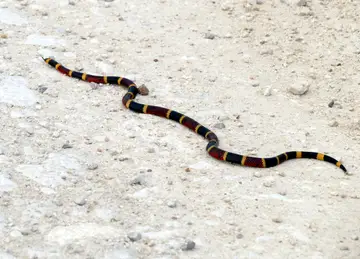
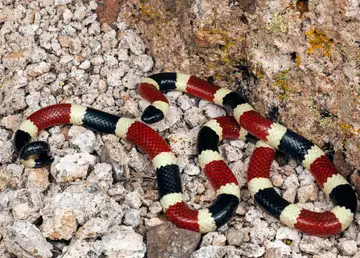
Size: Eastern coral snake: most adults about 20-30 in (51-76 cm), record 47.5 in; Texas coral snake usually 2.5 ft or shorter; Sonoran coral snake small, up to about 24 in. Florida Museum of Natural History
Colors: red, yellow and black rings; sonoran coral snake: light rings may be yellow or cream (white or yellow per NMSU); red rings often flecked or peppered with black. Pattern: rings go completely around the body, including the belly; red rings touch yellow rings (US coral snakes); tail banded only black and yellow (eastern coral snake); sonoran coral snake: tail usually without red bands.
Key features
- black snout followed by a broad yellow band N.C. Wildlife Resources Commission
- small, blunt head barely wider than the neck; round pupils
- smooth, shiny scales Georgia DNR Wildlife Resources Division
- no heat-sensing pit between eye and nostril, no large triangular head and no cat's-eye (elliptical) pupils: coral snakes are not pit vipers, so pit-viper clues do not apply to them South Carolina Department of Natural Resources
- Texas: the only venomous snake in Texas with red, yellow and black bands completely around the body Texas Parks and Wildlife Department
- Mississippi DWFP memory aid: red and yellow side by side like a traffic light Mississippi Department of Wildlife, Fisheries, and Parks
Young
Young look like adults (same ring pattern); about 8 inches at hatching.
Animals mistaken for coral snakes
Coral snakes or Scarlet kingsnake?
Coral snakes
Scarlet kingsnake Lampropeltis elapsoides
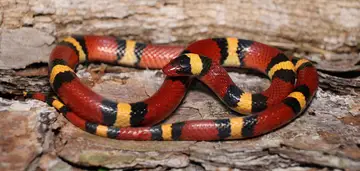
Red snout; yellow rings touch only black rings, never red. Florida Museum of Natural History
Nonvenomous per Florida Museum ("Non-venomous Scarlet Kingsnakes have red, black, and yellow (or white) rings down the body.").
Coral snakes or Scarlet snake?
Coral snakes
Scarlet snake Cemophora coccinea
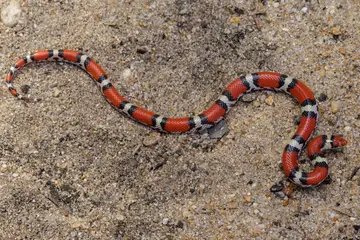
Red, pointed snout; red blotches outlined in black on the back; plain white belly (rings do not go all the way around). Florida Museum of Natural History
Nonvenomous per Florida Museum ("Non-venomous Scarletsnakes have red, black, and yellow (or white) rings down the body.").
Coral snakes or Milk snakes (Louisiana and Mexican milk snakes in Texas; milk snake in New Mexico)?
Coral snakes
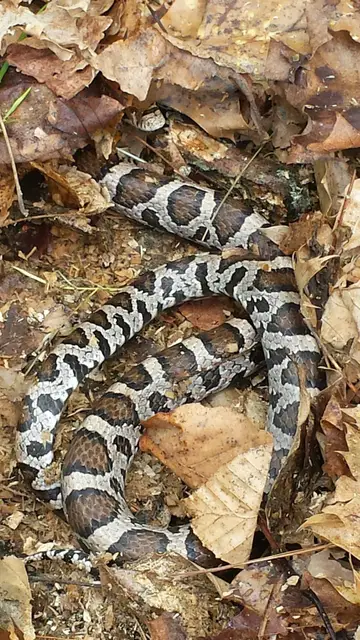


Red bands bordered by black, not yellow; in Texas the bands stop at the belly, which is a uniform color. Texas Parks and Wildlife Department
TPWD calls the Texas lookalikes harmless ("Because harmless Texas scarlet snakes and Louisiana and Mexican milk snakes share the red, black, yellow coloration pattern, it is important to notice the order of the colored bands."). For New Mexico, NMSU Extension groups the milk snake with "nonpoisonous snakes" on which red touches black.
Coral snakes or Sonoran mountain kingsnake?
Coral snakes
Sonoran mountain kingsnake
Red bands bordered by black; coral snake red bands are bordered by yellow. College of ACES
NMSU Extension groups it with "nonpoisonous snakes" on which red touches black ("on nonpoisonous snakes, red touches black").
Coral snakes or Western and Sonoran shovel-nosed snakes?
Coral snakes
Western and Sonoran shovel-nosed snakes
Arizona coral snake has a black snout, which separates it from shovel-nosed snakes. Arizona Game and Fish Department
Coral snakes or Longnose snake?
Coral snakes
Longnose snake
Paler, with stripes that do not go around the body and white flecks on top and sides. College of ACES
Where coral snakes live
- Native or listed
- Nonnative or not established
- No official record in our data
- 1–9
- 10–99
- 100–999
- 1,000+
State boundaries: U.S. Census Bureau, cartographic boundary file cb_2024_us_state_20m.
When it is active
Can be active day or night, with dawn and dusk as peak times (Georgia DNR); males active at the surface in spring, females in fall; may be inactive in winter. Mississippi: usually active in daytime. Sonoran coral snake: primarily nocturnal or crepuscular but can be active around the clock when conditions are favorable; hibernates in late fall and winter. Alabama DCNR and the Florida Museum call the eastern coral snake primarily diurnal. Georgia DNR Wildlife Resources Division
US open-licence records for all US coral snakes (genera Micrurus and Micruroides) peak in April to May and July to September.
Habitat and habits
Habitat: Eastern coral snake: well-drained sandy soils in longleaf pine, sandhills and pine flatwoods, also hammocks; secretive, under debris or in the ground; sometimes in suburban yards near habitat. Texas: woodlands, canyons and coastal plains. Sonoran: desertscrub to grassland and lower woodland, near rocky or gravelly drainages and washes. Georgia DNR Wildlife Resources Division
Behavior: Shy and secretive; usually flees. When threatened it may hide its head under its coils and wave or raise the tail; it bites if grabbed or pinned. The Sonoran coral snake may also make a popping noise.
Diet: Mostly other snakes and small lizards (skinks, glass lizards and other legless lizards), killed with venom.
Young: Egg-layers (the only US venomous snakes that lay eggs, per Georgia DNR). Eastern coral snake: in Florida typically about 4-13 eggs, hatching August-September (Florida Museum); Alabama DCNR gives two to 13. Sonoran coral snake: up to 3 eggs in July-August.
Legal status and reporting
Protection: North Carolina: state-listed Endangered; may not be captured, killed, harmed or possessed without a special NCWRC permit. Alabama: on the nongame reptiles protected by regulation 220-2-.92 (unlawful to take, kill or possess without a permit). Georgia: Species of Concern. Louisiana: ranked S2 (imperiled). N.C. Wildlife Resources Commission
Invasive status: native (not an invasive species) Louisiana Department of Wildlife and Fisheries
Report: North Carolina: document any sighting with photos if possible and report it to the N.C. Wildlife Resources Commission or the N.C. State Museum of Natural Sciences. No national reporting program; not an invasive species. N.C. Wildlife Resources Commission
Questions about coral snakes
What states have coral snakes?
Official sources confirm coral snakes in Alabama, Arizona, Florida, Georgia, Louisiana (rare; no confirmed eastern coral snake records since the 1980s), Mississippi, New Mexico (far southwest), North Carolina (southeastern corner, rare), South Carolina and Texas. The eastern coral snake ranges from southeastern North Carolina to extreme eastern Louisiana; the Texas coral snake lives in the southeastern half of Texas; the Sonoran coral snake lives in southern Arizona and far southwestern New Mexico.
Are there coral snakes in florida?
Yes. The Florida Museum says harlequin (eastern) coral snakes are found throughout Florida, in every county, and on Key Largo; FWC lists it among Florida's six venomous snakes.
Are there coral snakes in the florida keys?
Yes, on Key Largo: the Florida Museum says they also occur on Key Largo in the northern Florida Keys.
Are there coral snakes in texas?
Yes. TPWD says the Texas coral snake is the state's only member of the cobra family and lives in the southeastern half of Texas, in woodlands, canyons and coastal plains.
Are there coral snakes in arizona?
Yes. Arizona Game and Fish lists the Sonoran coralsnake as venomous and says it occurs across most of southern Arizona below about 6,000 feet.
Are there coral snakes in california?
Not on the official list: CDFW's complete list of California reptiles (2016) has no coral snake.
Are there coral snakes in north carolina?
Yes, but rarely seen: NCWRC says the eastern coral snake is one of the state's most rarely seen animals and is state-listed as Endangered. NC State Extension says it lives only in the southeastern corner of the state.
Are there coral snakes in south carolina?
Yes. SCDNR lists the coral snake among the state's six venomous snakes and says it is never common anywhere.
Are there eastern coral snakes in georgia?
Yes. Georgia DNR says they live mainly in the Coastal Plain, with a population in the lower Piedmont along the Flint River basin.
Are there coral snakes in alabama?
Yes. Alabama DCNR lists the eastern coral snake among Alabama's six venomous snakes; it is rare and found mainly in the Coastal Plain.
Are there coral snakes in louisiana?
Rarely, if at all. LDWF lists the harlequin coralsnake as a venomous native of the Florida Parishes, but says there have been no confirmed Louisiana records since the 1980s.
Are there coral snakes in tennessee?
No. TWRA says the coral snake does not occur in Tennessee.
Are there coral snakes in missouri?
No.
Are there coral snakes in pennsylvania?
Not on the official list: the Pennsylvania Fish and Boat Commission says 3 of the state's 21 snake species are venomous, and none of them is a coral snake.
Coral snake rhyme
Several state agencies give a rhyme like "Red on yellow kills a fellow; Red on black venom lack" (SCDNR wording) for US coral snakes. Official caveats: NCWRC says it should never be used in tropical America, and Georgia DNR warns that people misremember it, so the best advice is to leave any snake you can't easily identify alone.
Coral snake vs scarlet kingsnake
Scarlet kingsnakes have a red snout, and their yellow rings touch only black rings. Coral snakes have a black snout, and their red rings touch yellow rings.
Coral snake vs scarlet snake
Scarlet snakes have a red, pointed snout and a plain white belly, so their rings don't go all the way around. On a coral snake the rings go all the way around and the snout is black.
Coral snake vs milk snake
On milk snakes the red bands are bordered by black, and in Texas the bands stop at the belly. On a coral snake the red bands are bordered by yellow and the rings go all the way around.
Coral snake bite
Bites are rare and usually happen when a coral snake is grabbed, pinned or handled. The venom is mainly neurotoxic and can cause paralysis and respiratory failure. Call 911 or Poison Help at 1-800-222-1222.
Coral snake venom
Coral snake venom is mainly neurotoxic. Georgia DNR says it is dangerously potent, and Alabama DCNR calls it the most toxic venom of any North American snake.
Sources
- Venomous Snakes (Outdoor Workers). CDC / NIOSH. archived copy, captured October 1, 2026; checked November 3, 2026.
Quoted passages (1)
“Venomous snakes found in the United States include rattlesnakes, copperheads, cottonmouths (also called water moccasins), and coral snakes.”
- Venomous Snakes Fact Sheet Series: Eastern Coral Snake. Georgia DNR Wildlife Resources Division. PDF Last-Modified Fri, 02 Feb 2024 14:12:53 GMT; checked November 3, 2026.
Quoted passages (6)
“Being elapids, they have a dangerously potent venom, comprised mainly of neurotoxins which affects the connections between the brain and muscles, and could eventually lead to paralysis and respiratory or cardiac failure.”
“The thin body is covered in smooth, shiny scales that give the appearance of being highly polished.”
“Their preferred habitat has well-drained, sandy soil with areas of open ground. Longleaf pine stands, sandhills and pine flatwoods are the favored ecosystems.”
“Favored foods are smaller snakes, skinks and legless lizards.”
“Coral snakes are considered to be a nocturnal species, but in fact can be found active on the surface at any time day or night. Dawn and dusk seem to be high activity periods.”
“Coral snakes are the only venomous snakes in the US that lay eggs.”
- Florida Snake ID Guide species account: Harlequin Coralsnake. Florida Museum of Natural History (University of Florida). updated September 23, 2022; checked November 3, 2026.
Quoted passages (5)
“Most adult Harlequin Coralsnakes are about 20-30 inches (51-76 cm) in total length, with a record length recorded of 47.5 inches (120.7 cm).”
“The coloration of juveniles is the same as described for adults.”
“When approached, Harlequin Coralsnakes will typically flee to safety. However, they will often flatten the hind part of their bodies, hide their head beneath their coils, and waive their tail in the air.”
“However, the narrow yellow rings only contact the black rings, not the red rings as in Harlequin Coralsnakes. The rings completely encircle the body as in Harlequin Coralsnakes. They have red snouts.”
“Unlike Harlequin Coralsnakes, the rings do not completely encircle the body; the belly is a cream white color and unpatterned. They have red snouts that are somewhat pointed.”
- Venomous Snake Safety (Texas Junior Naturalists). Texas Parks and Wildlife Department. undated page; checked November 3, 2026.
- Online Field Guide species account: Sonoran Coralsnake (Micruroides euryxanthus). Arizona Game and Fish Department. 2023; checked November 3, 2026.
Quoted passages (1)
“Its black snout distinguishes this snake from the similar looking Western Shovel-nosed Snake and Sonoran Shovel-nosed Snake.”
- New Mexico Snakes: Information for New Mexico Homeowners (Circular 541). New Mexico State University Cooperative Extension Service (College of ACES). Revised and electronically distributed July 1998; checked November 3, 2026.
Quoted passages (2)
“On the milk snake and Sonoran mountain king snake, the red bands are bordered by black. The western coral snake has red bands bordered by yellow.”
“The longnose snake is pale compared with the western coral snake, with stripes that don’t extend around the body and white flecks on the top and side of the body.”
- Eastern Coral Snake (NCWRC species page). N.C. Wildlife Resources Commission. undated page; checked November 3, 2026.
Quoted passages (3)
“The small head has a black snout followed by a broad yellow band, and the tail is banded with black and yellow.”
“Specimens may not be legally captured, killed, harmed or possessed without a special permit from the N.C. Wildlife Resources Commission.”
“Any sightings of Eastern Coral Snakes should be documented with photographs if possible, and reported to the N.C. Wildlife Resources Commission or the N.C. State Museum of Natural Sciences in Raleigh.”
- Frequently Asked Questions about Reptile and Amphibians. South Carolina Department of Natural Resources. page footer 2020; checked November 3, 2026.
Quoted passages (1)
“…have a heat sensing pit between the eye and nostril. … They will have large triangular or arrow-shaped heads … The pit viper’s eyes have elliptical pupils, like a cat's eye. The coral snake is not a pit viper and does not have the characters listed above.”
- Hunter Education Online Course: Snakes. Texas Parks and Wildlife Department. undated page; checked November 3, 2026.
Quoted passages (2)
“They are the only venomous snake in Texas that is brightly colored red, yellow, and black bands completely encircling the body.”
“Finally, with scarlet and milk snakes, the bands do not completely encircle the body but stop at ground level, under-bellies being uniform in color.”
- Coral Snake (Venomous Snakes of Mississippi). Mississippi Department of Wildlife, Fisheries, and Parks. archived copy, captured August 15, 2025; checked November 3, 2026.
Quoted passages (1)
“The yellow and red bands are always side by side. Think of the red and yellow colors of a traffic light always being together.”
- Snake Species Field Guide: Harlequin Coralsnake. Louisiana Department of Wildlife and Fisheries. undated page; checked November 3, 2026.
- Living with Snakes. Florida Fish and Wildlife Conservation Commission (FWC). archived copy, captured June 16, 2026; checked November 3, 2026. Archived copy.
- Complete List of Amphibian, Reptile, Bird and Mammal Species in California. California Department of Fish and Wildlife (CWHR Program). 2016-05 (document dated "May, 2016"; checked November 3, 2026.
- Snakes: Family Elapidae (AG-472-02). NC State Extension (N.C. Cooperative Extension, NC State University). Publication date: Aug. 21, 2019; checked November 3, 2026.
- Venomous Snakes of South Carolina (poster). SCDNR and South Carolina Wildlife Magazine. SCDNR 03CE4028 3/03; checked November 3, 2026.
- Nongame Wildlife FAQs. Alabama Department of Conservation and Natural Resources (Outdoor Alabama). undated page; checked November 3, 2026.
- Eastern Coral Snake. Alabama Department of Conservation and Natural Resources (Outdoor Alabama). undated page; checked November 3, 2026.
- Reptiles » Snakes (Tennessee Watchable Wildlife species accounts). Tennessee Wildlife Resources Agency (Tennessee Watchable Wildlife website). undated page; checked November 3, 2026.
- Snake Facts. Missouri Department of Conservation. no publication date shown; checked November 3, 2026.
- Snakes (species accounts). Pennsylvania Fish and Boat Commission. undated page; checked November 3, 2026.
- Pennsylvania Native Reptile and Amphibian Species (PA Species and Endangered Species Act listing status). Pennsylvania Fish and Boat Commission. undated page; checked November 3, 2026.
- GBIF.org occurrence records, human observations licensed CC0 1.0 or CC BY 4.0 only, accessed November 3, 2026. The datasets behind these counts are listed on our Sources page.
- State boundaries: U.S. Census Bureau, cartographic boundary file cb_2024_us_state_20m.