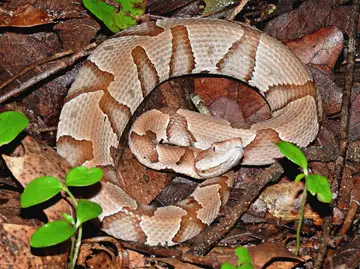
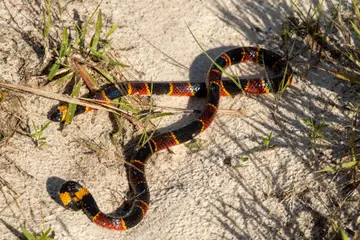
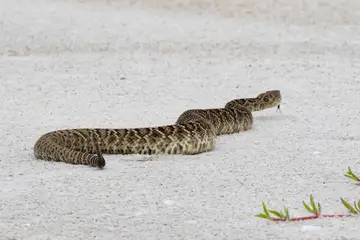
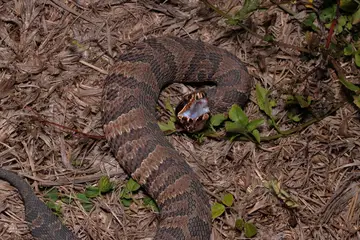
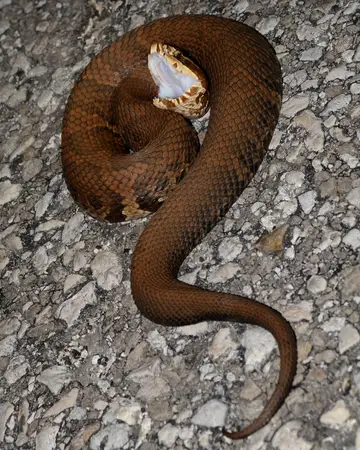
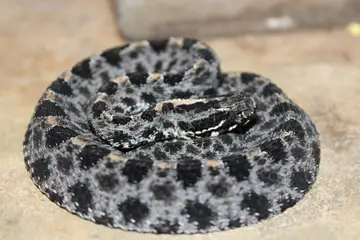
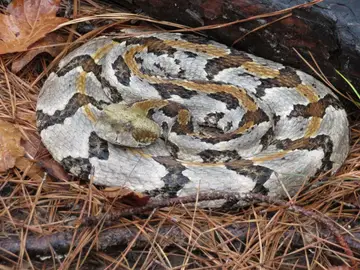
Georgia has 7 venomous snakes named by official sources: Copperhead, Northern Cottonmouth, Florida Cottonmouth, Eastern Diamond-backed Rattlesnake, Timber Rattlesnake, Pigmy Rattlesnake and Eastern Coral Snake. Each one is labelled venomous by Georgia DNR Wildlife Resources Division, Wildlife Conservation Section.
The 7 venomous snakes of Georgia
Recognize them from a distance; a photo cannot confirm that a snake is safe. Identifying animals safely.
Venom: “Of the 47 species of snakes known from Georgia, only seven species are venomous: Copperhead (Agkistrodon contortrix), Northern and Florida Cottonmouth (Agkistrodon piscivorus and Agkistrodon conanti), Eastern Diamond-backed Rattlesnake (Crotalus adamanteus), Timber/Canebrake Rattlesnake (Crotalus horridus), Pigmy Rattlesnake (Sistrurus miliarius) and Eastern Coral Snake (Micrurus fulvius).” (Georgia DNR Wildlife Resources Division, Wildlife Conservation Section)
Habitat: Occur in most forested habitats but are particularly common on rocky wooded hillsides in the mountains and swamp and river edges in the Piedmont and Coastal Plain. (Georgia DNR Wildlife Resources Division, Wildlife Conservation Section)
Georgia Species of Concern (STATUS: Rare, Georgia Species of Concern.)
What the sources say
Venom: “Of the 47 species of snakes known from Georgia, only seven species are venomous: Copperhead (Agkistrodon contortrix), Northern and Florida Cottonmouth (Agkistrodon piscivorus and Agkistrodon conanti), Eastern Diamond-backed Rattlesnake (Crotalus adamanteus), Timber/Canebrake Rattlesnake (Crotalus horridus), Pigmy Rattlesnake (Sistrurus miliarius) and Eastern Coral Snake (Micrurus fulvius).” (Georgia DNR Wildlife Resources Division, Wildlife Conservation Section)
Habitat: Coastal Plain populations are typically associated with sandy upland habitats such as longleaf pine sandhills and pine-saw palmetto flatwoods. (Georgia DNR Wildlife Resources Division, Wildlife Conservation Section)
Georgia Species of Concern (STATUS: Rare, Georgia Species of Concern.)
What the sources say
Venom: “Of the 47 species of snakes known from Georgia, only seven species are venomous: Copperhead (Agkistrodon contortrix), Northern and Florida Cottonmouth (Agkistrodon piscivorus and Agkistrodon conanti), Eastern Diamond-backed Rattlesnake (Crotalus adamanteus), Timber/Canebrake Rattlesnake (Crotalus horridus), Pigmy Rattlesnake (Sistrurus miliarius) and Eastern Coral Snake (Micrurus fulvius).” (Georgia DNR Wildlife Resources Division, Wildlife Conservation Section)
Habitat: Eastern Diamond-backed Rattlesnakes occupy upland habitats with an open canopy, especially native longleaf pine forests on sandhills, clay hills and flatwoods. (Georgia DNR Wildlife Resources Division, Wildlife Conservation Section)
Cottonmouths combined: mostly Coastal Plain; DNR brochure: 'differentiating the species and their geographic distributions is difficult' Georgia DNR Wildlife Resources Division
What the sources say
Venom: “Of the 47 species of snakes known from Georgia, only seven species are venomous: Copperhead (Agkistrodon contortrix), Northern and Florida Cottonmouth (Agkistrodon piscivorus and Agkistrodon conanti), Eastern Diamond-backed Rattlesnake (Crotalus adamanteus), Timber/Canebrake Rattlesnake (Crotalus horridus), Pigmy Rattlesnake (Sistrurus miliarius) and Eastern Coral Snake (Micrurus fulvius).” (Georgia DNR Wildlife Resources Division, Wildlife Conservation Section)
Habitat: Semi-aquatic. Cottonmouths prefer swamp-like habitats and can be very abundant in these areas. (Georgia DNR Wildlife Resources Division, Wildlife Conservation Section)
Venom: “Of the 47 species of snakes known from Georgia, only seven species are venomous: Copperhead (Agkistrodon contortrix), Northern and Florida Cottonmouth (Agkistrodon piscivorus and Agkistrodon conanti), Eastern Diamond-backed Rattlesnake (Crotalus adamanteus), Timber/Canebrake Rattlesnake (Crotalus horridus), Pigmy Rattlesnake (Sistrurus miliarius) and Eastern Coral Snake (Micrurus fulvius).” (Georgia DNR Wildlife Resources Division, Wildlife Conservation Section)
Habitat: Found in a variety of habitats at elevations of 0-1,640 feet and ranging from dry sandhills and longleaf pine forests to wet hammocks and seasonally flooded pine flatwoods. (Georgia DNR Wildlife Resources Division, Wildlife Conservation Section)
Venom: “Of the 47 species of snakes known from Georgia, only seven species are venomous: Copperhead (Agkistrodon contortrix), Northern and Florida Cottonmouth (Agkistrodon piscivorus and Agkistrodon conanti), Eastern Diamond-backed Rattlesnake (Crotalus adamanteus), Timber/Canebrake Rattlesnake (Crotalus horridus), Pigmy Rattlesnake (Sistrurus miliarius) and Eastern Coral Snake (Micrurus fulvius).” (Georgia DNR Wildlife Resources Division, Wildlife Conservation Section)
Habitat: Common in much of the heavily wooded country of the Coastal Plain, but in more open areas these snakes are primarily limited to wooded stream corridors. (Georgia DNR Wildlife Resources Division, Wildlife Conservation Section)
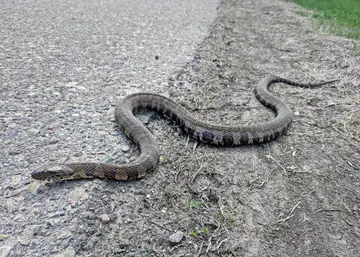
Cottonmouths are heavier-bodied with a larger, chunky head, a pit between nostril and eye, darker color, and a light line from the eye to the corner of the mouth (Missouri). Cottonmouths have cat-like pupils; watersnakes have round pupils and no facial pit, and seen from above a cottonmouth's eyes are hidden while a watersnake's are visible (Florida Museum). Georgia DNR: banded watersnakes have bands widest on top; banded cottonmouths have bands widest on the sides (hourglass-shaped from above). Cottonmouths float on the water; watersnakes swim with the body just below the surface (Virginia DWR). Cautions from the same agencies: Virginia DWR says some other nonvenomous snakes, such as the eastern hog-nosed snake, also float, and that watersnakes often flatten the head when threatened so it looks diamond-shaped; CDFW says older northern watersnakes can look almost entirely dark brown or black.
Northern watersnake or Copperhead?
Photo: U.S. Fish and Wildlife Service - Midwest Region · Public domain · Wikimedia Commons
Florida Museum (midland watersnake): the watersnake's crossbands are darker, narrower and much more numerous than a copperhead's and turn into blotches halfway down the body. Watersnakes have round pupils and dark vertical lines near the mouth; copperheads have no such lines.
Copperheads have bold hourglass-shaped bands, and young copperheads under about 12 inches have bright yellow tail tips. Brown snakes have small spots, not hourglass bands.
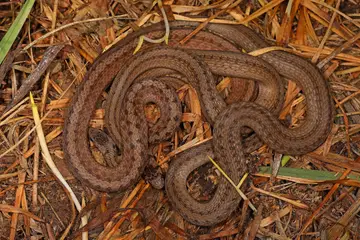
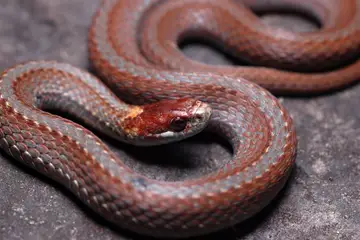
Brown Snake (Dekay's Brownsnake) or Red-bellied Snake?
Told apart mainly by range: the Florida brownsnake replaces Dekay's brownsnake in peninsular Florida and extreme southern Georgia (Dekay's occurs in the Florida Panhandle west of the Aucilla River). Florida Museum also gives 17 scale rows at midbody for Dekay's brownsnake and 15 for the Florida brownsnake.
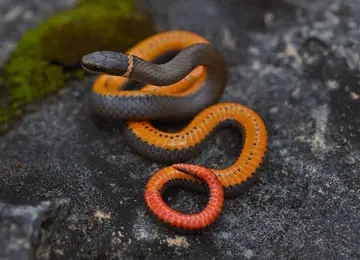
Brown Snake (Dekay's Brownsnake) or Ring-necked Snake?
Ring-necked snakes have smooth scales and yellow bellies with paired dots down the center.
Photos show typical adults; individuals vary. Never get close to compare.
When venomous snakes are active in Georgia
Records of snakes in Georgia peak in March to June and September. They show when people record snakes, not how many there are (about month bars).
JanFebMarAprMayJunJulAugSepOctNovDec
1,533 records of snakes in Georgia by month (GBIF, CC0 and CC BY records).
Eastern coral snakes: high surface activity of males in spring, females often active in fall; can be active day or night, especially dawn and dusk. Georgia DNR Wildlife Resources Division
“Georgia is fortunate to have among the highest biodiversity of snakes in the United States with 47 species.”
“Therefore, when it is cold or extremely hot outside, snakes are relatively inactive.”
Venomous Snakes of Georgia (brochure). Georgia DNR Wildlife Resources Division, Wildlife Conservation Section. PDF Last-Modified 2024-02-02; checked November 3, 2026.Quoted passages (6)
“Of the 47 species of snakes known from Georgia, only seven species are venomous: Copperhead (Agkistrodon contortrix), Northern and Florida Cottonmouth (Agkistrodon piscivorus and Agkistrodon conanti), Eastern Diamond-backed Rattlesnake (Crotalus adamanteus), Timber/Canebrake Rattlesnake (Crotalus horridus), Pigmy Rattlesnake (Sistrurus miliarius) and Eastern Coral Snake (Micrurus fulvius).”
“Of the 47 species of snakes known from Georgia, only seven species are venomous: Copperhead (Agkistrodon contortrix), Northern and Florida Cottonmouth (Agkistrodon piscivorus and Agkistrodon conanti), Eastern Diamond-backed Rattlesnake (Crotalus adamanteus), Timber/Canebrake Rattlesnake (Crotalus horridus), Pigmy Rattlesnake (Sistrurus miliarius) and Eastern Coral Snake (Micrurus fulvius). … only the Timber Rattlesnake, Eastern Diamond-backed Rattlesnake and Cottonmouths realistically represent a serious threat to human life.”
“Call 911 or the Georgia Poison Center (1-800-222-1222) immediately.”
“DO NOT TRY TO KILL THE SNAKE; it could bite again.”
“Caution should be used when approaching any snake, and snakes found in the wild should only be handled by experienced people after proper identification.”
“In Georgia, it is illegal (a misdemeanor, punishable by up to a $1,000 fine and a year in jail) to possess or kill many of the state’s nongame wildlife species, including non-venomous snakes (O.C.G.A. §27-1-28).”
Venomous Snakes Fact Sheet Series: Copperhead. Georgia DNR Wildlife Resources Division. PDF Last-Modified Fri, 02 Feb 2024 14:12:53 GMT; checked November 3, 2026.Quoted passages (2)
“They are thick snakes with keeled scales.”
“However, corn snakes are longer and slender and have smooth, shiny scales. Corn snakes also have an elongated head, and square blotches with black outlines going down the back. Corn snakes also tend to feature more red, orange and yellow colors against a grayish or brownish background.”
“Dawn and dusk seem to be high activity periods. Spring is often a time of high surface activity for male snakes, and in fall, females are often active.”