Texas coral snake
Micrurus tener · also called Texas coralsnake and Texas gulfcoast coralsnake · Last checked November 3, 2026.
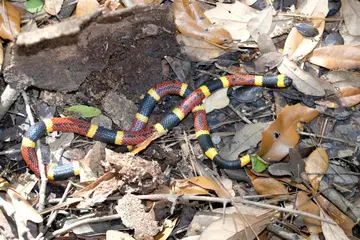
The Texas coral snake is a venomous, slender snake with complete rings of red, yellow and black, the red and yellow touching. It is usually 2.5 feet or shorter in Texas, and Arkansas gives adults an average of 20 to 30 inches. It is shy and non-aggressive, but Texas Parks and Wildlife says it can inflict a serious bite if handled. It is the only coral snake in Texas, found in the southeastern half of the state, and also lives in southern Arkansas. Louisiana lists it among its venomous snakes. If bitten, call 911 or Poison Help at 1-800-222-1222. Texas Parks and Wildlife Department
On this page
Is the Texas coral snake dangerous?
Venomous. TPWD: can inflict a serious bite if handled. Arkansas Extension: potent neurotoxic venom; if a coral snake bite is suspected, seek immediate medical attention. Texas Parks and Wildlife Department
“…they can still inflict a serious bite if handled”
Bites and stings: Shy, and bites are uncommon, but it can inflict a serious bite if handled. Texas DSHS says it does not have to "chew" to inflict a venomous bite. Arkansas Extension says the bite can be painless and hard to detect.
If someone is bitten or stung, call 911 or Poison Help at 1-800-222-1222.
How to identify a Texas coral snake
A photo or description can narrow it down, but cannot confirm what an animal is or that it is safe. Look from a distance and do not handle wild animals.
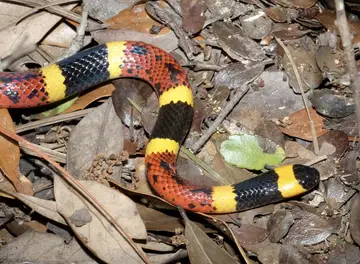
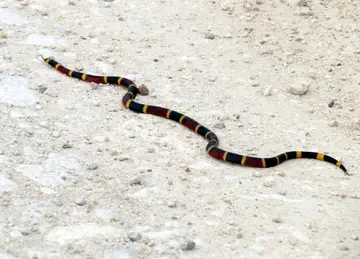

Size: Usually 2.5 feet or shorter (TPWD); adults average 20 to 30 inches (AGFC). Texas Parks and Wildlife Department
Colors: Brilliant red, yellow and black. Pattern: Broad black, narrow yellow and broad red rings, with the red always bordered by yellow; bands completely encircle the body.
Key features
- The only snake in Texas with touching red and yellow bands Texas Department of State Health Services
- Slender with a small head and round pupils; AGFC warns round pupils and a slender head do not mean a snake is nonvenomous AGFC
Young
Patterned like adults.
Animals mistaken for the Texas coral snake
Texas coral snake or Scarlet snake?
Texas coral snake
Scarlet snake Cemophora coccinea
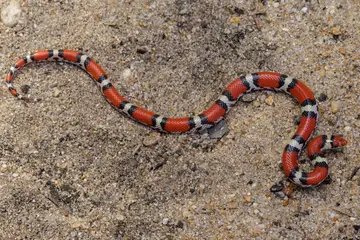

Bands stop at ground level and the belly is uniform; on the coral snake bands go all the way around. AGFC: orange or red incomplete bands bordered with black; belly without markings; pointed snout. Texas Parks and Wildlife Department
TPWD and AGFC call it harmless.
Texas coral snake or Milk snake (Louisiana and Mexican milk snakes in Texas)?
Texas coral snake
Milk snake (Louisiana and Mexican milk snakes in Texas) Lampropeltis triangulum
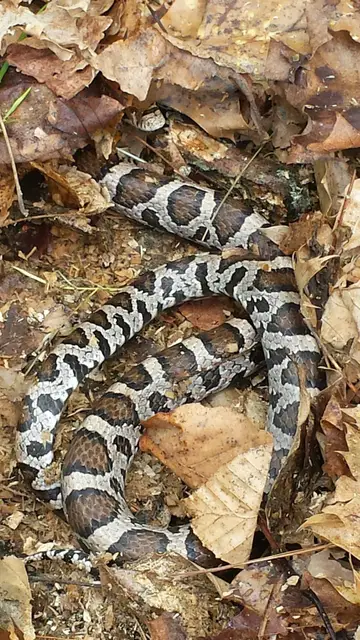
On the coral snake, red touches yellow and the bands go all the way around the body. TPWD: on milk snakes the bands stop at ground level and the belly is a uniform color. AGFC (Arkansas): wide orange or red bands bordered with black, separated by white, grayish or yellowish-white bands; the belly is black-and-white checkered or the bands extend onto it. Because milk snakes can have yellowish bands, check whether red touches yellow (coral snake) or red touches black (milk snake). Texas Parks and Wildlife Department
TPWD and AGFC call it harmless.
Texas coral snake or King snakes?
Texas coral snake
King snakes
Red and yellow do not touch on similarly colored harmless king, milk and scarlet snakes. Hosted by Texas A&M AgriLife Extension (Rangeland, Wildlife and Fisheries Management); authors at Texas A&M University Health Science Center and City of Pearland Animal Control
Called harmless in the AgriLife-hosted Texas reference.
Where the Texas coral snake lives
- Native or listed
- Nonnative or not established
- No official record in our data
- 1–9
- 10–99
- 100–999
- 1,000+
On our state guides
State boundaries: U.S. Census Bureau, cartographic boundary file cb_2024_us_state_20m.
When it is active
Arkansas: active late February through mid-November, in early morning or at dusk when humidity is high, and at night after summer rains. No Texas season was stated in the sources checked. AGFC
US open-licence records peak in April to May and July to September.
Habitat and habits
Habitat: Woodlands, canyons and coastal plains in Texas; moist pine, hardwood or mixed forests with loose, sandy soils, pine straw, leaf litter and logs in Arkansas. Texas Parks and Wildlife Department
Behavior: Secretive and largely burrowing, seldom seen even where common. Most human bites involve a snake that was picked up and handled.
Diet: Mostly other snakes and small reptiles; AGFC says lizards and small snakes.
Young: Lays 2 to 12 eggs in spring, hatching in August to September (Arkansas).
Legal status and reporting
Protection: Arkansas: Species of Greatest Conservation Need, which AGFC says confers no special or regulatory status. Texas: TPWD asks people not to kill snakes, even venomous ones; no Texas listing was found in the sources checked. AGFC
Questions about the Texas coral snake
Are there coral snakes in texas?
Yes. TPWD says the Texas coral snake is the state's only member of the Elapidae family and is found in the southeastern half of Texas, in woodlands, canyons and coastal plains. It is venomous; if bitten, call 911 or Poison Help at 1-800-222-1222.
Coral snakes in texas
The Texas coral snake is the only coral snake in Texas and the only snake there with touching red and yellow bands, per Texas DSHS. TPWD says it is shy and non-aggressive but can inflict a serious bite if handled.
Coral snake vs milk snake
On the Texas coral snake, red touches yellow and the bands go all the way around the body. TPWD says milk snakes in Texas have bands that stop at ground level. AGFC says milk snakes have red or orange bands bordered with black. TPWD and AGFC call milk snakes harmless. Texas DSHS says to avoid handling snakes unless properly trained.
Coral snake vs scarlet snake
On the Texas coral snake, red touches yellow and the bands go all the way around. TPWD says scarlet snake bands stop at ground level and the belly is uniform. AGFC says scarlet snakes have incomplete bands bordered with black, and a pointed snout.
Coral snake vs king snake
TPWD says harmless lookalikes never have red and yellow touching, and an AgriLife-hosted Texas reference names king, milk and scarlet snakes. The Texas DSHS says the Texas coral snake is the only snake in Texas with touching red and yellow bands.
Are there coral snakes in louisiana?
LDWF's 2022 Snakes of Louisiana poster lists the Texas coralsnake and harlequin coralsnake under venomous snakes, but gives no Louisiana range for the Texas coralsnake.
Sources
- Hunter Education Online Course: Snakes. Texas Parks and Wildlife Department. undated page; checked November 3, 2026.
Quoted passages (4)
“…they can still inflict a serious bite if handled”
“Coral snakes, which are venomous, do not have cat’s-eye pupils.”
“Coral snakes eat mostly other snakes and small reptiles”
“…with scarlet and milk snakes, the bands do not completely encircle the body but stop at ground level, under-bellies being uniform in color.”
- Venomous Snake Safety (Texas Junior Naturalists). Texas Parks and Wildlife Department. undated page; checked November 3, 2026.
Quoted passages (2)
“The coral snake is slender with a small indistinctive head and round pupils, and is usually is 2-1/2 feet or shorter.”
“Coral snakes are found in the southeastern half of Texas in woodlands, canyons and coastal plains.”
- Snake (Venom: Animal Bites, Venomous Bites). Texas Department of State Health Services. undated page; checked November 3, 2026.
Quoted passages (1)
“The Texas Coral Snake is the only snake in Texas with touching red and yellow bands.”
- Arkansas Snake Guide (pocket guide; Kelly J. Irwin, AGFC herpetologist). Arkansas Game and Fish Commission (AGFC). undated page; checked November 3, 2026.
Quoted passages (3)
“Young are patterned like adults”
“Active late February through mid-November Active in early morning or at dusk when humidity is high Also active at night after rains during summer months”
“Lays 2-12 eggs in spring, hatching in August-September”
- Snakes of Louisiana (17x22 poster). Louisiana Department of Wildlife and Fisheries. undated page; checked November 3, 2026.
- Learn how to identify Arkansas's venomous snakes. Arkansas Game and Fish Commission (AGFC). published 2021-03-10; checked November 3, 2026.
Quoted passages (1)
“…the coral snake which is a venomous snake native to Arkansas has round pupils”
- The Venomous Snakes of Texas Health Service Region 6/5S. Hosted by Texas A&M AgriLife Extension (Rangeland, Wildlife and Fisheries Management); authors at Texas A&M University Health Science Center and City of Pearland Animal Control. undated page; checked November 3, 2026.
Quoted passages (2)
“Coral snakes are secretive and generally inoffensive animals that are largely fossorial and seldom seen, even in areas that harbor dense populations.”
“…can therefore be readily distinguished from the similarly-colored harmless king, milk and scarlet snakes by the infamous rhyme, ‘red on yellow kill a fellow.’”
- 2025 Arkansas Wildlife Action Plan, Chapter 2: Species of Greatest Conservation Need. Arkansas Game and Fish Commission (AGFC). 2025 plan; checked November 3, 2026.
Quoted passages (1)
“Texas Coralsnake Micrurus tener”
- GBIF.org occurrence records, human observations licensed CC0 1.0 or CC BY 4.0 only, accessed November 3, 2026. The datasets behind these counts are listed on our Sources page.
- State boundaries: U.S. Census Bureau, cartographic boundary file cb_2024_us_state_20m.