States Wildlife

Venomous Snakes in Louisiana: 7 Species & How to Tell

Last checked November 3, 2026 against official sources.

On this page
  1. The 7 venomous snakes
  2. Lookalikes
  3. When they are active
  4. If you are bitten or stung
  5. How to report
  6. Common questions
  7. About this list
  8. Sources

Louisiana has 7 venomous snakes named by official sources: Eastern Copperhead, Eastern Diamond-backed Rattlesnake, Harlequin Coralsnake, Northern Cottonmouth, Pygmy Rattlesnake, Timber Rattlesnake and Texas Coralsnake. Each one is labelled venomous by Louisiana Department of Wildlife and Fisheries.

The 7 venomous snakes of Louisiana

Recognize them from a distance; a photo cannot confirm that a snake is safe. Identifying animals safely.

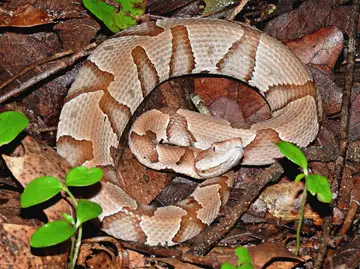
Eastern Copperhead
Photo: USFWSmidwest · Public domain · Wikimedia Commons

Eastern Copperhead

Agkistrodon contortrix

Venomous per Louisiana Department of Wildlife and Fisheries

Danger to people
“They are not aggressive but create a potential hazard by lying motionless and camouflaged.” Louisiana Department of Wildlife and Fisheries
Size
Adults usually about 2 to 3 feet (24-36 in); record about 53 inches.
How to recognize it
  • Vertical (cat-like) pupils and a heat-sensing pit between eye and nostril
  • Heavy-bodied; keeled scales
  • Head shape alone is not a reliable way to identify copperheads
Where in Louisiana
Found throughout wooded and forested areas of Louisiana except for permanent swamps and coastal cheniers. Louisiana Department of Wildlife and Fisheries
Conservation
Populations are considered stable within the state.
50 records by month.

Full Eastern Copperhead guide

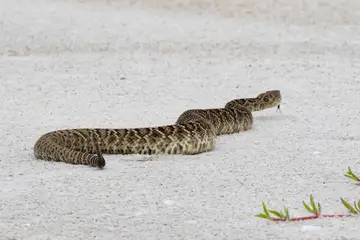
Eastern Diamond-backed Rattlesnake
Photo: Kent P. McFarland · CC0 1.0 · iNaturalist

Eastern Diamond-backed Rattlesnake

Crotalus adamanteus

Venomous per Louisiana Department of Wildlife and Fisheries

Danger to people
“A Restricted Snake Permit is required for possession of any native and non-native venomous snake species in Louisiana.” Louisiana Department of Wildlife and Fisheries
Size
Most adults 33 to 72 inches (about 3 to 6 feet); record 99 inches.
How to recognize it
  • Light-bordered dark stripe running diagonally through each eye
  • Tail ends in a rattle, often held above the ground
  • Cat-like vertical pupil and a deep heat-sensing pit between nostril and eye
Where in Louisiana
Found in open pinelands in upland portions of Tangipahoa, Washington, and St. Tammany Parishes … Louisiana Department of Wildlife and Fisheries
Conservation
No record of a stable population in the state and is ranked as S1 (critically imperiled).

Full Eastern Diamond-backed Rattlesnake guide

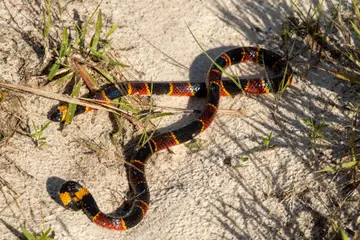
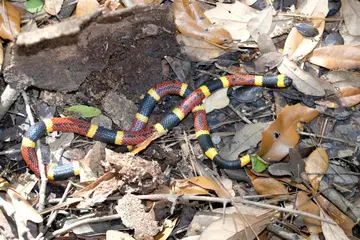
Harlequin Coralsnake
Photo: Court Harding · CC BY 4.0 · iNaturalist

Harlequin Coralsnake

Micrurus fulvius

Venomous per Louisiana Department of Wildlife and Fisheries

Danger to people
“They should not be held under any circumstances—if carelessly handled, they may bite unexpectedly.” Louisiana Department of Wildlife and Fisheries
Where in Louisiana
Found in the Florida Parishes east of the upper Amite River and lower Tangipahoa River. There have been no confirmed records from Louisiana since the 1980s … Louisiana Department of Wildlife and Fisheries
What the sources say

Range: Found in the Florida Parishes east of the upper Amite River and lower Tangipahoa River. There have been no confirmed records from Louisiana since the 1980s. Inhabit dry, wooded areas, especially pinelands and mixed forests, but some may be found in open pastures.

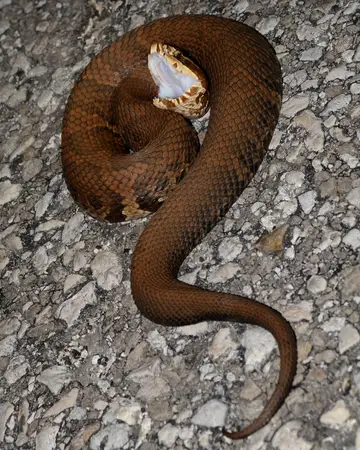
Northern Cottonmouth
Photo: Geoff Gallice from Gainesville · CC BY 2.0 · Wikimedia Commons

Northern Cottonmouth

Agkistrodon piscivorus

Venomous per Louisiana Department of Wildlife and Fisheries

Danger to people
“They are highly defensive and not inclined to get out of one's way.” Louisiana Department of Wildlife and Fisheries
Size
Typically 30 to 48 inches (about 3 to 4 feet); recorded up to 75 inches.
How to recognize it
  • Heat-sensing pit between nostril and eye; no rattle
  • Head much wider than the neck, with a dark bar from the eye to the jaw; vertical (cat-eye) pupils
  • Gapes to show the white lining of its mouth when threatened
Where in Louisiana
Found throughout Louisiana. They frequent swamplands and pond, lake, and stream borders, especially those with dense canopies … Louisiana Department of Wildlife and Fisheries
Conservation
Relatively common in many places. Populations are considered stable within the state.
218 records by month.
What the sources say

Range: Found throughout Louisiana. They frequent swamplands and pond, lake, and stream borders, especially those with dense canopies. They often remain coiled near water, or on log jams in water, rarely ascending shrubs or palmettos. They frequently travel between streams, even over low ridges, and can be found in almost any habitat.

Full Northern Cottonmouth guide

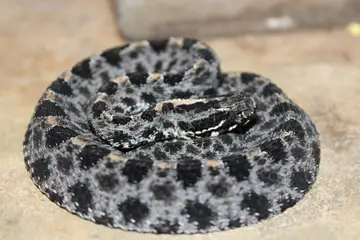
Pygmy Rattlesnake
Photo: Jolieokefenokee · CC BY 4.0 · Wikimedia Commons

Pygmy Rattlesnake

Sistrurus miliarius

Venomous per Louisiana Department of Wildlife and Fisheries

Danger to people
“A Restricted Snake Permit is required for possession of any native and non-native venomous snake species in Louisiana.” Louisiana Department of Wildlife and Fisheries
Size
Adults usually 12-24 inches (30-61 cm); record 31-33 inches. Newborns about 5-6 inches.
How to recognize it
  • Tiny rattle at the end of a slender tail; buzz sounds like an insect
  • Pit viper: heat-sensing pit between nostril and eye, vertical (cat-like) pupils, keeled scales; nine large plates on top of the head
  • Large head scales (other rattlesnakes have small scales on the head)
Where in Louisiana
Found in upland areas and pine flatwoods in the Florida Parishes and northern and central Louisiana, southwest to Calcasieu Parish … Louisiana Department of Wildlife and Fisheries
Conservation
Rarely encountered and ranked as S2 (imperiled) in Louisiana.
What the sources say

Range: Found in upland areas and pine flatwoods in the Florida Parishes and northern and central Louisiana, southwest to Calcasieu Parish. There are isolated populations in the west edge of the Atchafalaya Basin-Vermilion River area, the salt dome islands around Cote Blanch Bay, and live oak ridges from the New Orleans area southward and eastward. Found in wooded areas but tend to avoid swamps. Favor areas with a grass understory such as pinelands and dry coastlands but are also found in palmetto flatwoods.

Full Pygmy Rattlesnake guide

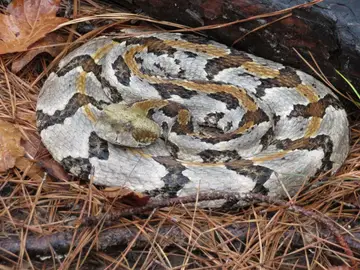
Timber Rattlesnake
Photo: NPS Photo · Public domain · Wikimedia Commons

Timber Rattlesnake

Crotalus horridus

Venomous per Louisiana Department of Wildlife and Fisheries

Danger to people
“A Restricted Snake Permit is required for possession of any native and non-native venomous snake species in Louisiana.” Louisiana Department of Wildlife and Fisheries
Size
Most adults 36 to 60 inches (3 to 5 feet); record 74.5 inches.
How to recognize it
  • Black tail ending in a rattle
  • Heat-sensing pit between nostril and eye
  • Large, thick head distinct from the neck; cat-like vertical pupil
Where in Louisiana
Inhabit wooded and forested areas, preferring hardwoods. Found in most of Louisiana except coastal marshes … Louisiana Department of Wildlife and Fisheries
Conservation
Populations appear stable in some places but have vanished from other known areas. Ranked as S3/S4 (rare/apparently secure) in Louisiana.
What the sources say

Range: Inhabit wooded and forested areas, preferring hardwoods. Found in most of Louisiana except coastal marshes. They occur on the salt dome islands around Cote Blanche Bay and adjacent high ground from Morgan City to Patterson, but there are no records west of the Atchafalaya Basin, in Acadiana, or in the pinelands of southwestern Louisiana.

Full Timber Rattlesnake guide

For 7 other snakes on Louisiana's list, no official source we use states whether it is venomous: Ball Python, Boa Constrictor, Brahminy Blindsnake, Burmese Python, Eastern Milksnake, Eastern Pinesnake and Reticulated Python. That does not make them harmless. Leave every snake alone.

See all 50 snakes, venomous and not, on Louisiana snakes.

Snakes people confuse

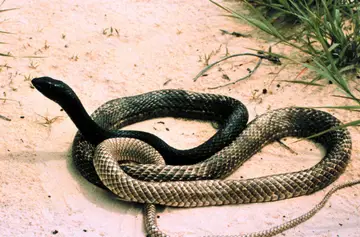
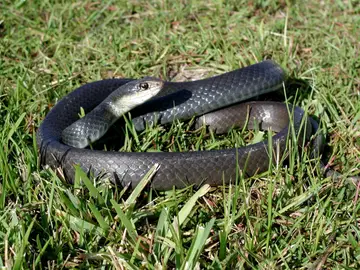
Coachwhip or North American racer (black racer)?

Coachwhip
Photo: NOAA · Public domain · Wikimedia Commons

Coachwhip Non-venomous

North American racer (black racer)
Photo: Everglades NPS from Homestead, Florida, United States · Public domain · Wikimedia Commons

North American racer (black racer) Non-venomous

TWRA: the racer lacks the coachwhip's reddish tint along the sides of the tail; an all-black coachwhip is distinctly lighter or reddish toward the rear. Oklahoma: the coachwhip is much larger.

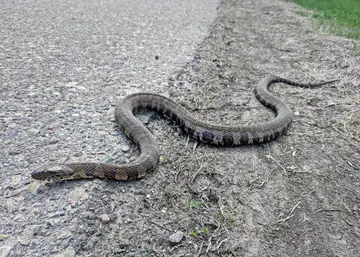
Northern watersnake or Cottonmouth (water moccasin)?

Northern watersnake
Photo: U.S. Fish and Wildlife Service - Midwest Region · Public domain · Wikimedia Commons

Northern watersnake Non-venomous

Cottonmouth (water moccasin)
Photo: Geoff Gallice from Gainesville · CC BY 2.0 · Wikimedia Commons

Cottonmouth (water moccasin) Venomous

Cottonmouths are heavier-bodied with a larger, chunky head, a pit between nostril and eye, darker color, and a light line from the eye to the corner of the mouth (Missouri). Cottonmouths have cat-like pupils; watersnakes have round pupils and no facial pit, and seen from above a cottonmouth's eyes are hidden while a watersnake's are visible (Florida Museum). Georgia DNR: banded watersnakes have bands widest on top; banded cottonmouths have bands widest on the sides (hourglass-shaped from above). Cottonmouths float on the water; watersnakes swim with the body just below the surface (Virginia DWR). Cautions from the same agencies: Virginia DWR says some other nonvenomous snakes, such as the eastern hog-nosed snake, also float, and that watersnakes often flatten the head when threatened so it looks diamond-shaped; CDFW says older northern watersnakes can look almost entirely dark brown or black.

Northern watersnake or Copperhead?

Northern watersnake
Photo: U.S. Fish and Wildlife Service - Midwest Region · Public domain · Wikimedia Commons

Northern watersnake Non-venomous

Copperhead
Photo: USFWSmidwest · Public domain · Wikimedia Commons

Copperhead Venomous

Florida Museum (midland watersnake): the watersnake's crossbands are darker, narrower and much more numerous than a copperhead's and turn into blotches halfway down the body. Watersnakes have round pupils and dark vertical lines near the mouth; copperheads have no such lines.

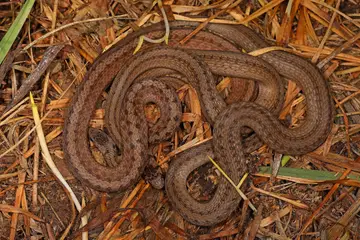
Brown Snake (Dekay's Brownsnake) or Copperhead?

Brown Snake (Dekay's Brownsnake)
Photo: Judy Gallagher · CC BY 2.0 · Wikimedia Commons

Brown Snake (Dekay's Brownsnake) Non-venomous

Copperhead
Photo: USFWSmidwest · Public domain · Wikimedia Commons

Copperhead Venomous

Copperheads have bold hourglass-shaped bands, and young copperheads under about 12 inches have bright yellow tail tips. Brown snakes have small spots, not hourglass bands.

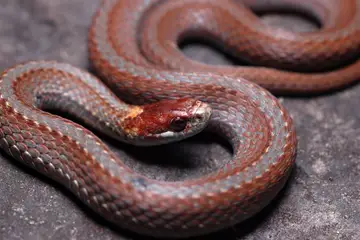
Brown Snake (Dekay's Brownsnake) or Red-bellied Snake?

Brown Snake (Dekay's Brownsnake)
Photo: Judy Gallagher · CC BY 2.0 · Wikimedia Commons

Brown Snake (Dekay's Brownsnake) Non-venomous

Red-bellied Snake
Photo: Rstanton13 · CC BY-SA 4.0 · Wikimedia Commons · resized

Red-bellied Snake Non-venomous

The red-bellied snake has a red underside; the brown snake's belly is cream, yellow or pink.

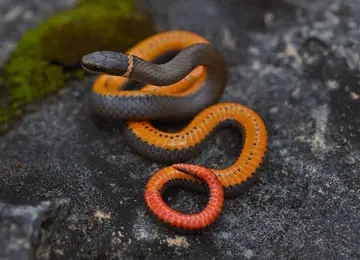
Brown Snake (Dekay's Brownsnake) or Ring-necked Snake?

Brown Snake (Dekay's Brownsnake)
Photo: Judy Gallagher · CC BY 2.0 · Wikimedia Commons

Brown Snake (Dekay's Brownsnake) Non-venomous

Ring-necked Snake
Photo: Peter Paplanus from St. Louis, Missouri · CC BY 2.0 · Wikimedia Commons

Ring-necked Snake Non-venomous

Ring-necked snakes have smooth scales and yellow bellies with paired dots down the center.

Photos show typical adults; individuals vary. Never get close to compare.

When venomous snakes are active in Louisiana

Records of snakes in Louisiana peak in March to June. They show when people record snakes, not how many there are (about month bars).

1,817 records of snakes in Louisiana by month (GBIF, CC0 and CC BY records).

If you are bitten or stung

Call 911 or Poison Help at 1-800-222-1222 right away. Poison Help connects you to your local poison center, any time of day.

Official advice from Louisiana Department of Wildlife and Fisheries:

How to report

Nuisance alligators: contact an LDWF field office, or Operation Game Thief 800-442-2511 after hours and weekends. Sick/injured/stranded sea turtles or marine mammals: 844-SEA-TRTL (844-732-8785). Rabies: Louisiana Department of Health, Office of Public Health, 1-800-256-2748. Louisiana Department of Wildlife and Fisheries

Common questions

About this list

The species list comes from Snake Species Field Guide (LDWF web) + Snakes of Louisiana poster (LDWF, 2022) (Louisiana Department of Wildlife and Fisheries, web guide undated (retrieved 2026-11-03); poster 2022). 50 more entries come from other official sources named on each card.

Venom labels come only from official sources and link to them; "Not stated" never means harmless. How labels work.

"Nonnative" and "Invasive" follow the wording of the source list. See invasive species in Louisiana.

Sources

  1. About Us. Louisiana Department of Wildlife and Fisheries. undated page; checked November 3, 2026.
  2. Snake Species Field Guide. Louisiana Department of Wildlife and Fisheries. undated page; checked November 3, 2026.
    Quoted passages (1)
    “Venomous Snake Species”
  3. Snake Species Field Guide: Coachwhip Snake. Louisiana Department of Wildlife and Fisheries. undated page; checked November 3, 2026.
  4. Snake Species Field Guide: Common Gartersnake. Louisiana Department of Wildlife and Fisheries. undated page; checked November 3, 2026.
  5. Snake Species Field Guide: Common Watersnake. Louisiana Department of Wildlife and Fisheries. undated page; checked November 3, 2026.
  6. Snake Species Field Guide: Common Wormsnake. Louisiana Department of Wildlife and Fisheries. undated page; checked November 3, 2026.
  7. Snake Species Field Guide: Dekay's Brownsnake. Louisiana Department of Wildlife and Fisheries. undated page; checked November 3, 2026.
  8. Snake Species Field Guide: Diamond-backed Watersnake. Louisiana Department of Wildlife and Fisheries. undated page; checked November 3, 2026.
  9. Snake Species Field Guide: Eastern Copperhead. Louisiana Department of Wildlife and Fisheries. undated page; checked November 3, 2026.
    Quoted passages (3)
    “They are not aggressive but create a potential hazard by lying motionless and camouflaged.”
    “During the summer, they are active at night and very early in the morning.”
    “Found throughout wooded and forested areas of Louisiana except for permanent swamps and coastal cheniers.”
  10. Snake Species Field Guide: Eastern Diamond-backed Rattlesnake. Louisiana Department of Wildlife and Fisheries. undated page; checked November 3, 2026.
    Quoted passages (2)
    “A Restricted Snake Permit is required for possession of any native and non-native venomous snake species in Louisiana.”
    “There are no more than eight verifiable records of this snake in Louisiana”
  11. Snake Species Field Guide: Eastern Hog-nosed Snake. Louisiana Department of Wildlife and Fisheries. undated page; checked November 3, 2026.
  12. Snake Species Field Guide: Eastern Ribbonsnake. Louisiana Department of Wildlife and Fisheries. undated page; checked November 3, 2026.
  13. Snake Species Field Guide: Flat-headed Snake. Louisiana Department of Wildlife and Fisheries. undated page; checked November 3, 2026.
  14. Snake Species Field Guide: Glossy Swampsnake. Louisiana Department of Wildlife and Fisheries. undated page; checked November 3, 2026.
  15. Snake Species Field Guide: Graham's Crawfish Snake. Louisiana Department of Wildlife and Fisheries. undated page; checked November 3, 2026.
  16. Snake Species Field Guide: Harlequin Coralsnake. Louisiana Department of Wildlife and Fisheries. undated page; checked November 3, 2026.
    Quoted passages (2)
    “They should not be held under any circumstances—if carelessly handled, they may bite unexpectedly.”
    “There have been no confirmed records from Louisiana since the 1980s.”
  17. Snake Species Field Guide: Louisiana Pinesnake. Louisiana Department of Wildlife and Fisheries. undated page; checked November 3, 2026.
    Quoted passages (1)
    “Most active in March through May and in the fall, especially November.”
  18. Snake Species Field Guide: Mississippi Green Watersnake. Louisiana Department of Wildlife and Fisheries. undated page; checked November 3, 2026.
  19. Snake Species Field Guide: North American Racer. Louisiana Department of Wildlife and Fisheries. undated page; checked November 3, 2026.
  20. Snake Species Field Guide: Northern Cottonmouth. Louisiana Department of Wildlife and Fisheries. undated page; checked November 3, 2026.
    Quoted passages (2)
    “They are highly defensive and not inclined to get out of one's way.”
    “Found throughout Louisiana.”
  21. Snake Species Field Guide: Northern Mole Kingsnake. Louisiana Department of Wildlife and Fisheries. undated page; checked November 3, 2026.
  22. Snake Species Field Guide: Pine Woods Littersnake. Louisiana Department of Wildlife and Fisheries. undated page; checked November 3, 2026.
  23. Snake Species Field Guide: Plain-bellied Watersnake. Louisiana Department of Wildlife and Fisheries. undated page; checked November 3, 2026.
  24. Snake Species Field Guide: Prairie Kingsnake. Louisiana Department of Wildlife and Fisheries. undated page; checked November 3, 2026.
  25. Snake Species Field Guide: Pygmy Rattlesnake. Louisiana Department of Wildlife and Fisheries. undated page; checked November 3, 2026.
    Quoted passages (1)
    “A Restricted Snake Permit is required for possession of any native and non-native venomous snake species in Louisiana.”
  26. Snake Species Field Guide: Rainbow Snake. Louisiana Department of Wildlife and Fisheries. undated page; checked November 3, 2026.
  27. Snake Species Field Guide: Red cornsnake. Louisiana Department of Wildlife and Fisheries. undated page; checked November 3, 2026.
  28. Snake Species Field Guide: Red-bellied Mudsnake. Louisiana Department of Wildlife and Fisheries. undated page; checked November 3, 2026.
  29. Snake Species Field Guide: Red-bellied Snake. Louisiana Department of Wildlife and Fisheries. undated page; checked November 3, 2026.
  30. Snake Species Field Guide: Ring-necked Snake. Louisiana Department of Wildlife and Fisheries. undated page; checked November 3, 2026.
  31. Snake Species Field Guide: Rough Earthsnake. Louisiana Department of Wildlife and Fisheries. undated page; checked November 3, 2026.
  32. Snake Species Field Guide: Rough Greensnake. Louisiana Department of Wildlife and Fisheries. undated page; checked November 3, 2026.
  33. Snake Species Field Guide: Saltmarsh Snake. Louisiana Department of Wildlife and Fisheries. undated page; checked November 3, 2026.
  34. Snake Species Field Guide: Scarlet Kingsnake. Louisiana Department of Wildlife and Fisheries. undated page; checked November 3, 2026.
    Quoted passages (1)
    “Rings continue across belly. Snout is always red.”
  35. Snake Species Field Guide: Scarlet Snake. Louisiana Department of Wildlife and Fisheries. undated page; checked November 3, 2026.
  36. Snake Species Field Guide: Smooth Earthsnake. Louisiana Department of Wildlife and Fisheries. undated page; checked November 3, 2026.
  37. Snake Species Field Guide: Southeastern Crowned Snake. Louisiana Department of Wildlife and Fisheries. undated page; checked November 3, 2026.
  38. Snake Species Field Guide: Southern Watersnake. Louisiana Department of Wildlife and Fisheries. undated page; checked November 3, 2026.
  39. Snake Species Field Guide: Speckled Kingsnake. Louisiana Department of Wildlife and Fisheries. undated page; checked November 3, 2026.
  40. Snake Species Field Guide: Timber Rattlesnake. Louisiana Department of Wildlife and Fisheries. undated page; checked November 3, 2026.
    Quoted passages (2)
    “A Restricted Snake Permit is required for possession of any native and non-native venomous snake species in Louisiana.”
    “Move from hibernation sites to summer foraging grounds in mid-spring and return to winter quarters in late summer and early fall; most often observed during these periods of travel.”
  41. Snake Species Field Guide: Western Milksnake. Louisiana Department of Wildlife and Fisheries. undated page; checked November 3, 2026.
  42. Snake Species Field Guide: Western Ratsnake. Louisiana Department of Wildlife and Fisheries. undated page; checked November 3, 2026.
  43. Snake Species Field Guide: Western Ribbonsnake. Louisiana Department of Wildlife and Fisheries. undated page; checked November 3, 2026.
  44. Snake Species Field Guide: Western Wormsnake. Louisiana Department of Wildlife and Fisheries. undated page; checked November 3, 2026.
  45. Snakes of Louisiana (17x22 poster). Louisiana Department of Wildlife and Fisheries. undated page; checked November 3, 2026.
  46. 2025 Louisiana State Wildlife Action Plan. Louisiana Department of Wildlife and Fisheries. 2025 plan; checked November 3, 2026.
  47. Nuisance Alligators. Louisiana Department of Wildlife and Fisheries. undated page; checked November 3, 2026.
    Quoted passages (1)
    “Operation Game Thief: 800-442-2511 / (for nuisance alligator reports after hours and on weekends)”
  48. GBIF.org occurrence records, human observations licensed CC0 1.0 or CC BY 4.0 only, accessed November 3, 2026. The datasets behind these counts are listed on our Sources page.