States Wildlife

Are there pythons in Louisiana?

Last checked November 3, 2026 against official sources.

On this page
  1. The answer
  2. More official answers
  3. Which ones
  4. Where in the US
  5. Lookalikes
  6. Sources

Burmese, Reticulated and Ball Pythons appear on LDWF's 2025 Invasive Species List (Tier 3); the list defines Tiers 1-4 as non-native species currently known to occur in Louisiana. No locations or population sizes are given.

Louisiana Department of Wildlife and Fisheries: “Burmese Python Python bivittatus” Source

How we answer questions

  • Are there venomous snakes in Louisiana?

    Yes. LDWF's field guide lists six venomous species (Eastern Copperhead, Harlequin Coralsnake, Eastern Diamond-backed Rattlesnake, Northern Cottonmouth, Pygmy Rattlesnake, Timber Rattlesnake); the LDWF 2022 poster also shows the Texas Coralsnake under "Venomous Snakes". Louisiana Department of Wildlife and Fisheries

  • Are there water moccasins (cottonmouths) in Louisiana?

    Yes. The Northern Cottonmouth (also known as Water Moccasin) is found throughout Louisiana. Louisiana Department of Wildlife and Fisheries

  • Are there coral snakes in Louisiana?

    Rarely. LDWF lists the Harlequin Coralsnake as venomous and says there have been no confirmed Louisiana records since the 1980s; the 2025 SWAP says it "may be extirpated from the state". The LDWF 2022 Snakes of Louisiana poster also shows the Texas Coralsnake under "Venomous Snakes" (no Louisiana range given). Louisiana Department of Wildlife and Fisheries

  • Are there rattlesnakes in Louisiana?

    Yes. LDWF lists Timber, Pygmy and Eastern Diamond-backed Rattlesnakes as venomous. LDWF says there are no more than eight verifiable Eastern Diamond-backed records in Louisiana (last in 1995) and ranks it S1; the 2025 SWAP says it "may be extirpated from the state". Louisiana Department of Wildlife and Fisheries

  • Are there copperheads in Louisiana?

    Yes. LDWF: found throughout wooded and forested areas except permanent swamps and coastal cheniers. Louisiana Department of Wildlife and Fisheries

The 3 on Louisiana's list

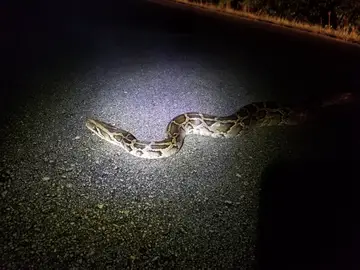
Reticulated Python
Photo: Rushen · CC BY-SA 2.0 · Wikimedia Commons · resized

Reticulated Python

Malayopython reticulatus

Not stated Nonnative

Venom
No official source we use states whether this animal is venomous. That does not mean it is harmless: do not handle it.
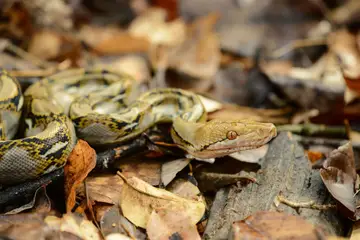
Burmese Python
Photo: Court Harding · CC BY 4.0 · iNaturalist

Burmese Python

Python bivittatus

Not stated Nonnative

Venom
No official source we use states whether this animal is venomous. That does not mean it is harmless: do not handle it.
Size
Most adults in Florida 10 to 16 feet; Florida record 16.8 feet.
How to recognize it
  • Dark spearhead (arrow) shape on top of the head
  • Very large and heavy bodied; every life stage larger than native snakes in its invasive range
  • Smooth scales; vertical (cat-like) pupil; deep facial pits along the front of the upper lip

Full Burmese Python guide

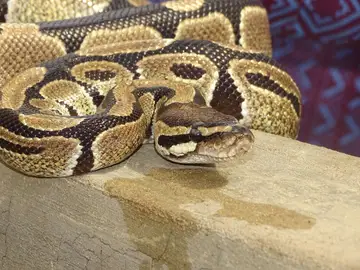
Ball Python
Photo: KOUAGOU Damien · CC BY-SA 4.0 · Wikimedia Commons · resized

Ball Python

Python regius

Not stated Nonnative

Venom
No official source we use states whether this animal is venomous. That does not mean it is harmless: do not handle it.

All snakes in the state: Louisiana snakes.

Where the Burmese python lives in the US

Georgia: nonnative, on an official sourceLouisiana: on the state's official list (nonnative)Florida: nonnative, on an official sourceOhio: nonnative, on an official source
Official presence. 4 states where a state list or official source names it. Gray means no official record in our data, not that it is absent.
  • Native or listed
  • Nonnative or not established
  • No official record in our data
Florida: 58 records
Observation records. Open-licence records on GBIF in 1 state. Records are sightings people shared, not confirmation that a population lives there.
  • 1–9
  • 10–99
  • 100–999
  • 1,000+

Burmese Python: identification, range and danger

What else it could be

  • Northern African Python

    USGS: the Northern African python's back pattern is less vivid/defined and its belly scales are patterned black and white, while the Burmese python's belly scales are white. Florida Museum: Northern African rock pythons have two mostly continuous, irregular dark blotches down the back bordered by black and white. Caution: Florida Museum also says the Burmese belly has dark spots along the sides, so belly colour alone is not a clean test.

When snakes are seen in Louisiana

1,817 records (GBIF, CC0 and CC BY).

Other questions about Louisiana

Sources

  1. 2025 Louisiana State Wildlife Action Plan. Louisiana Department of Wildlife and Fisheries. 2025 plan; checked November 3, 2026.
    Quoted passages (1)
    “Burmese Python Python bivittatus”
  2. Snake Species Field Guide. Louisiana Department of Wildlife and Fisheries. undated page; checked November 3, 2026.
    Quoted passages (1)
    “Venomous Snake Species”
  3. Snake Species Field Guide: Northern Cottonmouth. Louisiana Department of Wildlife and Fisheries. undated page; checked November 3, 2026.
    Quoted passages (1)
    “Found throughout Louisiana.”
  4. Snake Species Field Guide: Harlequin Coralsnake. Louisiana Department of Wildlife and Fisheries. undated page; checked November 3, 2026.
    Quoted passages (1)
    “There have been no confirmed records from Louisiana since the 1980s.”
  5. Snake Species Field Guide: Eastern Diamond-backed Rattlesnake. Louisiana Department of Wildlife and Fisheries. undated page; checked November 3, 2026.
    Quoted passages (1)
    “There are no more than eight verifiable records of this snake in Louisiana”
  6. Snake Species Field Guide: Eastern Copperhead. Louisiana Department of Wildlife and Fisheries. undated page; checked November 3, 2026.
    Quoted passages (1)
    “Found throughout wooded and forested areas of Louisiana except for permanent swamps and coastal cheniers.”
  7. GBIF.org occurrence records, human observations licensed CC0 1.0 or CC BY 4.0 only, accessed November 3, 2026. The datasets behind these counts are listed on our Sources page.