Carpenter bee
Xylocopa (genus); main species in the eastern US: Xylocopa virginica (eastern carpenter bee) · also called eastern carpenter bee and large carpenter bee · Last checked November 3, 2026.
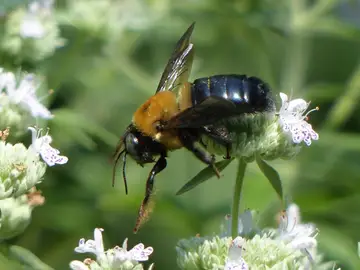
Carpenter bees are large bees that look like bumble bees but have a shiny, mostly hairless black abdomen. Females bore round holes about half an inch wide into bare wood such as eaves, decks and fascia boards to raise their young. Males hover and chase intruders but have no stinger; females can sting but rarely do unless they are handled or bothered. Penn State and the Missouri Department of Conservation say the eastern carpenter bee is the only large carpenter bee in Pennsylvania and Missouri, and NC State Extension describes carpenter bees in North Carolina. University of Kentucky Entomology
This page covers a genus (Xylocopa (genus); main species in the eastern US: Xylocopa virginica (eastern carpenter bee)), not a single species.
On this page
Is the carpenter bee dangerous?
Males cannot sting. Females can give a painful sting but seldom do unless handled or bothered. University of Kentucky Entomology
“The males are harmless, however, since they lack the ability to sting. Female carpenter bees can inflict a painful sting but will seldom do so -- unless they are handled or bothered by people.”
Bites and stings: Females can sting; males cannot sting.
If someone is bitten or stung, call 911 or Poison Help at 1-800-222-1222.
How to identify a carpenter bee
A photo or description can narrow it down, but cannot confirm what an animal is or that it is safe. Look from a distance and do not handle wild animals.
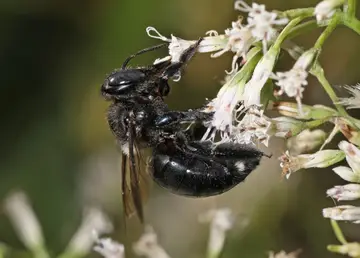
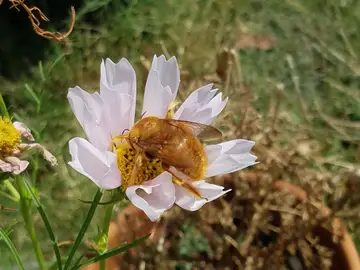
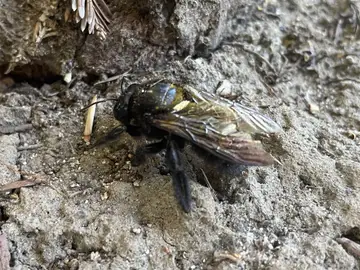
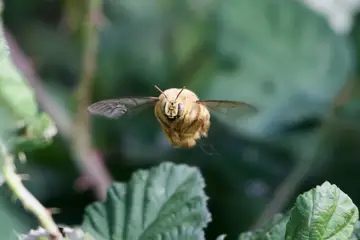
Size: About 3/4 to 1 inch long, robust and heavy-bodied. Clemson Cooperative Extension Home & Garden Information Center
Colors: Shiny black abdomen; bright yellow, orange or white hairs on the thorax. Pattern: Males have a white face patch; females have an all-black face.
Key features
- Abdomen shiny and mostly hairless (bumble bees have a hairy abdomen) University of Kentucky Entomology
- Perfectly round entrance hole about the diameter of a little finger in wood; coarse sawdust may be present below the opening University of Kentucky Entomology
- Males hover in front of people near nests University of Kentucky Entomology
Young
Eggs and larvae develop inside sealed cells in the wood tunnel, each cell provisioned with pollen and a single egg.
Animals mistaken for the carpenter bee
Carpenter bee or Bumble bee?
Carpenter bee
Bumble bee Bombus
Bumble bees have a hairy abdomen, usually with black and yellow stripes, and nest in existing cavities, often underground; carpenter bees have a shiny abdomen and tunnel into wood. University of Kentucky Entomology
Bumble bees also sting: UF/IFAS lists the bumble bee in its 'Summary of Important Stinging Arthropods' with stinging ability 'Yes'. NC State Extension notes that bumble bee males have no stinger.
Where the carpenter bee lives
- Native or listed
- Nonnative or not established
- No official record in our data
- 1–9
- 10–99
- 100–999
- 1,000+
State boundaries: U.S. Census Bureau, cartographic boundary file cb_2024_us_state_20m.
When it is active
Adults overwinter in old tunnels and emerge in spring (April and May, per NC State and Clemson Extension); very active from early spring through summer, and new adults emerge in late summer.
US open-licence records for all carpenter bees (genus Xylocopa) peak in April to May and July to September.
Habitat and habits
Habitat: Nests in wood: prefers unpainted, weathered softwood such as redwood, cedar, cypress and pine, including eaves, rafters, fascia boards, siding, decks and outdoor furniture; in nature, primarily a forest species.
Behavior: Solitary, not colonial. Males are territorial and investigate anything that enters their territory but are interested only in rival males.
Diet: Adults feed on flower nectar and pollinate many flowers; females stock nest cells with pollen and nectar for the larvae. They do not eat the wood they tunnel.
Young: A female bores a tunnel, builds about 5 to 8 cells each with a pollen provision and one egg, and seals them with chewed wood; new adults emerge in late summer.
Sources
- Carpenter Bees (ENTFACT-611). University of Kentucky Entomology (Cooperative Extension). Revised: 3/26; checked November 3, 2026.
Quoted passages (6)
“The males are harmless, however, since they lack the ability to sting. Female carpenter bees can inflict a painful sting but will seldom do so -- unless they are handled or bothered by people.”
“Carpenter bees resemble bumblebees, but typically have a shiny, hairless abdomen.”
“The entrance hole in the wood surface is perfectly round and about the diameter of your little finger. Coarse sawdust may be present below the opening”
“Male carpenter bees can be especially intimidating, hovering in front of people who are around nesting sites.”
“Inside the tunnel, about five or six cells are constructed for housing individual eggs. Working back to front, the bee provisions each cell with pollen (collected from spring-flowering plants) and a single egg”
“(Bumblebees usually have a hairy abdomen with black and yellow stripes.) The bees also have different nesting habits—bumblebees nest in an existing cavity often underground (e.g., in abandoned rodent burrows), whereas carpenter bees tunnel into wood to lay their eggs.”
- Eastern Carpenter Bee (Field Guide). Missouri Department of Conservation. undated page; checked November 3, 2026.
- Carpenter Bees. Penn State Extension. updated May 12, 2026; checked November 3, 2026.
- Non-Honey Bee Stinging Insects in North Carolina. NC State Extension. Publication date: Feb. 5, 2015; checked November 3, 2026.
- Carpenter Bees (HGIC factsheet). Clemson Cooperative Extension Home & Garden Information Center. published 2020-06-12; checked November 3, 2026.
Quoted passages (1)
“Carpenter bees are robust, heavy-bodied bees that range three-quarters inch to one inch in length.”
- GBIF.org occurrence records, human observations licensed CC0 1.0 or CC BY 4.0 only, accessed November 3, 2026. The datasets behind these counts are listed on our Sources page.
- State boundaries: U.S. Census Bureau, cartographic boundary file cb_2024_us_state_20m.