Curly-tailed Lizard
Leiocephalus carinatus · also called northern curly-tailed lizard, northern curlytail lizard, curly tail lizard and Bahama curly-tailed lizard · Last checked November 3, 2026.
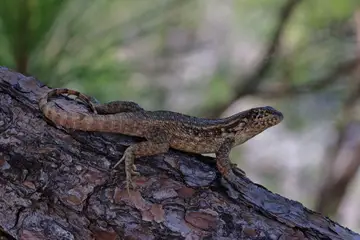

The northern curly-tailed lizard is a robust gray to tan lizard, about 7 to 10.5 inches long, that holds its dark-banded tail curled over its back. It is not native to the US. Native to Cuba, the Cayman Islands and the Bahamas, it was brought to Florida to eat sugarcane pests and now lives from Key West to Central Florida. Florida is the only state where official sources checked confirm it. No official source checked states whether it is venomous or dangerous to people or pets. UF/IFAS Extension
On this page
Is the curly-tailed lizard dangerous?
Bites and stings: UF/IFAS Extension warns that most reptiles will bite or scratch if provoked. No species-specific bite information was found.
No official source we use states whether this animal is venomous. That does not mean it is harmless: do not handle it.
How to identify a curly-tailed lizard
A photo or description can narrow it down, but cannot confirm what an animal is or that it is safe. Look from a distance and do not handle wild animals.
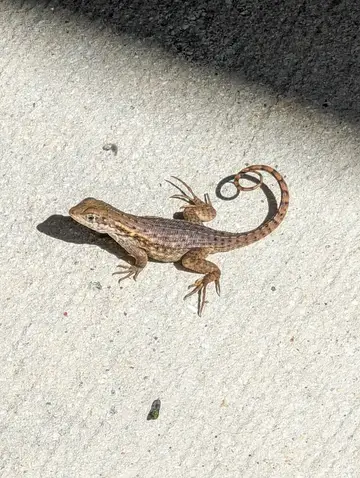
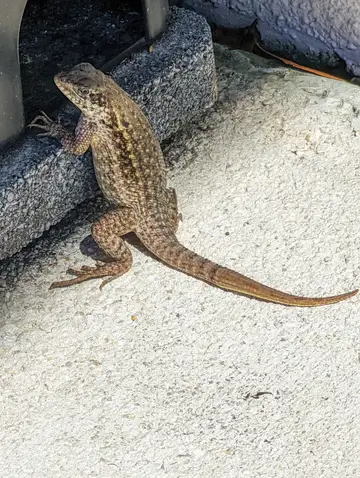
Size: 7 to 10.5 inches; FWC says males may reach 11 inches. UF/IFAS Extension
Colors: Gray to tan. Pattern: Light stripes on the nape and along the upper sides, and a dark-banded tail.
Key features
- Dark-banded tail held curved above the back. Florida Fish and Wildlife Conservation Commission
- Lifts and curls its tail when approached. UF/IFAS Extension Sarasota County
- Low crest along the spine. Florida Fish and Wildlife Conservation Commission
Animals mistaken for the curly-tailed lizard
Curly-tailed Lizard or Red-sided curly-tailed lizard?
Curly-tailed Lizard
Red-sided curly-tailed lizard Leiocephalus schreibersii
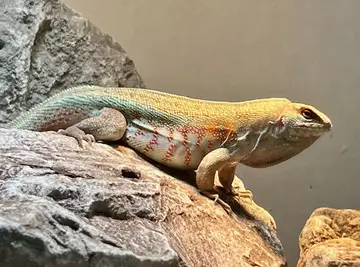

Red vertical bars on the sides separated by pale blue patches, a less tightly curled tail, and side skin folds. FWC says it is the only curlytail in Florida with those folds. Florida Fish and Wildlife Conservation Commission
Where the curly-tailed lizard lives
- Native or listed
- Nonnative or not established
- No official record in our data
- 1–9
- 10–99
- 100–999
- 1,000+
On our state guides
State boundaries: U.S. Census Bureau, cartographic boundary file cb_2024_us_state_20m.
When it is active
US open-licence records peak in February to June and October.
Habitat and habits
Habitat: Parks, farmland, canal edges and seawalls in South Florida, especially areas with ground rubble. A Florida Museum article says it can thrive even in a parking lot. Florida Fish and Wildlife Conservation Commission
Behavior: Alert and robust. Mostly on the ground but climbs well. Can hitchhike in cars, plant delivery trucks and boats, which helps it reach new places.
Diet: Eats insects and smaller lizards, and has been recorded eating fish scraps and human food. The Florida Museum says it eats anything that fits in its gullet.
Young: FWC lists populations as confirmed breeding and self-sustaining for 10 or more years. No official source checked gives clutch size or breeding season.
Legal status and reporting
Federal: No ECOS record for Leiocephalus carinatus: a live FWS ECOS query for the genus on 2026-11-03 returned only the Navassa curly-tailed lizard (Leiocephalus eremitus, "Resolved Taxon"). ECOS
Invasive status: Nonnative and established in Florida. The National Park Service lists it as invasive at Everglades National Park, and USGS calls Florida populations invasive. FWC marks it as nonnative on its checklist and said in 2011 that threats to natives were unknown; a Florida Museum article says it threatens native lizards' food sources and preys on their hatchlings. US National Park Service
Report: In Florida, FWC prefers reports of lower-priority species, such as small nonnative lizards, through the free IveGot1 app or the web form at IveGot1.org. The FWC Invasive Species Hotline, 888-Ive-Got1 (483-4681), also takes reports of nonnative animals; FWC asks the public to call it especially for high-priority species: all nonnative snakes, monitor lizards and tegus. FWC
Questions about the curly-tailed lizard
Curly tail lizard
Usually the northern curly-tailed lizard, a gray to tan nonnative lizard of about 7 to 10.5 inches that holds its dark-banded tail curled over its back. It lives in Florida, from Key West to Central Florida. No official source checked states whether it is venomous or dangerous.
Sources
- WEC291/UW336: Nonnative Reptiles in South Florida: Identification Guide. UF/IFAS Extension (EDIS). page copyright 2024 University of Florida; checked November 3, 2026.
Quoted passages (1)
“Northern curly-tailed lizard, 7 to 10.5 inches.”
- Nonnatives - Northern Curlytail Lizard. Florida Fish and Wildlife Conservation Commission. archived copy, captured April 11, 2011; checked November 3, 2026.
Quoted passages (5)
“The dark-banded tail is held curved above the back.”
“…a low vertebral crest”
“It is now common in parks, in agricultural lands, along canal edges, along seawalls, and in other habitats in Dade, Broward, and Palm Beach counties”
“This alert, robust lizard is mostly terrestrial but climbs well”
“Populations are confirmed breeding and apparently self-sustaining for 10 or more consecutive years.”
- Wild Sarasota: Lizard Land. UF/IFAS Extension Sarasota County. August 14, 2024; checked November 3, 2026.
Quoted passages (1)
“…these lizards will lift and curl their tail when approached”
- Florida lizard's bad case of constipation makes history. Florida Museum of Natural History (University of Florida). updated March 1, 2023; checked November 3, 2026.
Quoted passages (1)
“Known for eating anything that can fit in its gullet”
- Checklist of Florida's Amphibians and Reptiles (Revised 2023). Florida Fish and Wildlife Conservation Commission (FWC). Revised 2023; checked November 3, 2026.
- ECOS species report queries (genus-wide). U.S. Fish and Wildlife Service (ECOS). live query 2026-11-03; checked November 3, 2026.
- Reptiles - Everglades National Park. U.S. National Park Service. updated April 21, 2025; checked November 3, 2026.
Quoted passages (1)
“Invasive species altering native food chains.”
- Report Nonnative Species. Florida Fish and Wildlife Conservation Commission (FWC). archived copy, captured October 25, 2026; checked November 3, 2026.
Quoted passages (1)
“Reporting nonnatives using the IveGot1 app or the IveGot1 website is preferred for lower priority species, such as small nonnative lizards and iguanas.”
- Nonnatives - Red-sided Curlytail Lizard. Florida Fish and Wildlife Conservation Commission. archived copy, captured October 21, 2011; checked November 3, 2026.
Quoted passages (1)
“…red vertical bars on the flanks separated by pale blue patches”
- GBIF.org occurrence records, human observations licensed CC0 1.0 or CC BY 4.0 only, accessed November 3, 2026. The datasets behind these counts are listed on our Sources page.
- State boundaries: U.S. Census Bureau, cartographic boundary file cb_2024_us_state_20m.