Dobsonfly (eastern dobsonfly)
Corydalus cornutus · also called Eastern dobsonfly, Hellgrammite (larva) and Devil scratcher (larva, Ozark dialect) · Last checked November 3, 2026.
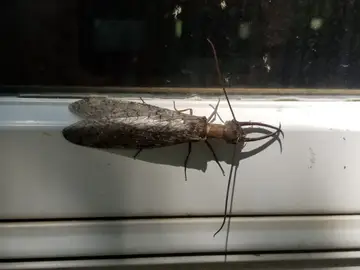
The dobsonfly is a very large, soft-bodied insect, usually drab gray, black or brown, with long veined wings and big pincers. Adults can be more than 3 1/2 inches long, with a wingspan of up to about 5 inches. Males have long, tusk-like jaws that cannot hurt people. Females have short, stubby jaws that can give a painful bite that can draw blood. The aquatic larvae, called hellgrammites, can also bite painfully. Dobsonflies are not venomous. They live near rocky streams and rivers across eastern North America, and adults are seen at lights at night in late spring and early summer. Missouri Department of Conservation
On this page
Is the dobsonfly dangerous?
Dobsonflies are not venomous; the worst they can do is pinch. Only adult females can deliver a painful bite; male jaws cannot hurt people. Missouri Department of Conservation
“As adults, only the females are capable of delivering a painful bite. … Dobsonflies are not venomous and the worst they can do is pinch you.”
Bites and stings: Yes, in defense: females and larvae (hellgrammites) can give a painful bite; males cannot hurt people. Iowa State: both adults and larvae will bite if handled carelessly.
How to identify a dobsonfly
A photo or description can narrow it down, but cannot confirm what an animal is or that it is safe. Look from a distance and do not handle wild animals.
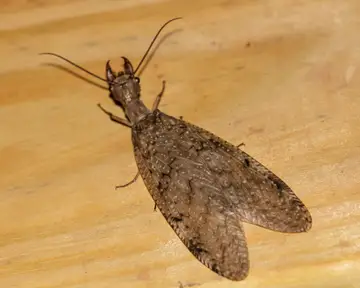
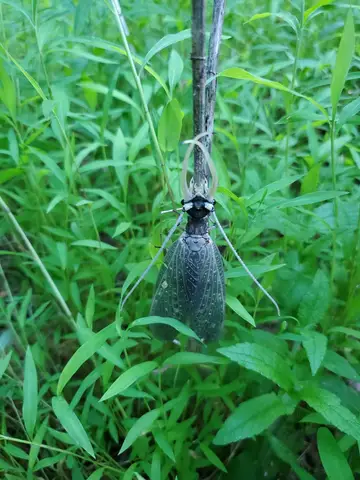
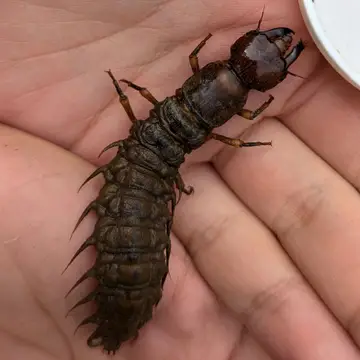
Size: Adults can exceed 3 1/2 inches long with a wingspan up to about 5 inches; larvae 2 to 3 inches (to about 4 inches).
Colors: Adults usually drab gray, black or brown; larvae usually dark brown, tan or black. Pattern: Wings with conspicuous veins, folded lengthwise along the body at rest.
Key features
- Males have very long, tusk-like jaws (up to about 1.6 inches) that cannot hurt people; females have short, stubby jaws but better leverage, and can pinch harder.
- Long antennae and a large head with prominent pincers. Missouri Department of Conservation
- Usually found near water; nocturnal and attracted to lights. Missouri Department of Conservation
- Egg masses on branches or rocks beside streams look like bird droppings. Missouri Department of Conservation
Young
Hellgrammites are aquatic, flattened larvae with sharp pincers, three pairs of legs and eight pairs of leg-like side appendages with gill tufts; some people think they look like centipedes.
Animals mistaken for the dobsonfly
Dobsonfly (eastern dobsonfly) or Fishflies?
Dobsonfly (eastern dobsonfly)
Fishflies
Male fishflies lack the huge tusks, and many have comb-like or feathery antennae; female dobsonflies have more prominent pincers and a distinctively shaped pronotum. Missouri Department of Conservation
Where the dobsonfly lives
- Native or listed
- Nonnative or not established
- No official record in our data
- 1–9
- 10–99
- 100–999
- 1,000+
State boundaries: U.S. Census Bureau, cartographic boundary file cb_2024_us_state_20m.
When it is active
Adults are nocturnal and drawn to lights, most often seen in late spring and early summer (Missouri); in Colorado the western dobsonfly is out from early June through midsummer, peaking in July. Adults live only days (about three days for males, 8 to 10 for females).
US open-licence records peak in June to July.
Habitat and habits
Habitat: Larvae live under rocks in the swiftest parts of large streams and rivers, usually in relatively unpolluted water; adults stay near water and rest in thick streamside vegetation.
Behavior: When bothered, adults raise their heads and spread their jaws defensively.
Diet: Larvae are predators of aquatic insects, small fish and other small prey; adults usually do not eat.
Young: Eggs (about 1,000 per mass) are laid on surfaces overhanging water; larvae crawl or fall into the stream and need 1 to 3 years to develop (UF/IFAS; MDC says typically 2 or 3), then leave the water to pupate in a cell dug in soil, typically under a rock, log or debris.
Sources
- Eastern Dobsonfly (Field Guide). Missouri Department of Conservation. undated page; checked November 3, 2026.
Quoted passages (7)
“As adults, only the females are capable of delivering a painful bite. … Dobsonflies are not venomous and the worst they can do is pinch you.”
“Head large, with prominent pincers and long antennae.”
“Usually found near water. … Nocturnal; attracted to lights.”
“Egg masses are laid on branches or rocks next to streams. These masses resemble bird droppings”
“The larvae are predaceous and snatch nearly anything that swims or ambles by, including other aquatic insects, small fish, and other prey small enough for them to subdue. … adults don't usually eat at this stage”
“However, when molested, both sexes will raise their heads and spread their jaws defensively.”
“Male fishflies, however, don't have the huge tusks, and males of many fishflies have pectinate (comblike or feathery) antennae. Females of the two groups can be distinguished by the more prominent pincers of female dobsonflies, and by their distinctively shaped pronotums”
- Eastern Dobsonfly (Adult), Hellgrammite (Larva) Corydalus cornutus (EENY 414 / IN987). UF/IFAS Extension (EDIS), Featured Creatures. original publication July 2007; checked November 3, 2026.
- Dobsonflies (Home and Garden IPM). University of Maine Cooperative Extension. undated page; checked November 3, 2026.
- Hellgrammite (Field Guide). Missouri Department of Conservation. undated page; checked November 3, 2026.
Quoted passages (1)
“Aquatic, long-bodied, somewhat flattened. … Head with a pair of large, sharp pincers; can deliver a painful bite. … Thorax with 3 pairs of legs, each tipped with a tiny pair of pincers. … Some people think they look like centipedes. … Abdomen segmented, with 8 pairs of pointed, leglike appendages along the sides, each with a cottony or hairy gill tuft at the base.”
- GBIF.org occurrence records, human observations licensed CC0 1.0 or CC BY 4.0 only, accessed November 3, 2026. The datasets behind these counts are listed on our Sources page.
- State boundaries: U.S. Census Bureau, cartographic boundary file cb_2024_us_state_20m.