Hercules beetles
Dynastes · also called eastern Hercules beetle, western Hercules beetle, rhinoceros beetle and unicorn beetle · Last checked November 3, 2026.
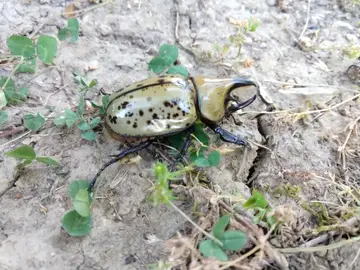
Hercules beetles are huge horned scarab beetles. The eastern Hercules beetle, up to about 2 1/2 inches long, is the most massive beetle in the eastern US: greenish-gray to tan with black spots (darker when humid), and males have two long forward-pointing horns. Missouri Department of Conservation and Mississippi State Extension say they are harmless to people, though they are strong and give off a foul smell when handled. They live in hardwood forests across the eastern US; a western species lives in Arizona, New Mexico and Utah. The giant Hercules beetle of Central and South America does not live in the US. Missouri Department of Conservation
This page covers a genus (Dynastes), not a single species.
On this page
Are Hercules beetles dangerous?
Missouri Department of Conservation: Hercules beetles are harmless to people. Missouri Department of Conservation
“Hercules beetles are harmless to people.”
Bites and stings: No bite described by the sources checked. They are strong enough to pry out of fingers and give off a foul-smelling odor when handled (Mississippi State Extension).
No official source we use states whether this animal is venomous. That does not mean it is harmless: do not handle it.
How to identify Hercules beetles
A photo or description can narrow it down, but cannot confirm what an animal is or that it is safe. Look from a distance and do not handle wild animals.
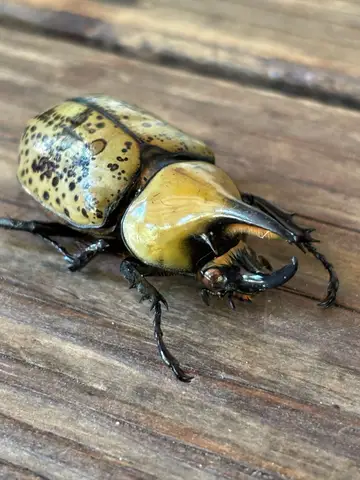
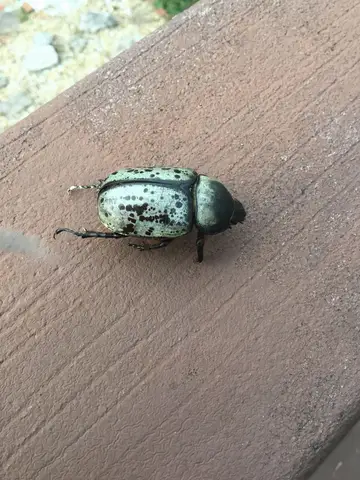
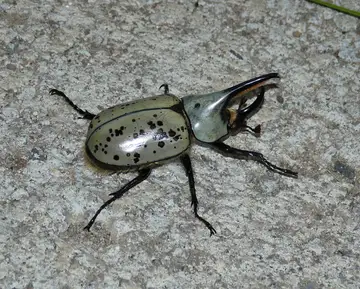
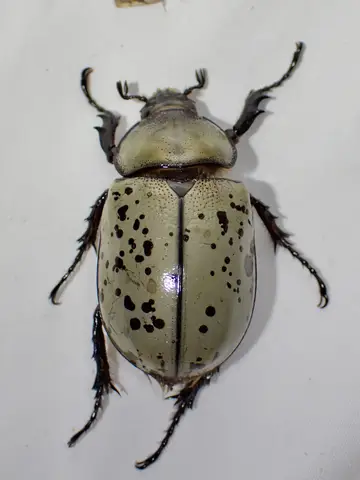
Size: Eastern Hercules beetle adults about 1.5 to 2.5 inches (up to 60 mm); males can be nearly 2 1/2 inches counting the horns. Larvae are bigger than adults, up to 90 mm. University of Arkansas Arthropod Museum
Colors: greenish-gray, tan, pale green or yellow with black spots; some nearly all black or brown; turns dark brown in high humidity. Pattern: black spots on the wing covers, unique to each beetle.
Key features
- males have two horns, one from the thorax and one from the head; females have none University of Arkansas Arthropod Museum
- females lack horns Missouri Department of Conservation
- very heavy for its size: the most massive beetle in the eastern US University of Arkansas Arthropod Museum
- can fly despite its size; often found under lights Mississippi State University Extension Service
Young
Larvae are plump, C-shaped white grubs with a dark brown head, living in rotting wood.
Animals mistaken for Hercules beetles
Hercules beetles or Other horned scarab beetles?
Hercules beetles
Other horned scarab beetles Scarabaeidae
Several other large scarabs have horned males, but they are dark brown and their horns are arranged differently (LSU AgCenter). LSU AgCenter
Not described as dangerous in the sources checked.
Hercules beetles or Stag beetles?
Hercules beetles
Stag beetles Lucanidae
Missouri Department of Conservation: stag beetles have prominent pincers; males usually have enlarged, sometimes astonishing jaws, and most are black, brownish or reddish brown. MDC
Not described in the sources checked.
Where Hercules beetles live
- Native or listed
- Nonnative or not established
- No official record in our data
- 1–9
- 10–99
- 100–999
- 1,000+
State boundaries: U.S. Census Bureau, cartographic boundary file cb_2024_us_state_20m.
When it is active
Adults are active in summer and come to lights at night; Arkansas says they emerge in June or July. University of Arkansas Arthropod Museum
US open-licence records for all Hercules beetles (genus Dynastes) peak in July to August.
Habitat and habits
Habitat: Hardwood (deciduous) forests with large rotting logs, stumps and dead trees; adults come to lights at night. Missouri Department of Conservation
Behavior: Males use their horns to fight other males for breeding sites. Adults fly and are drawn to lights; most people see only one or two in a lifetime, usually near buildings.
Diet: Larvae eat rotting heartwood of hardwood trees; adults eat rotting fruit and tree sap.
Young: Eggs are laid in summer in soil cavities, often near the bases of dead and dying trees, or in decaying hardwood logs and stumps. LSU AgCenter says the larval stage can last up to a year; Mississippi State says a generation takes about two years and Arkansas says development may take 2 or 3 years. Adults can live six months to two years.
Legal status and reporting
Federal: No record returned by the USFWS ECOS query for Dynastes tityus or Dynastes grantii on 2026-11-03. US Fish and Wildlife Service
Invasive status: Native; not invasive. DWR
Sources
- Eastern Hercules Beetle (Field Guide). Missouri Department of Conservation. undated page; checked November 3, 2026.
Quoted passages (4)
“Hercules beetles are harmless to people.”
“Females lack the horns.”
“Look for Hercules beetles in deciduous forests and around lights at night.”
“The larvae eat rotting heartwood, usually of deciduous trees, and the adults eat rotting fruits and tree sap.”
- Eastern Hercules Beetle, Bug's Eye View No. 1 (Blake Layton). Mississippi State University Extension Service. 2015; checked November 3, 2026.
Quoted passages (2)
“Despite their size, Eastern Hercules beetles are able to fly.”
“These big beetles are not very common, and most people encounter only one or two in a life time, usually around the outsides of buildings where they have crash landed after being attracted to lights.”
- Dynastes tityus, Eastern Hercules Beetle (Coleoptera: Scarabaeidae) (P4051; Hudnall and Carlton). LSU AgCenter. 4/29/26; checked November 3, 2026.
Quoted passages (3)
“Larvae are plump white grubs, typically assuming the C-shape that is characteristic of many scarab beetle larvae.”
“Adults can live from six months to two years, during which individuals are sometimes observed on trees scraping bark and feeding on sap.”
“No similar species occur in Louisiana although adult males of several other large scarabs possess horns. These other species are dark brown in color and the arrangements of male horns are different.”
- Eastern Hercules beetle. University of Arkansas Arthropod Museum. undated page; checked November 3, 2026.
Quoted passages (4)
“They range in length from 1.5 to 2.5 inches long, and they are usually greenish-gray or tan, except for blotches of black.”
“The male has a large pronotal horn that projects forward and almost meets another horn projecting upward from the front of the head.”
“The adults are the most massive beetles in the eastern United States.”
“Adults overwinter in pupal cells and emerge the following June or July.”
- ECOS species report query (Dynastes tityus, Dynastes grantii, Cardinalis cardinalis, Chrysemys picta, Chrysemys dorsalis, Canis rufus). U.S. Fish and Wildlife Service. live query 2026-11-03; checked November 3, 2026.
- List of Native and Naturalized Fauna of Virginia. Virginia Department of Wildlife Resources (DWR). May, 2026; checked November 3, 2026.
Quoted passages (1)
“Eastern Hercules Beetle Dynastes tityus”
- MDC Field Guide: Land Invertebrates and Butterflies and Moths (selected species accounts). Missouri Department of Conservation (MDC). undated page; checked November 3, 2026.
Quoted passages (1)
“Stag beetles are a family that, though not very colorful, have prominent pincers! Male stag beetles usually have enlarged, sometimes astonishing jaws. Most are black, brownish, or reddish brown.”
- GBIF.org occurrence records, human observations licensed CC0 1.0 or CC BY 4.0 only, accessed November 3, 2026. The datasets behind these counts are listed on our Sources page.
- State boundaries: U.S. Census Bureau, cartographic boundary file cb_2024_us_state_20m.