Hickory Tussock Moth Caterpillar
Lophocampa caryae · also called hickory tiger moth, hickory tussock and hickory tiger · Last checked November 3, 2026.
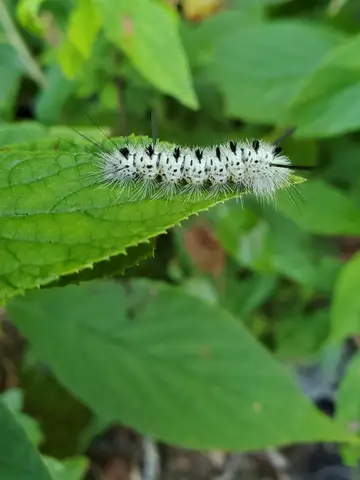
The hickory tussock moth caterpillar is a fuzzy white-and-black caterpillar, up to about 1.7 inches long, often seen wandering in late summer and fall. Official sources describe irritation from its hairs rather than bites: the barbed hairs can lodge in skin and cause a rash and itching, and sources differ on how severe that can be. Sources disagree on venom: Ohio State says the hairs are not attached to venom glands, while Tennessee Poison Center lists it among stinging caterpillars whose hairs contain a toxin. Penn State Extension places it mainly in northeastern North America from Maine to North Carolina and west to Wisconsin and Illinois, less commonly southwest into Texas. Penn State Extension
On this page
Is the hickory tussock moth caterpillar dangerous?
Penn State Extension: exposure generally causes a localized rash and itching. If hairs are swallowed or get in the eye, or an allergic reaction follows, seek immediate medical attention. Penn State Extension
“If the hairs are ingested or embedded in the eye, or if an allergic reaction happens in response to the setae becoming embedded in the skin, immediate medical attention should be sought.”
Bites and stings: Official sources describe irritation from its hairs, not bites. The barbed hairs detach easily and can embed in skin, eyes or mucous membranes.
No official source we use states whether this animal is venomous. That does not mean it is harmless: do not handle it.
If someone is bitten or stung, call 911 or Poison Help at 1-800-222-1222.
How to identify a hickory tussock moth caterpillar
A photo or description can narrow it down, but cannot confirm what an animal is or that it is safe. Look from a distance and do not handle wild animals.
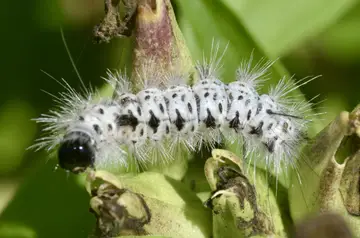
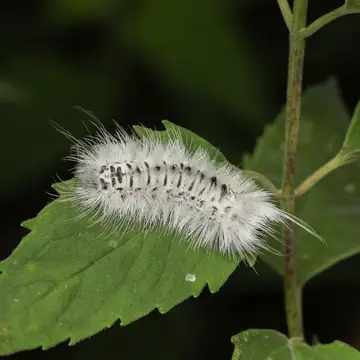
Size: Older caterpillars grow up to 1.7 inches (4.5 cm). Penn State Extension
Colors: White and black; young caterpillars white with black spots. Pattern: Tufts of white and black hairs with black warts; patterns range from thin black stripes across the back to a row of black spots.
Key features
- Black hairs arranged in tufts along the back, with a set of black 'pencils' often at the front and back Penn State Extension
- Long, stiff white hairs and short black hairs on later stages Ohio State University Extension
- Fuzzy grey cocoons in leaf litter Maine Forest Service, Maine DACF
Young
Early stages have black head capsules, yellowish-white to yellow bodies and short black hairs from black spots; they feed in groups.
Where the hickory tussock moth caterpillar lives
- Native or listed
- Nonnative or not established
- No official record in our data
- 1–9
- 10–99
- 100–999
- 1,000+
State boundaries: U.S. Census Bureau, cartographic boundary file cb_2024_us_state_20m.
When it is active
Caterpillars July to September; adult moths May to June (Penn State) or June and July (Maine). Cocoons may be found year-round. Penn State Extension
US open-licence records peak in June and August to September.
Habitat and habits
Habitat: Hardwood trees, with mature caterpillars wandering on the ground, undergrowth and even house siding; cocoons in leaf litter or under bark. Maine Forest Service, Maine DACF
Behavior: Young caterpillars feed in groups; older ones feed alone or in small groups and wander looking for a place to spin a cocoon. Active by day. Seldom a serious pest in Ohio.
Diet: Many hardwoods, including hickory, pecan, walnut, American hornbeam, ash, elm, oak and willow. In Maine they favor birch, quaking aspen, basswood and black locust.
Young: One generation per year. Eggs are laid under leaves in clusters of up to 100 or more; winter is spent as a pupa in a hair-covered cocoon.
Legal status and reporting
Invasive status: Not invasive: a native species, usually controlled by natural enemies. Penn State Extension
Questions about the hickory tussock moth caterpillar
Hickory tussock moth caterpillar
A fuzzy white-and-black native caterpillar of hardwood trees, up to about 1.7 inches long and most often seen from July to September. Its barbed hairs can cause a rash and itching. Ohio State says the hairs are not attached to venom glands, but Tennessee Poison Center lists it among stinging caterpillars whose hairs contain a toxin. University of Maine and University of New Hampshire say the reaction can be severe. Call 911 or Poison Help at 1-800-222-1222.
Sources
- Hickory Tussock Moth Caterpillar. Penn State Extension. updated September 8, 2025; checked November 3, 2026.
Quoted passages (7)
“If the hairs are ingested or embedded in the eye, or if an allergic reaction happens in response to the setae becoming embedded in the skin, immediate medical attention should be sought.”
“Older caterpillars can grow up to 1.7 inches (4.5 cm)”
“The black setae are arranged in tufts along the back and a set of black "pencils" often occurs at the front and back.”
“Mature caterpillars are often encountered when they leave the host plant and crawl around in search of a protected place to spin a cocoon”
“Adult moths fly May–June and caterpillars are present July–September.”
“Hickory tussock moths have one generation per year.”
“Because hickory tussock moths are a native species, they are usually controlled by a host of natural enemies.”
- Hickory Tussock (Tiger) Moth (Buckeye Yard & Garden onLine). Ohio State University Extension. Published June 19, 2026; checked November 3, 2026.
Quoted passages (2)
“The later instars become adorned with prominent, long, stiff white hairs and short black hairs.”
“Early instars have prominent black head capsules and range in color from yellowish-white to yellow.”
- Should I be worried about the fuzzy caterpillars that are defoliating my oak? University of New Hampshire Extension. September 2018; checked November 3, 2026.
- Tussock Caterpillars. University of Maine Cooperative Extension. undated page; checked November 3, 2026.
- What can sting but cannot fly … yet? Tennessee Poison Center (Vanderbilt University Medical Center). July 21, 2014; checked November 3, 2026.
- Hickory Tussock Moth. Maine Forest Service, Maine DACF. undated page; checked November 3, 2026.
Quoted passages (2)
“…they spin fuzzy grey cocoons in the leaf litter”
“The caterpillars feed gregariously when they are young and then wander – A LOT – as they get larger and are frequently encountered on the ground, undergrowth and even climbing up siding.”
- Hickory Tussock Moth (Home and Garden IPM fact sheet). University of Maine Cooperative Extension. undated page; checked November 3, 2026.
Quoted passages (1)
“The caterpillars feed on a wide variety of hardwood trees, including hickory, pecan, walnut, American hornbeam, ash, elm, oak and willow.”
- GBIF.org occurrence records, human observations licensed CC0 1.0 or CC BY 4.0 only, accessed November 3, 2026. The datasets behind these counts are listed on our Sources page.
- State boundaries: U.S. Census Bureau, cartographic boundary file cb_2024_us_state_20m.