Horse fly
Tabanidae (family); the vast majority of horse flies are in genera Tabanus and Hybomitra · also called tabanid fly · Last checked November 3, 2026.
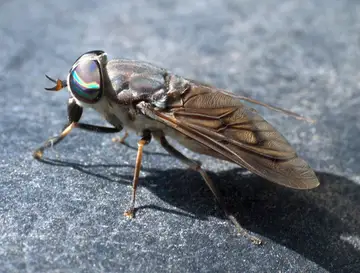

Horse flies are large, stout, blood-feeding true flies in the family Tabanidae. Only females bite, and extension sources describe the bite as painful, sometimes with allergic reactions. Approximately 335 horse and deer fly species occur in the continental U.S., over 160 of them horse flies. Purdue University Entomology Extension
This page covers a family (Tabanidae (family); the vast majority of horse flies are in genera Tabanus and Hybomitra), not a single species.
On this page
Is the horse fly dangerous?
Bites are painful and may cause an allergic reaction. Significant allergic reactions can develop in some people. University of Maine Cooperative Extension
“The bite is often quite painful, resembling a bee sting for many people, and a lot of people react to the fly’s saliva, causing pain and itching at the site of the bite. Significant allergic reactions can develop for some people.”
Bites and stings: Females bite and feed on blood; males do not bite. Extension sources differ on how often horse flies bite people, so do not read this as "they will not bite you".
No official source we use states whether this animal is venomous. That does not mean it is harmless: do not handle it.
If someone is bitten or stung, call 911 or Poison Help at 1-800-222-1222.
How to identify a horse fly
A photo or description can narrow it down, but cannot confirm what an animal is or that it is safe. Look from a distance and do not handle wild animals.
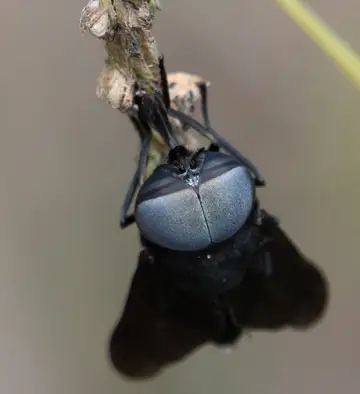
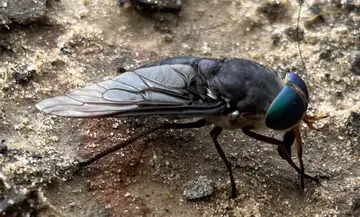
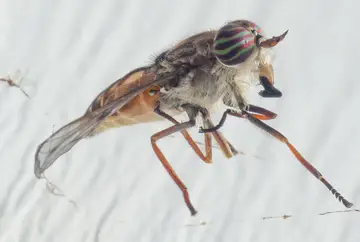
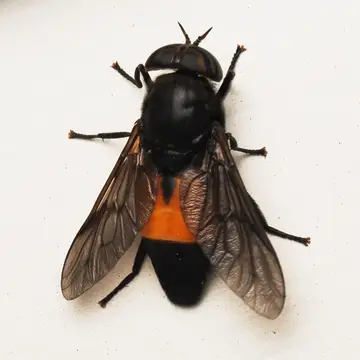
Size: Most species 0.5 to 1.25 inches long (Purdue). Other extension figures: 3/8 to 1 1/8 inches (Maryland); 3/4 to 1 1/4 inches (Kentucky); 14 to 19 mm (NC State); some species such as the black horse fly up to two inches (Wisconsin). Purdue University Entomology Extension
Colors: Usually gray or blackish; thorax grayish-brown. Pattern: Eyes often have horizontal stripes; some horse flies have colorful purple or green eye bands.
Key features
- Stout body with a very large head and very large eyes University of Maine Cooperative Extension
- Wings clear or uniformly cloudy (Purdue), usually without the dark bands of deer flies. Maryland says some species have wings that are entirely dark. Purdue University Entomology Extension
- Antennae shorter than the head, with a thick base Purdue University Entomology Extension
Young
Larvae are about 10 to 19 mm long, white, brownish or greenish, spindle-shaped and tapered at both ends.
Animals mistaken for the horse fly
Horse fly or Deer fly?
Horse fly
Deer fly Chrysops spp.
Deer flies are smaller: nearly all 0.25 to 0.33 inches (Purdue), about 1/4 to 1/2 inch (Maryland). They have dark bands or patches on the wings, and antennae longer than the head and nearly uniformly slender, where horse fly antennae are shorter than the head with a thick base (Purdue). Purdue University Entomology Extension
Also bites: most deer fly species will bite humans (Purdue table).
Where the horse fly lives
- Native or listed
- Nonnative or not established
- No official record in our data
- 1–9
- 10–99
- 100–999
- 1,000+
State boundaries: U.S. Census Bureau, cartographic boundary file cb_2024_us_state_20m.
When it is active
Daytime feeders; deer and horse flies can be active May until September in Wisconsin. NC State says most flies emerge sometime from May through August. University of Wisconsin-Madison Extension
US open-licence records for all horse flies and deer flies (family Tabanidae) peak in June to August.
Habitat and habits
Habitat: Abundant in damp, wooded and wetland environments; larvae of most species live in freshwater and saltwater marshes, some in streams, moist forest soils or decomposing wood. University of Maine Cooperative Extension
Behavior: Females are attracted by carbon dioxide and by motion, size, shape and dark color. They do not enter structures to feed.
Diet: Females take blood, mostly from large mammals, and both sexes feed on sugars such as nectar. Purdue says larvae of horse fly species studied are predators of other soft-bodied animals; Wisconsin says larvae can be predators or vegetarians.
Young: Eggs are laid in clusters near water; larvae develop in water or wet soil. Most species complete one generation a year; Purdue says very large horse flies need 2 to 3 years for larval development.
Sources
- Horse and Deer Flies. Purdue University Entomology Extension (public health site). Copyright 2008; checked November 3, 2026.
Quoted passages (6)
“…most species 0.5 to 1.25 inches”
“…clear or uniformly cloudy”
“…shorter than head, with a thick base”
“Only female horse and deer flies take a blood meal, and, with rare exception, they feed during the daytime.”
“…female horse and deer flies do not enter structures and thus do not feed on humans indoors.”
“…dark bands or patches on a clear background”
- Horse Flies (Home and Garden IPM). University of Maine Cooperative Extension. undated page; checked November 3, 2026.
Quoted passages (3)
“The bite is often quite painful, resembling a bee sting for many people, and a lot of people react to the fly’s saliva, causing pain and itching at the site of the bite. Significant allergic reactions can develop for some people.”
“…with a stout body and a very large head with very large eyes”
“Both horse flies and deer flies are abundant in damp, wooded and wetland environments, which provide the necessary habitat for their eggs and larvae.”
- Horse Flies and Deer Flies (ENTFACT-511). University of Kentucky Entomology. Revised 01/00; checked November 3, 2026.
- Horse Flies and Deer Flies. NC State Extension (NC State University / N.C. A&T). Published May 1, 2001; checked November 3, 2026.
Quoted passages (2)
“Spindle-shaped, the larvae taper to a point at both ends.”
“Eggs are laid in clusters on objects, such as plant stems and leaves, near the water.”
- Deer Flies and Horse Flies (XHT1049). University of Wisconsin-Madison Extension. Revised 4/27/2004; checked November 3, 2026.
Quoted passages (1)
“Deer flies and horse flies can be active from May until September.”
- GBIF.org occurrence records, human observations licensed CC0 1.0 or CC BY 4.0 only, accessed November 3, 2026. The datasets behind these counts are listed on our Sources page.
- State boundaries: U.S. Census Bureau, cartographic boundary file cb_2024_us_state_20m.