House centipede
Scutigera coleoptrata · Last checked November 3, 2026.
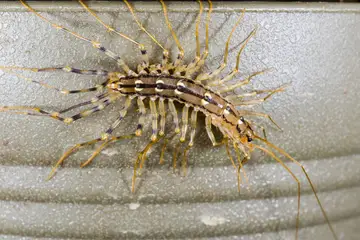

The house centipede is a fast, yellowish-brown centipede with three dark stripes and up to 15 pairs of very long legs, usually seen indoors in damp basements, crawl spaces and bathrooms. It catches insects and spiders with venomous fangs; the Missouri Department of Conservation says it cannot easily bite people and that a bite is generally no worse than a bee sting. Native to the Mediterranean region, it was introduced to North America and is now widespread across the United States. Missouri Department of Conservation
On this page
Is the house centipede dangerous?
Venomous fangs are used on prey; it cannot easily bite people, and if it does, the bite is generally no worse than a bee sting. Missouri Department of Conservation
“They cannot easily bite humans, but if they do, it is generally no worse than a bee sting.”
Bites and stings: Can bite but rarely does: it cannot easily bite humans; a bite is generally no worse than a bee sting (Missouri Department of Conservation).
If someone is bitten or stung, call 911 or Poison Help at 1-800-222-1222.
How to identify a house centipede
A photo or description can narrow it down, but cannot confirm what an animal is or that it is safe. Look from a distance and do not handle wild animals.
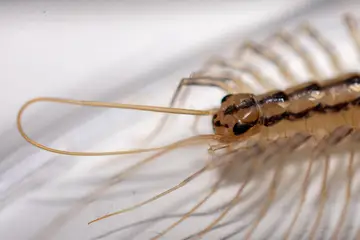
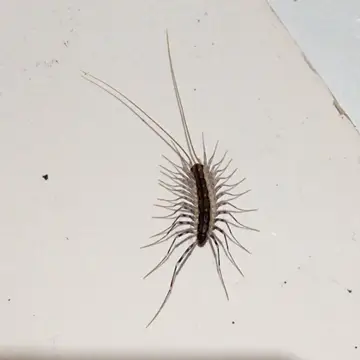
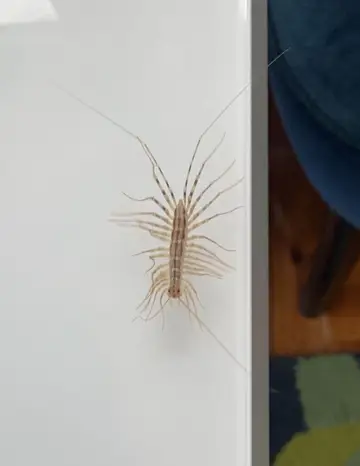
Size: Body to about 1 inch (MDC) or 1 to 1.5 inches (Penn State); about 3 to 4 inches overall including legs and antennae.
Colors: Yellowish-brown; dirty yellow body; legs banded light and dark. Pattern: Three dark stripes along the top of the body; legs banded light and dark.
Key features
- Up to 15 pairs of extremely long legs, one pair per leg-bearing segment Missouri Department of Conservation
- Body not flattened; runs very fast Missouri Department of Conservation
- On adult females the last pair of legs is nearly twice the body length Penn State Extension
Young
Newly hatched young have 4 pairs of legs and add pairs as they molt (5, 7, 9, 11, 13, then 15).
Animals mistaken for the house centipede
House centipede or Other centipedes (stone, soil and bark centipedes)?
House centipede
Other centipedes (stone, soil and bark centipedes) Chilopoda
Centipedes in general are usually flattened. Unlike many other centipedes, the house centipede's body is not flattened top to bottom; it is fast, with relatively long, banded legs (adults have 15 pairs) and long antennae.
MDC: centipede claws are venomous and larger species can inflict a painful bite if mishandled. In Missouri, the giant red-headed centipede (southernmost counties) is of most concern: its bite can be intensely painful and cause swelling, and infants, the elderly or people in poor health could potentially be harmed.
House centipede or Millipedes?
House centipede
Millipedes Diplopoda
Millipedes have more cylindrical (not flattened) bodies, elbowed antennae, and 2 pairs of legs per body segment; centipedes have 1 pair. Millipedes are generally slow-moving.
MDC: some millipedes can emit a foul-smelling substance, and a few species give off a cyanide-containing secretion when harassed.
Where the house centipede lives
- Native or listed
- Nonnative or not established
- No official record in our data
- 1–9
- 10–99
- 100–999
- 1,000+
State boundaries: U.S. Census Bureau, cartographic boundary file cb_2024_us_state_20m.
When it is active
Active at night; in Pennsylvania it does not survive winters outdoors but reproduces in heated buildings, and in summer may be found outdoors near buildings. Penn State Extension
US open-licence records peak in April to August.
Habitat and habits
Habitat: Indoors in damp areas such as basements, crawl spaces, cellars and bathrooms, especially in winter; outdoors under rocks, logs and similar protected places. Missouri Department of Conservation
Behavior: Hides in dark, damp places in the home by day and hunts at night; runs away when a person approaches.
Diet: Predator of other arthropods: cockroach nymphs, spiders, silverfish, crickets, bedbugs, flies, moths and earwigs.
Young: Females lay 35 to 100 eggs and do not guard them; females can live several years and produce up to 150 young.
Legal status and reporting
Invasive status: Introduced (non-native) from the Mediterranean region; no official source checked calls it invasive. Missouri Department of Conservation
Questions about the house centipede
House centipede bite
House centipedes have venomous fangs for prey but cannot easily bite people; the Missouri Department of Conservation says a bite is generally no worse than a bee sting. For any bite concern, call 911 or Poison Help 1-800-222-1222.
House centipede what do they eat
Other small arthropods, including cockroach nymphs, spiders, silverfish, crickets, bedbugs, flies, moths and earwigs (MDC); Penn State adds firebrats and carpet beetle larvae.
House centipede lifespan
Penn State Extension says females have been known to survive for several years.
House centipede baby
Young house centipedes hatch with only 4 pairs of legs and gain more with each molt (5, 7, 9, 11, 13, then 15 pairs). Newly hatched young are rarely seen.
House centipede where do they come from
The species is native to the Mediterranean region and was introduced to North America. Inside buildings they shelter under concrete slabs, inside cement block walls, in floor drains without water traps and in damp crawl spaces, and move indoors especially in winter.
House centipede how to get rid of
Official advice focuses on prevention: seal small cracks and entry points, reduce humidity (for example with dehumidifiers), and reduce the insects they feed on, or consult a licensed pest controller. Many sightings can mean another pest is abundant.
House centipede vs centipede
The house centipede is one kind of centipede. Unlike most other centipedes, its body is not flattened, and adults have 15 pairs of long, banded legs and long antennae.
House centipede vs silverfish
UF/IFAS describes silverfish as wingless insects about 0.85 cm (0.33 in) long, silver or pearl-gray, covered in tiny scales, with two long antennae and three long bristled tail appendages. MDC describes the house centipede as yellowish-brown with up to 15 pairs of extremely long legs, and says silverfish are among its prey.
Centipede vs millipede
Centipedes have one pair of legs per body segment, are usually flattened, move fast and can bite. Millipedes are rounder, slower, have two pairs of legs on most segments and mostly eat decaying plant material.
Sources
- House Centipede (Field Guide). Missouri Department of Conservation. undated page; checked November 3, 2026.
Quoted passages (6)
“They cannot easily bite humans, but if they do, it is generally no worse than a bee sting.”
“The house centipede is a yellowish-brown, distinctively shaped centipede with up to 15 pairs of extremely long legs. … As with all other centipedes, there is only one pair of legs per leg-bearing body segment.”
“Unlike many other centipedes commonly encountered, house centipedes are not flattened top to bottom, and they can run startlingly quickly.”
“House centipedes are usually found inside homes in damp areas like basements, crawl spaces, cellars, and bathrooms, especially in winter, when they move indoors. … Outside you will find them under rocks and logs or in similar protected areas.”
“Their diet consists of cockroach nymphs, spiders, silverfish, crickets, bedbugs, flies, moths, and earwigs, many of which are considered household pests.”
“Native to the Mediterranean region; introduced to North America and other parts of the world.”
- House Centipedes. Penn State Extension. updated January 19, 2026 (original Steve Jacobs 2013; checked November 3, 2026.
Quoted passages (3)
“Adult house centipedes have 15 pairs of legs with the last pair (on adult females) nearly twice the length of the body”
“Newly hatched larvae (which are rarely seen) have four pairs of legs. During the next five larval molts, the centipedes will have 5, 7, 9, 11, and 13 pairs of legs”
“House centipedes do not survive winters outdoors in Pennsylvania, but readily reproduce in heated structures. During the summer, they can sometimes be found outdoors in areas near buildings.”
- Centipedes (Field Guide). Missouri Department of Conservation. undated page; checked November 3, 2026.
- Silverfish Lepisma saccharina (EENY-705/IN1211, Featured Creatures). University of Florida IFAS Extension (EDIS / Ask IFAS). EENY-705: original publication date May 2018; checked November 3, 2026.
- Millipedes (Field Guide). Missouri Department of Conservation. undated page; checked November 3, 2026.
- GBIF.org occurrence records, human observations licensed CC0 1.0 or CC BY 4.0 only, accessed November 3, 2026. The datasets behind these counts are listed on our Sources page.
- State boundaries: U.S. Census Bureau, cartographic boundary file cb_2024_us_state_20m.