Lone star tick
Amblyomma americanum · also called Seed tick (larvae, per OSU Extension) · Last checked November 3, 2026.
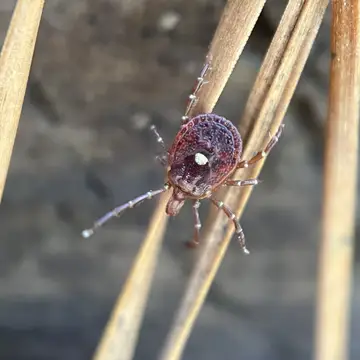
The lone star tick is a small, brown, blood-feeding tick. CDC calls it a very aggressive tick that bites humans; the adult female has a single white dot (the "lone star") on her back. CDC says it is widely distributed in the Northeast, South and Midwest. It can transmit ehrlichiosis, tularemia, Heartland virus and Bourbon virus, and CDC says it is the tick most often associated with alpha-gal syndrome (red meat allergy) in the U.S. CDC says lone star ticks have not been shown to transmit the Lyme disease bacterium. Call 911 or Poison Help at 1-800-222-1222. CDC
On this page
Is the lone star tick dangerous?
CDC: transmits Bourbon virus, Ehrlichia chaffeensis and E. ewingii (human ehrlichiosis), Heartland virus and tularemia; a circular rash of unknown cause (STARI) sometimes follows a bite; growing evidence suggests alpha-gal syndrome (red meat allergy) may be triggered by its bite. CDC
“Transmits: Bourbon virus, Ehrlichia chaffeensis and Ehrlichia ewingii (which cause human ehrlichiosis), Heartland virus, and tularemia. A circular rash of unknown cause (STARI) sometimes follows the bite of the lone star tick, and growing evidence suggests that alpha-gal syndrome (red meat allergy) may be triggered by the bite of lone star ticks.”
Bites and stings: Yes. CDC: "A very aggressive tick that bites humans." CDC says nymphs and adult females bite people most often, and that lone star ticks bite people in all life stages (larvae, nymphs and adults).
No official source we use states whether this animal is venomous. That does not mean it is harmless: do not handle it.
If someone is bitten or stung, call 911 or Poison Help at 1-800-222-1222.
How to identify a lone star tick
A photo or description can narrow it down, but cannot confirm what an animal is or that it is safe. Look from a distance and do not handle wild animals.
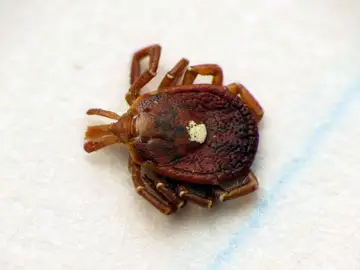
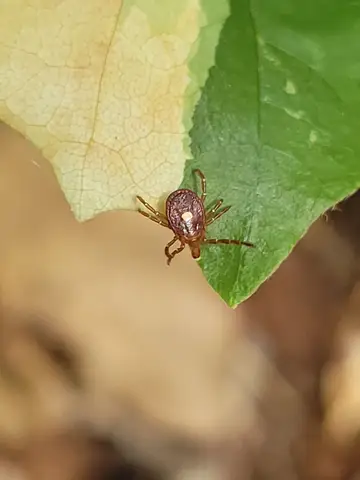
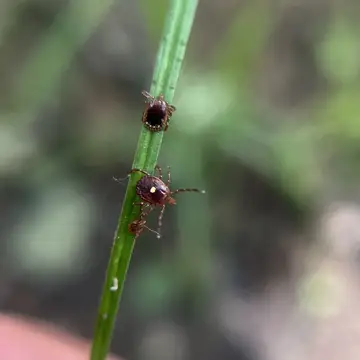
Size: Unfed adult female about 3/16 inch; fed female nearly round, about 7/16 inch; male about 3/16 inch. Ohio State University Extension
Colors: Brown / reddish-brown. Pattern: Adult female: single white (silvery) dot on the back; male: whitish markings along the rear edge.
Key features
- Hard tick: larva 6 legs, nymph and adult 8 legs Ohio State University Extension
Young
Larvae ("seed ticks") may gather in large numbers on vegetation; immature stages are tan or brown and hard to identify to species.
Animals mistaken for the lone star tick
Lone star tick or Blacklegged tick (deer tick)?
Lone star tick
Blacklegged tick (deer tick) Ixodes scapularis
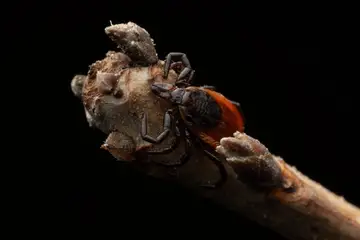
Per OSU Extension, blacklegged tick adults are dark chocolate brown, the adult female's rear half is red or orange, and every stage is smaller than the comparable stage of other medically important ticks. The lone star adult female instead has a single silvery spot on her scutum. Ohio State University Extension
CDC: transmits the agents of anaplasmosis, babesiosis, Lyme disease, hard tick relapsing fever, ehrlichiosis (E. muris eauclairensis) and Powassan virus disease.
Lone star tick or American dog tick?
Lone star tick
American dog tick Dermacentor variabilis
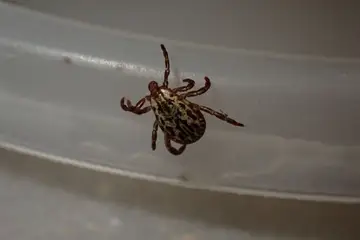
Per OSU Extension, American dog tick adults are brownish with light grey mottling on the scutum. The lone star adult female has a single silvery spot on the scutum. Note that the lone star male also has whitish markings (along the rear edge), so males of the two species are harder to separate. Ohio State University Extension
OSU Extension: primary transmitter of Rocky Mountain spotted fever; may also transmit tularemia.
Where the lone star tick lives
- Native or listed
- Nonnative or not established
- No official record in our data
- 1–9
- 10–99
- 100–999
- 1,000+
State boundaries: U.S. Census Bureau, cartographic boundary file cb_2024_us_state_20m.
When it is active
Warm months (OSU). Penn State: larvae in late summer and fall; nymphs and adults in spring and summer. Tennessee Department of Health: reported ehrlichiosis cases (spread by this tick) peak May-July, and April-June is when Tennesseans are most at risk of getting it. Penn State Extension
US open-licence records peak in May to June.
Habitat and habits
Habitat: Shady places along roadsides and meadows, and grassy and shrubby habitats; Tennessee Department of Health also names wooded and brushy areas, plus yards next to brush or with tall grass or leaf litter. Ohio State University Extension
Behavior: Waits at the tips of low vegetation for a host to pass.
Diet: Blood. All stages feed on almost any bird or mammal, including humans.
Young: Egg, six-legged larva, eight-legged nymph, adult; blood meal needed at every stage.
Legal status and reporting
Report: Ohio: ticks can be submitted for species identification to the C. Wayne Ellett Plant and Pest Diagnostic Clinic (PPDC) at Ohio State. OSU says how to submit a specimen is explained on ppdc.osu.edu, by your local county Extension office, or by the PPDC (phone 614-292-5006). Ohio State University Extension
Questions about the lone star tick
Lone star tick disease
CDC says it can transmit Bourbon virus, the Ehrlichia bacteria that cause human ehrlichiosis, Heartland virus and tularemia. A rash called STARI sometimes follows a bite, and growing evidence suggests its bite may trigger alpha-gal syndrome. CDC says lone star ticks have not been shown to transmit the Lyme disease bacterium. Call 911 or Poison Help at 1-800-222-1222.
Lone star tick red meat allergy
CDC says alpha-gal syndrome (AGS) is a serious, potentially life-threatening allergy that can develop after a tick bite. In the U.S. the lone star tick is the tick most often associated with it, and not everyone bitten develops AGS.
Lone star tick meat allergy
Yes. CDC links lone star tick bites to alpha-gal syndrome, also called red meat allergy or tick bite meat allergy.
Lone star tick disease red meat
This is alpha-gal syndrome. CDC says reactions occur after people eat red meat or are exposed to other mammal products, and the lone star tick is the U.S. tick most often associated with it.
Lone star tick range
CDC says it is widely distributed in the Northeast, South and Midwest of the United States. Official state sources cited here confirm it in Ohio, Pennsylvania, Tennessee, New York, Georgia and Virginia.
Lone star tick location
CDC: the Northeast, South and Midwest. CDC says most alpha-gal cases occur in South, East and Central states, where most lone star ticks are found.
Lone star tick map
CDC publishes a county map of where lone star ticks live; its summary is the Northeast, South and Midwest.
Lone star tick bite
CDC says it bites humans aggressively, and nymphs and adult females bite people most often. Its saliva can irritate the skin, and redness at the bite does not necessarily mean infection. Call 911 or Poison Help at 1-800-222-1222.
Deer tick vs lone star tick
The lone star adult female has a single white dot on a reddish-brown body. OSU Extension says blacklegged (deer) ticks are smaller and dark chocolate brown, and the adult female's rear half is red or orange. CDC lists Lyme disease bacteria among the germs the blacklegged tick transmits, but says lone star ticks have not been shown to transmit the Lyme disease bacterium. The lone star tick transmits the bacteria that cause ehrlichiosis and is linked to alpha-gal syndrome.
Sources
- Where Ticks Live. CDC. archived copy, captured September 28, 2026; checked November 3, 2026.
Quoted passages (1)
“Transmits: Bourbon virus, Ehrlichia chaffeensis and Ehrlichia ewingii (which cause human ehrlichiosis), Heartland virus, and tularemia. A circular rash of unknown cause (STARI) sometimes follows the bite of the lone star tick, and growing evidence suggests that alpha-gal syndrome (red meat allergy) may be triggered by the bite of lone star ticks.”
- About Alpha-gal Syndrome. CDC. archived copy, captured October 24, 2026; checked November 3, 2026.
- About Southern Tick-Associated Rash Illness. CDC. archived copy, captured October 17, 2026; checked November 3, 2026.
- Ticks and Tick-Borne Diseases (HYG-2073). Ohio State University Extension. June 6, 2013; checked November 3, 2026.
Quoted passages (10)
“The unfed adult female is about 3/16-inch long, brown, with a distinctive silvery spot on the upper surface of the scutum (hence the name 'lone star'.). … Once fed, the female is almost circular in shape and ~7/16-inch long. The male tick is about 3/16-inch long, brown, with whitish markings along the rear edge.”
“Ticks have a life cycle that includes the egg and three stages: six-legged larva, eight-legged nymph, and eight-legged adult.”
“Larval lone star ticks, commonly referred to as seed ticks, may congregate in large numbers on vegetation. … immature stages (larvae and nymphs) are entirely tan or brown and difficult to identify to species.”
“Shade is an important environmental factor for this species, which typically occurs in shady locations along roadsides and meadows and in grassy and shrubby habitats.”
“All stages readily feed on almost any bird or mammal, including humans.”
“All stages crawl to the tip of low growing vegetation and wait for a host to pass by.”
“Ticks must consume blood at every stage to develop.”
“Ticks can be submitted for species identification to the C. Wayne Ellett Plant and Pest Diagnostic Clinic (PPDC) at The Ohio State University. Information detailing how to submit a specimen can be obtained from the PPDC website at ppdc.osu.edu, your local county Extension office, or by contacting the PPDC: phone (614-292-5006)”
“Both sexes are dark chocolate brown, but the rear half of the adult female is red or orange. … All comparable stages of the blacklegged tick are relatively smaller than other medically important ticks. … The unfed adult female is about 3/16-inch long, brown, with a distinctive silvery spot on the upper surface of the scutum”
“Adults typically are brownish with light grey mottling on the scutum. … with a distinctive silvery spot on the upper surface of the scutum … The male tick is about 3/16-inch long, brown, with whitish markings along the rear edge.”
- Common Ticks and Tick-Borne Diseases in Pennsylvania. Penn State Extension. updated November 27, 2025; checked November 3, 2026.
Quoted passages (1)
“Larval lone star ticks are active during the late summer and fall, while nymphs and adults are active during the spring and summer.”
- Vector-borne diseases. Tennessee Department of Health. archived copy, captured August 6, 2026; checked November 3, 2026.
- Lyme disease and other diseases carried by ticks (Publication 2825). New York State Department of Health. Revised: July 2023; checked November 3, 2026.
- Stinging and Biting Pests (Circular 782). University of Georgia Cooperative Extension. published with major revisions October 26, 2022; checked November 3, 2026.
- Virginia Native and Naturalized Species. Virginia Department of Wildlife Resources. May, 2026; checked November 3, 2026.
- GBIF.org occurrence records, human observations licensed CC0 1.0 or CC BY 4.0 only, accessed November 3, 2026. The datasets behind these counts are listed on our Sources page.
- State boundaries: U.S. Census Bureau, cartographic boundary file cb_2024_us_state_20m.